
Corpus Christi Texas Directional Boring: Small Lines Go Under the Street, in Clay a Few Feet Above the Bay
Quick Answer: Trinity Boring Solutions takes directional boring and horizontal directional drilling (HDD) jobs in Corpus Christi, Texas and across Nueces County. The city right of way permit draws a line at 6 inches. A utility that crosses a street at or near a right angle and measures 6 inches or less on the outside will not be permitted to go in by cutting the road. It goes under. The ground it goes through is heavy coastal clay on the mainland and sand on the islands, in a city whose official elevation is about 7 feet, so water is never far below a pit. Trinity works in Oklahoma and Texas with Vermeer and Ditch Witch rigs it owns, and crews travel to the coast from Yukon, Oklahoma.
Corpus Christi, Texas bores at a glance
- City and county: Corpus Christi, Texas, the seat of Nueces County. Population 317,247 in the 2025 Census estimate.
- City rule: a crossing 6 inches or less in outside diameter is not installed by cutting the road
- Clearance: 3 feet from the bottom of the pavement to the top of the line
- Depth: new underground lines at least 36 inches below the surface
- From city utilities: 18 inches clear
- Permit timing: 14 days of review, good for 30 days, 72 hours of notice before work
- Insurance: pollution liability once an excavation is deeper than 3 feet
- Ground: Victoria clay of the Beaumont Formation inland, sandy soils at the coast
- State roads: TxDOT Corpus Christi District, ten Coastal Bend counties
- Phone answered 24 hours a day: (405) 409-7423
When does Corpus Christi make you bore?
Corpus Christi makes you bore when a line 6 inches or smaller crosses a street at or near a right angle. The city Right of Way Construction Permit says a utility crossing the right of way at a perpendicular or near perpendicular angle, with an outside diameter of 6 inches or less, will not be permitted to be installed by cutting of the road section. Exceptions go to the Director of Public Works (Corpus Christi Right of Way Construction Permit). The city standard construction specifications carry the same rule and tie it to the cuts and excavations ordinance (Corpus Christi standard construction specifications).
Six inches takes in most of what gets bored in a city: water and gas services, electric conduit, fiber duct, small force mains. For those the question of trench or bore is already answered.
The permit also shows what a cut costs the people who are allowed to make one. A cut running along an asphalt street is repaired with a full lane overlay. A cut across one is repaired 12 feet wide. On concrete the full panels are replaced. A bore leaves the street alone.
What depths and clearances does the city set?
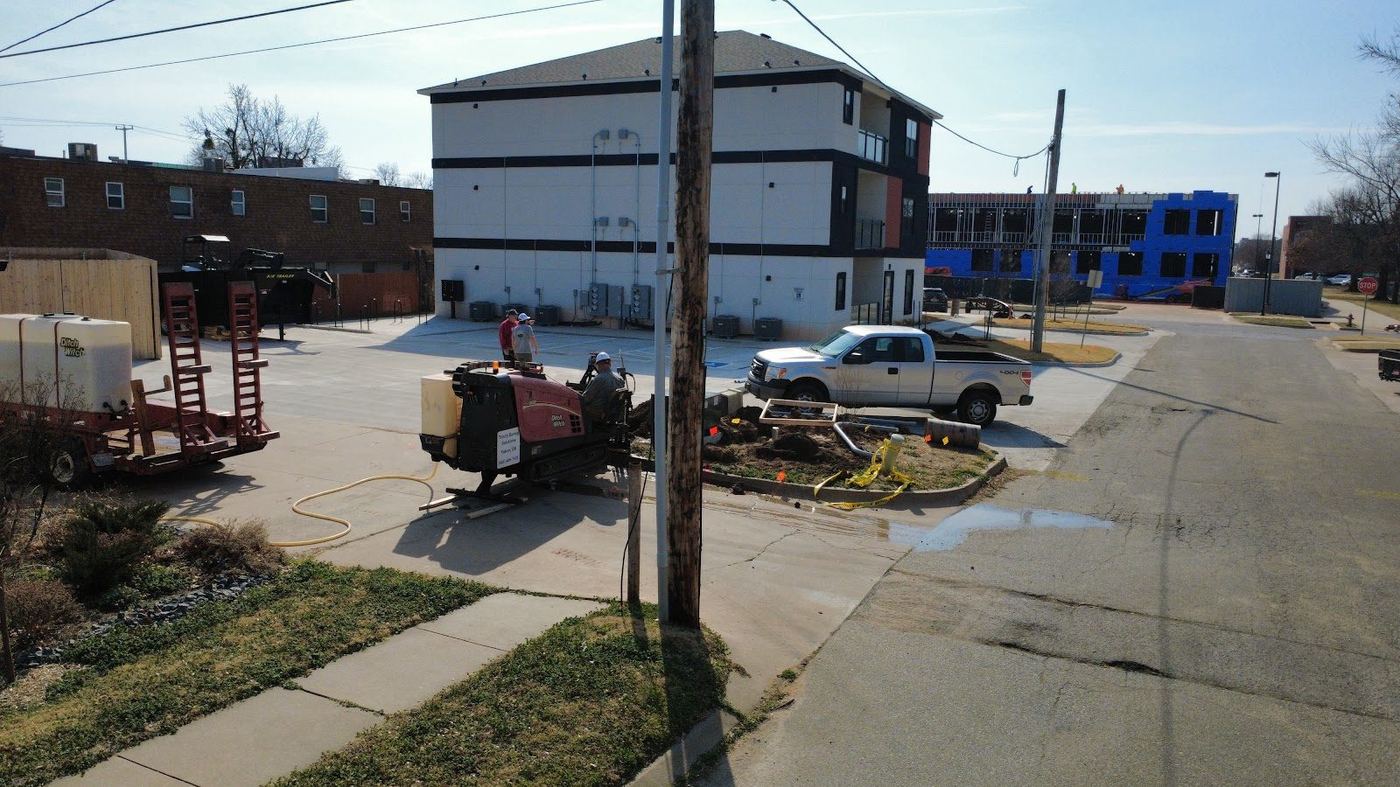
Corpus Christi sets 3 feet of clearance under the pavement, 36 inches of cover from the surface and 18 inches of separation from city pipe.
- 3 feet under the pavement. The minimum clearance from the bottom of the pavement to the top of the facility is 3 feet.
- 36 inches of cover. New underground facilities are at least 36 inches down, measured from the top of the surface.
- 18 inches from city pipe. A new line stays 18 inches clear of the outside of a city utility.
The first two are not the same number. Three feet under the pavement is measured from the bottom of the street section, so under a thick street the line ends up deeper than 36 inches from the top. We draw the profile from the pavement thickness, not from the surface.
How does the permit timeline run?
The Corpus Christi permit form puts numbers on each stage, and they stack up to about three weeks before a rig can set up.
| Stage | What the city says |
|---|---|
| Who can apply | The facility owner, an authorized agent or the contractor |
| What needs a permit | Street cuts, boring operations, new utility installations and subsurface utility exploration in city right of way |
| Review | 14 days |
| How long the permit lasts | 30 days |
| Notice before work starts | 72 hours to Traffic Engineering and Engineering Services |
| Lane closures | 8:30 in the morning to 4:30 in the afternoon, Monday to Friday |
The Public Works right of way office takes the applications (Corpus Christi right of way permits). We do not put permits in our quotes. Whoever holds the permit, the owner or the prime, needs the bore dates to fit inside those 30 days, so the schedule is worth settling before the application goes in.
Why does the permit ask for pollution liability insurance?
The Corpus Christi permit asks for pollution liability insurance because bore pits go deeper than 3 feet. The insurance section of the permit adds pollution liability coverage when an excavation is deeper than 3 feet. A line that has to sit 36 inches down needs pits deeper than that, so the coverage comes into play on nearly every bore in the city. It is worth sorting out with whoever is pulling the permit before the certificate is sent in.
What ground will a bore hit in Corpus Christi?
The drill in Corpus Christi works through heavy clay on the mainland and sand on the islands, on flat ground close to sea level. Nueces County is coastal prairie that runs from sea level up to about 180 feet, and the city itself is listed at about 7 feet (Handbook of Texas: Nueces County; Wikipedia: Corpus Christi, Texas). Rock is not the concern here. Two very different soils are.
On the mainland: Victoria clay
The USDA soil series for this clay has its type location in Nueces County. Victoria clay is very deep and very slowly permeable, and it formed in clayey delta and marine sediments of the Beaumont Formation. In dry weather it opens cracks from under half an inch to about 3 inches wide that can reach 60 inches down or more (USDA Victoria soil series). Five feet is as deep as many utility bores run, so in a dry spell the cracks can reach the bore.
The Beaumont is not clay all the way. A state study on Petronila Creek in Nueces County found clays and silts from the surface to between 10 and 15 feet, and silty sand lenses inside the clay below that (Railroad Commission of Texas study). A bore that stays shallow stays in clay. One that dives under a channel can find the sand.
At the coast and on the islands: sand
The Handbook of Texas calls the coastal soils sandy, and that takes in Padre Island and Mustang Island, the barrier islands east of the city. Sand below the water line does not stand up on its own. The pits are shored or sloped, and the drilling fluid is mixed thick enough to keep the hole from closing behind the reamer.
How close is the water?
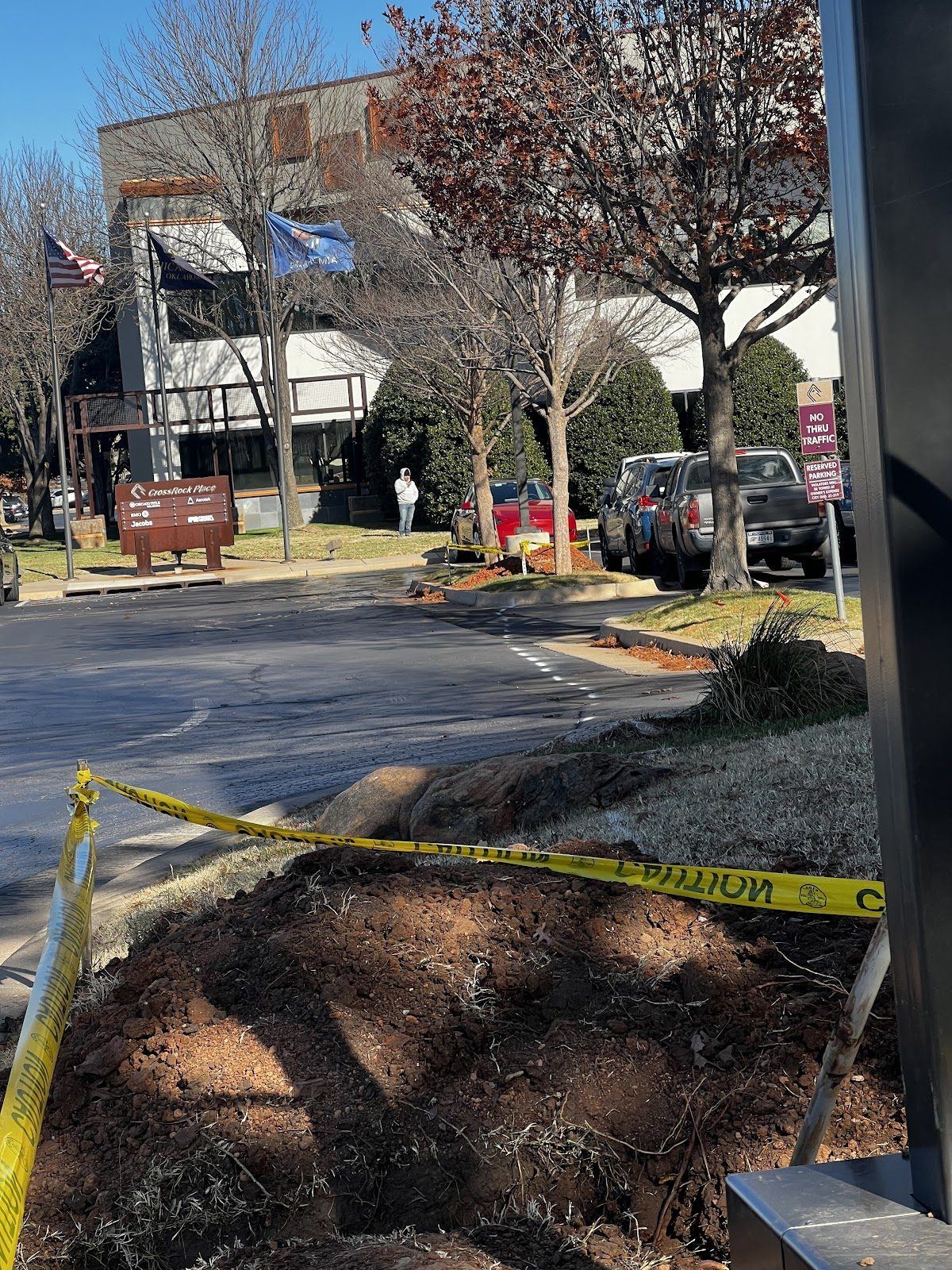
Groundwater in Corpus Christi has been logged 5 to 8 feet down at a port site and 14 to 18 feet down at city test sites, so it depends how near the bay you are. Two sets of borings show the spread:
- At a Port of Corpus Christi site, the Rincon West storage area, the geotechnical report logged groundwater 5 to 8 feet below the surface and noted that the water table generally sits near the tide level next to it (Port of Corpus Christi geotechnical summary).
- At test sites drilled for a city aquifer storage study, the driller first met groundwater between 14 and 18 feet down (Texas Water Development Board report).
A bore pit for a 36 inch deep line is usually 4 to 6 feet deep. Near the bay, the ship channel, Oso Bay or the Laguna Madre that can be at the water. The city has a whole specification for controlling groundwater in excavations (Corpus Christi ground water control specification). On a job near the water that means a pump at the pit, pits kept small and closed up quickly, and pit locations picked with the water in mind.
Where in Corpus Christi do we bore?
We take bores all over Corpus Christi: downtown and the bayfront, the Southside, Flour Bluff, Calallen and Annaville on the northwest side, the industrial ground along the ship channel, and Padre Island across the causeway. Nearby we take calls from Portland, Robstown, Port Aransas, Ingleside and Aransas Pass.
Directional drilling in Corpus Christi puts water, gas, sewer, power and fiber lines in by the same method, whether the thing in the way is a street, a driveway, a parking lot or a drainage channel.
The city limits reach into Aransas, Kleberg and San Patricio counties as well as Nueces. The Nueces County page and the San Patricio County page cover the ground on both sides of the bay.
Whose lines are under a Corpus Christi street?
A good share of the lines under a Corpus Christi street belong to the city. Corpus Christi runs its own gas system, Corpus Christi Gas, for homes and businesses (Corpus Christi Gas), alongside city water and wastewater. That is why the 18 inch clearance from city utilities comes up so often here: the gas main, the water main and the sewer can all be city pipe.
Everything gets marked through Texas811, and filing that ticket is part of our job. A request has to be in at least 48 hours before the work and can be made up to 14 days before it. Saturdays, Sundays and legal holidays do not count toward the 48 hours (Texas Utilities Code, Chapter 251). Then each crossing is opened with our hydrovac, which we include in the price. The 18 inches gets measured off the pipe itself.
What about Padre Island Drive, the Crosstown and Interstate 37?
Padre Island Drive, the Crosstown Expressway and Interstate 37 in Corpus Christi are all state highways. Padre Island Drive is State Highway 358 and the Crosstown Expressway is State Highway 286. Interstate 37, US 181 and State Highway 44 are state roads too. A utility crossing any of them is a TxDOT matter.
Under Texas rules a line placed beneath an existing highway is put in by boring or tunneling, and the rule describes the casing a crossing gets (43 Texas Administrative Code 21.40). Nueces County falls in the TxDOT Corpus Christi District with Aransas, Bee, Goliad, Jim Wells, Karnes, Kleberg, Live Oak, Refugio and San Patricio counties (TxDOT districts). The request for a utility permit is made in the state online system (TxDOT utility installation permits).
How is a Corpus Christi bore priced?
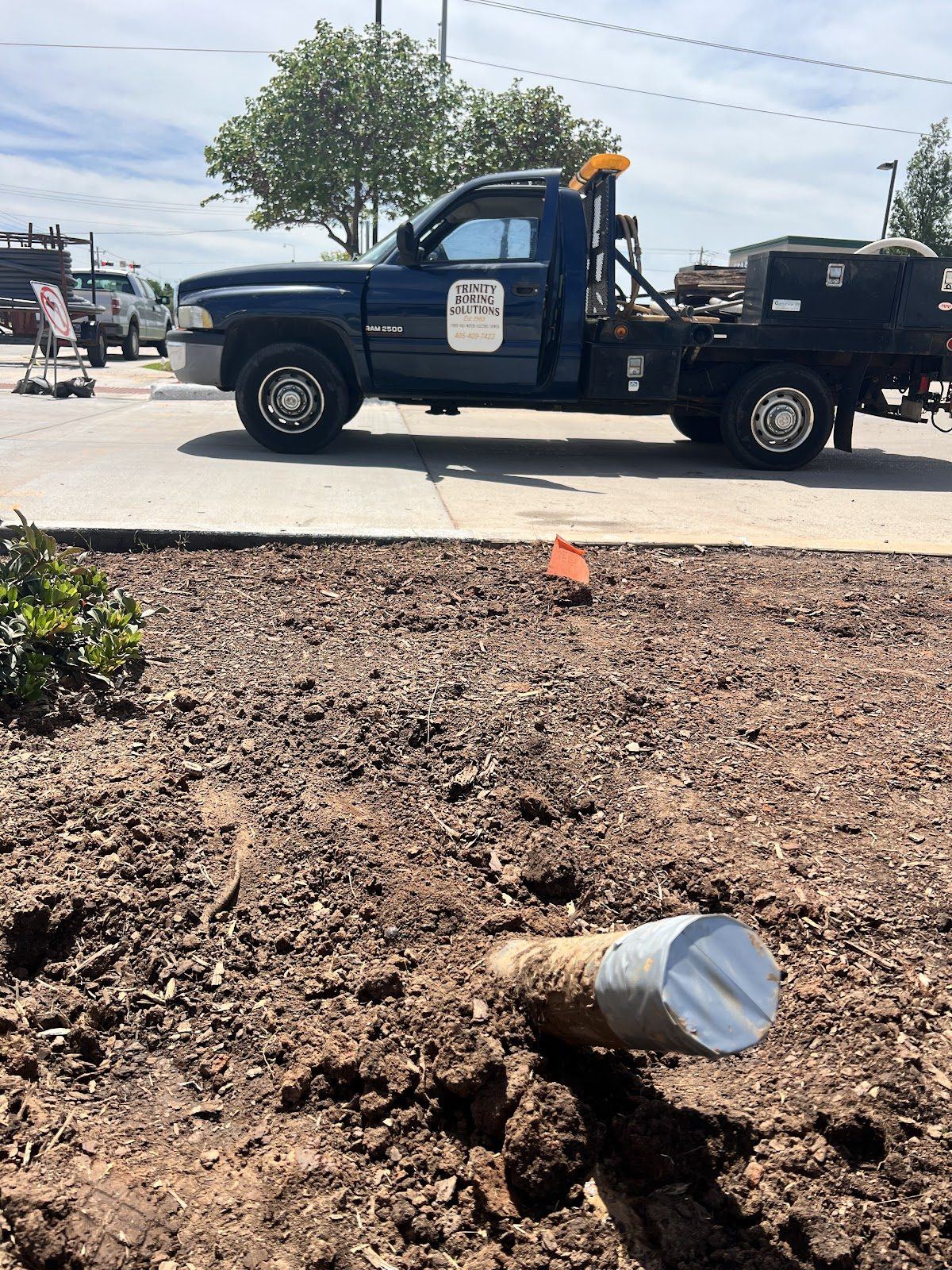
A Corpus Christi bore is priced on its own conditions, like every bore we quote. The footage and the conduit size point to a general range, and these move a Corpus Christi job inside it:
- Soil. Stiff clay, sand, or sand under water
- Utilities to cross. Each is exposed and measured first, and the city pipes need their 18 inches
- Length and depth. Thick pavement pushes the bore deeper
- Concrete. Cut out and removed where a pit needs it
- Water in the way. A drainage channel, a creek or a wet pit that has to be pumped
- Pits. An excavator and sand backfill where the pits are deep
- The kind of job. Routine, high profile or emergency
- Mobilization. Corpus Christi is about 540 miles from our yard in a straight line, so a mobilization fee can apply
What comes back to you is one price for the whole job. Hydrovac work on the lines we cross is inside it. Permits are outside it, and so is replacing any concrete we take out.
Corpus Christi boring questions, answered
Does Trinity Boring Solutions do directional boring in Corpus Christi, TX?
Yes. Trinity takes directional boring and horizontal directional drilling (HDD) jobs in Corpus Christi and Nueces County. Trinity works in Oklahoma and Texas with rigs it owns, and crews travel from Yukon, Oklahoma.
Does Corpus Christi allow a street to be cut for a small utility crossing?
No. The city Right of Way Construction Permit says a utility crossing at a perpendicular or near perpendicular angle with an outside diameter of 6 inches or less will not be permitted to be installed by cutting the road section. Exceptions are decided by the Director of Public Works.
How deep does a line have to be under a Corpus Christi street?
A line under a Corpus Christi street has to sit at least 3 feet below the bottom of the pavement, measured to the top of the line. New underground facilities are at least 36 inches below the surface, and they keep 18 inches clear of city utilities.
How long does a Corpus Christi right of way permit take?
The permit form gives a 14 day review. The permit is valid for 30 days, and the city asks for 72 hours of notice to Traffic Engineering and Engineering Services before work begins.
Is pollution liability insurance required for boring in Corpus Christi?
The city permit includes pollution liability coverage in its insurance requirements when an excavation is deeper than 3 feet, which covers most bore pits.
What kind of soil is under Corpus Christi?
The soil under Corpus Christi is mostly Victoria clay, a very slowly permeable clay formed in the Beaumont Formation that cracks deeply when dry. Soils at the coast and on Padre and Mustang islands are sandy.
How deep is groundwater in Corpus Christi?
Groundwater depth in Corpus Christi varies with distance from the bay. Borings at a Port of Corpus Christi site found water 5 to 8 feet down, near tide level. Test drilling for a city aquifer storage study first met groundwater at 14 to 18 feet.
What does directional boring cost in Corpus Christi?
A general range comes from the footage and the conduit size. Clay or wet sand, utility crossings, pavement thickness, concrete, water, pit work, urgency and mobilization set the number. Trinity quotes one price for the whole job and does not include permits.
Where the Corpus Christi facts on this page come from
- City of Corpus Christi: Right of Way Construction Permit
- City of Corpus Christi Public Works: right of way permits
- City of Corpus Christi: standard construction specifications
- City of Corpus Christi: specification 022021, control of ground water
- USDA Natural Resources Conservation Service: Victoria soil series
- Texas State Historical Association, Handbook of Texas: Nueces County
- Railroad Commission of Texas: Petronila Creek soil feasibility study addendum
- Port of Corpus Christi: geotechnical design summary, Rincon West storage area
- Texas Water Development Board: Corpus Christi aquifer storage and recovery report
- City of Corpus Christi: Corpus Christi Gas
- Texas Utilities Code, Chapter 251: underground facility damage prevention
- 43 Texas Administrative Code 21.40: underground utilities on state highways
- Texas Department of Transportation: districts and their counties
- Texas Department of Transportation: utility installation permits
- U.S. Census Bureau QuickFacts: Corpus Christi
- Wikipedia: Corpus Christi, Texas
About the author
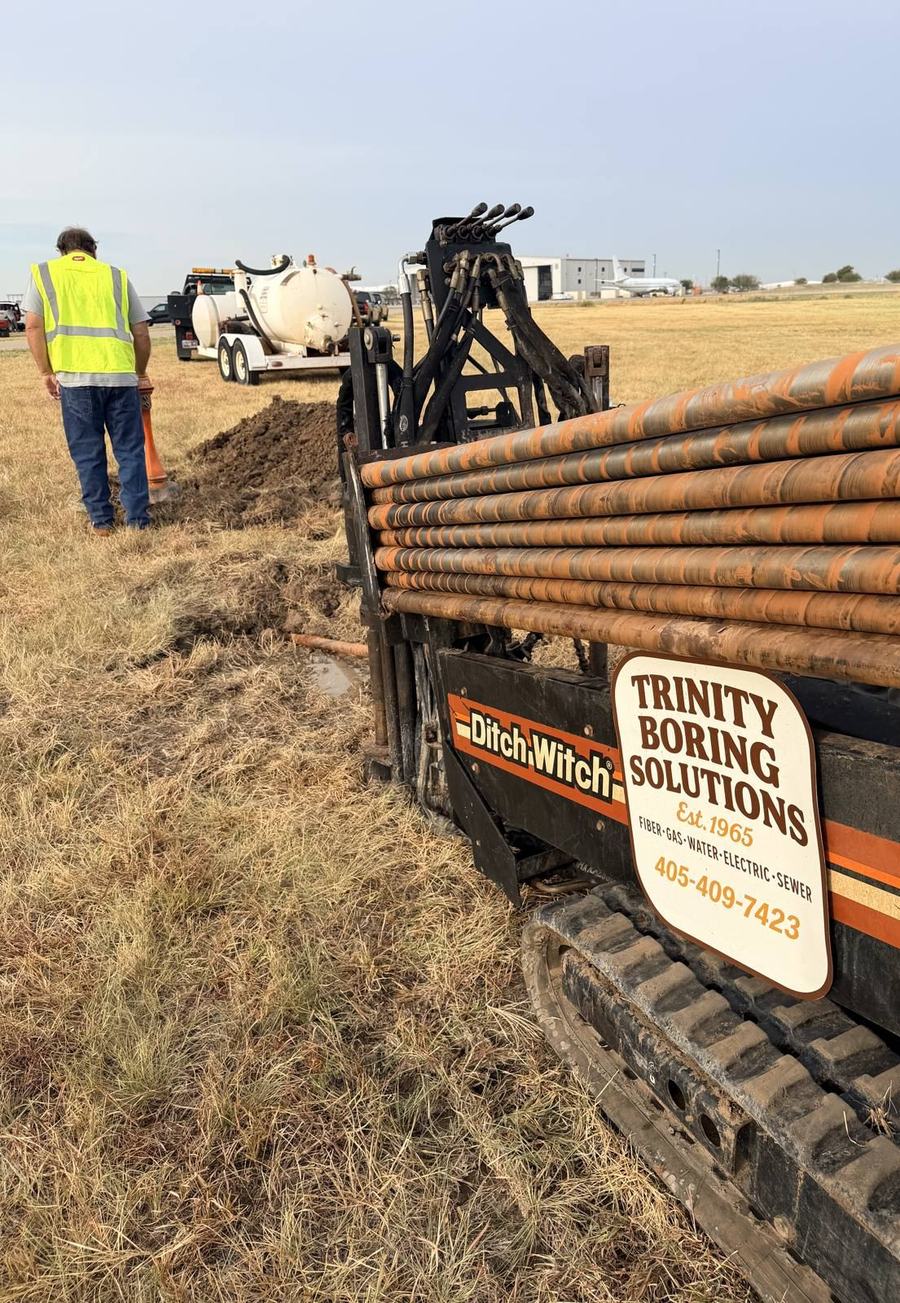
Darren Rice is owner and president of Trinity Boring Solutions, based in Yukon, Oklahoma. Dean Rice founded the family business in 1965 and Darren began its directional boring work in 1982. Since then he has bored in red clay, river sand and sandstone across Oklahoma and Texas. He wrote this page from the Corpus Christi permit form and the soil and water reports linked above. His phone is (405) 409-7423.
Get a Quote for a Bore in Corpus Christi
Send the address, what is going in, the conduit size and the footage, and tell us how close the job is to the water.
Trinity Boring Solutions
9102 NW Expressway, Yukon, OK 73099
(405) 409-7423 | darren@trinityboringsolutions.com
Free Bore Planner
Plan Your Bore in Corpus Christi, Texas
Type the address of your job in Corpus Christi. The Bore Planner opens an aerial map at that spot. Drop one pin where the bore starts and one where it ends, tell us what is going in and send the scope to our crew.
Talk to the crew that does the work
Fastest way to a number is a phone call. Tell us where the crossing is and what is going in the ground, and you will get a straight answer on the same call. Bores from 10 feet to 5,000 feet, 3/4 inch service line through 48 inch casing, anywhere in Oklahoma and Texas. We run 24/7 for main breaks and emergency repairs.
Answered by a person, not a call center.
Would rather not call? Send the details and we will come back with a written quote.
County and State Pages for Corpus Christi
Same county: Robstown · Port Aransas · Bishop · North San Pedro · Banquete · Agua Dulce · Driscoll · Spring Gardens · Rancho Banquete · La Paloma-Lost Creek · Tierra Grande · Sandy Hollow-Escondidas. All counties: Texas county list. All seven states: directional boring service area.