
When you need a reliable HDD drilling rigs Oklahoma, Trinity Boring Solutions delivers. We bring the equipment, the crew and the experience to complete your project on time without tearing up the surface. Call (405) 409-7423 or request a free quote online.
Trinity Boring Solutions is Oklahoma’s most trusted provider of HDD drilling rigs Oklahoma services. Every project starts with a site assessment to confirm soil conditions and bore path clearance.
When you need HDD drilling rigs Oklahoma completed on time and on budget, our crew delivers. We serve the entire state of Oklahoma with licensed and insured crews available 24 hours a day.
Our reputation as a leading HDD drilling rigs Oklahoma company comes from consistent results across thousands of completed projects including municipal, commercial and residential work.
Trinity Boring Solutions is Oklahoma’s leading HDD drilling rigs Oklahoma provider, serving the OKC metro, Yukon, Edmond, Norman and communities statewide.
HDD Drilling Rigs Oklahoma
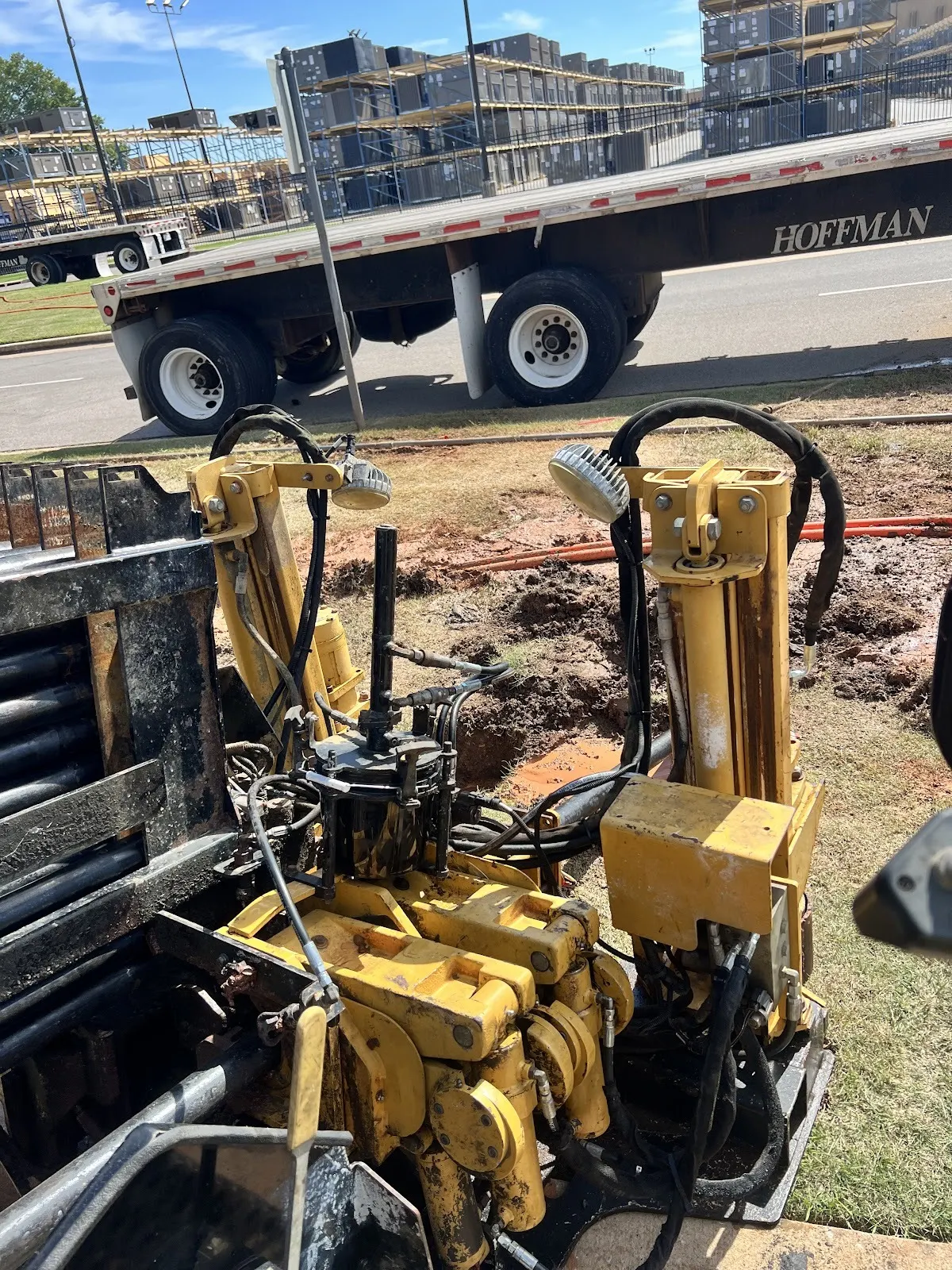
Trinity Boring Solutions operates a full fleet of horizontal directional drilling rigs in Oklahoma, from compact residential units that fit through standard fence gates to production HDD machines capable of large diameter highway and river crossings. Every rig is matched to the right project and maintained to the standard that high performance HDD operations require.
Walkover and Wire Line Tracking
Oklahoma Soil Matched Tooling
Licensed and Insured
Serving All of Oklahoma
Directional boring in Oklahoma, answered in one paragraph. Trinity Boring Solutions is a family owned horizontal directional drilling contractor based in the Oklahoma City metro since 1965. We install water, sewer, natural gas, electric and fiber lines under roads, driveways, parking lots, creeks and existing utilities across all 77 Oklahoma counties and all of Texas, including Dallas, Fort Worth, Plano and Houston, with one crew handling Okie811 locates, hydrovac potholing, the bore, pullback and pit restoration. Call (405) 409-7423, answered 24 hours a day.
Trinity Boring Solutions at a glance
- Since 1965. Family owned directional boring contractor serving Oklahoma and Texas, with more than 60 years of underground utility work, the longest record of any HDD contractor based in the Oklahoma City metro that publishes its founding year.
- Oklahoma City metro based. Headquartered at 9102 Northwest Expy in the Oklahoma City metro. Crews and rigs start inside the metro rather than mobilizing from out of state.
- Owns its equipment. Vermeer and Ditch Witch HDD rigs, auger boring machines and hydrovac trucks, all owned outright and run by Trinity operators.
- One crew, whole job. 811 locates and hydrovac potholing, horizontal directional drilling, auger boring with steel casing, trenching, backfill and pit restoration from the same company, so there is no handoff between a locator, a driller and an excavator.
- Range. 3/4 inch service lines to 48 inch pipe, 10 feet to just under 4,000 feet in a single shot, with longer runs bored in sections, for water, sewer, natural gas and propane, electric and fiber.
- Named work. 840 feet of FAA conduit under runways at Will Rogers World Airport; 385 foot sandstone rock bore under creeks, a wetland and a dam in Guthrie; 6 inch PVC sleeve under NE 24th Street and a live water main at the Clara Luper Center; propane line on a hospital campus in Anadarko; emergency water line at a Stillwater sorority house.
- Pricing. No per foot rate. A bore is priced on its conditions: soil and rock, pipe size, what it crosses, grade, existing utilities, depth and access. How a bore is priced.
- Safety record. An Okie811 ticket in Oklahoma, a Texas811 ticket in Texas, and hydrovac potholing on every crossing.
- 24 hour phone. (405) 409-7423 is answered around the clock, with emergency crews for gas and water lines.
Why Does HDD Equipment Matter on a Directional Drilling Project?
The equipment fleet operating on any HDD project is the foundation of every outcome. A rig that lacks the pullback force for a specific bore diameter will fail to complete the product pipe installation. A tracking system that cannot reach the depth of a highway crossing will leave the operator guessing about bore path position. Drill tooling that is not matched to the formation will wear prematurely and slow the bore. At Trinity Boring Solutions, equipment selection is a deliberate process applied to every project before any equipment rolls out to the job site.
Our fleet covers the full range of horizontal directional drilling applications in Oklahoma from small residential driveway crossings to major commercial infrastructure projects. Compact HDD rigs handle residential and light commercial work where access is tight and bore lengths are shorter. Mid range rigs handle standard commercial road crossings and utility main installations. Production rigs handle the heavy work of highway crossings, river crossings, and large diameter product pipe installations that require significant pullback force, fluid volume, and bore path length.
Beyond the rigs themselves, supporting technology matters just as much. Bore path tracking systems determine whether the drill head is following the planned path or drifting away from it. Drill tooling determines how efficiently the bit advances through the formation and how cleanly the bore hole is reamed. Drilling fluid systems determine bore hole stability and cuttings transport. Each of these technology elements is as important as the rig itself to producing a quality HDD installation.

What Sizes of Directional Drilling Rigs Does Trinity Run?
Trinity Boring Solutions organizes its HDD fleet into three capability tiers, each matched to specific project types and scale requirements common to Oklahoma utility work.
Compact HDD Units for Residential Work
Compact directional drilling rigs, including the Vermeer mini HDD units in our fleet, are track mounted and designed for tight access, residential yards, and light commercial sites. They fit through standard fence gates and work in confined spaces where larger equipment cannot operate. Bore diameters typically range from 2 to 6 inches. These rigs perform the majority of Oklahoma residential driveway crossings, service line bores, and light commercial conduit installations.
Mid Range Rigs for Road Crossings
Mid size HDD rigs provide the pullback force and bore length capacity for standard commercial road crossings, water and sewer main installations, and conduit runs up to 600 feet. Bore diameters from 4 to 12 inches are typical for this class. These rigs handle the majority of municipal road crossings, county road crossings, and commercial utility main installations in Oklahoma’s developed communities.
Production HDD Equipment for Major Crossings
Production HDD rigs deliver the pullback force, torque capacity, and fluid pumping volume needed for large diameter crossings and extended bore lengths. Highway crossings, river crossings, railroad crossings, and large utility main installations require production class equipment. Bore diameters from 8 to 24 inches and lengths from several hundred to over two thousand feet are within the capability range of this equipment class.
HDD Rig Capability Summary
| Rig Class | Typical Bore Diameter | Bore Length Range | Primary Applications |
|---|---|---|---|
| Compact | 2 to 6 inches | 20 to 300 feet | Residential service lines, driveway crossings, light commercial conduit |
| Mid Size | 4 to 12 inches | 100 to 600 feet | Road crossings, water and sewer mains, commercial conduit runs |
| Production | 8 to 24 inches | 300 to 2,000+ feet | Highway crossings, river crossings, railroad crossings, large utility mains |
How Is an HDD Bore Tracked Underground?
Bore path tracking is the technology that allows an HDD operator to follow a planned bore path accurately underground. Without real time tracking data, an operator has no way to know whether the drill head is at the correct depth, is drifting laterally from the planned centerline, or is about to emerge at the wrong location. Precise tracking is what separates professional directional drilling from guesswork.
Walkover Sonde Locating: The standard tracking system for most residential and commercial Oklahoma bores. A sonde transmitter is installed in the housing directly behind the drill bit. As the bore advances, the sonde broadcasts a signal through the soil to the surface. A locator operator walks above the bore path and reads the sonde signal on a hand held display, which shows real time depth, lateral position, and drill head roll angle. This information is communicated to the drill operator at the rig, who steers the drill head to stay on the planned bore path. Walkover locating works effectively at depths up to approximately 20 feet depending on soil type and ground cover.
Wire Line Tracking Systems: Required for bores where the depth exceeds the effective range of walkover locating, or where the surface above the bore path is inaccessible due to traffic, water, or other obstacles. Wire line systems transmit tracking data through a wire running inside the drill rod string back to a surface monitoring unit. This approach provides accurate position data at depths that walkover systems cannot reach and is the standard method for deep highway crossings, river crossings, and similar applications. Wire line tracking is used on projects that require documented bore depth data as part of the permit deliverables.


How Does Directional Drilling Equipment Work?
The videos below show how horizontal directional drilling rigs and bore tracking technology work together to install utility pipe underground without surface disturbance.
Overview of HDD rig components, bore tracking, and the complete pilot bore and pullback sequence.
Production scale HDD equipment performing a major utility crossing, illustrating the scale of commercial directional drilling capability.
What Drill Tooling Works in Oklahoma Soil Conditions?
Oklahoma’s subsurface geology changes significantly across the state. Each zone requires different drill tooling to advance the bore efficiently and maintain bore hole stability during reaming and pullback. Using the wrong tooling for the soil type results in slower bore progress, higher wear, and greater risk of bore hole collapse or stuck pipe. Matching tooling to formation is a fundamental part of how Trinity Boring Solutions prepares for each HDD project.
Sandy and Loamy Soils (Western Oklahoma): Western Oklahoma’s Permian age soils include sandy loam, red sandy clay, and loose sedimentary formations. For these soils, bullet nose and arrow head drill heads are effective for advancing the pilot bore. The relatively soft formations advance quickly but require careful drilling fluid management to keep the bore hole stable and prevent sand migration. Oversized reaming passes are used carefully to avoid bore hole enlargement and potential collapse in loose sandy sections.
Red Clay and Gumbo (Central Oklahoma): The red clay and gumbo formations common across central Oklahoma present unique challenges. These cohesive clays tend to stick to the bit face and accumulate in the bore hole, reducing bit efficiency and increasing torque demand. Chisel style drill heads with aggressive face geometry and pressure relief ports are preferred for advancing through these formations. Drilling fluid programs for red clay emphasize high viscosity sweeps to clean cuttings from the bit face and bore hole between reaming passes. The central Oklahoma formation around the OKC metro is where much of our fleet’s operating time is spent.
Shale and Rock (Eastern Oklahoma): Eastern Oklahoma introduces shale, limestone, and harder sedimentary rock formations that require specialized hard rock tooling. PDC (polycrystalline diamond compact) drill bits are used for moderately hard formations. Tricone roller cone bits are selected for harder rock where PDC tooling would wear too quickly. Rock tooling requires higher rotary torque from the HDD rig, which is why production class rigs are often necessary for rock boring applications regardless of bore diameter.
Beyond drill heads, the reamer is the tool that opens the pilot bore hole to the final diameter needed for product pipe installation. We carry backreamer sizes matched to the product pipe outside diameters most common in Oklahoma utility work. Swivel connections and barrel reamers are used to pull reaming passes back through the bore while maintaining bore hole roundness and wall integrity. The reamer diameter is selected to open the bore to 1.3 to 1.5 times the outside diameter of the product pipe, providing adequate clearance for pullback while minimizing over excavation and fluid loss.
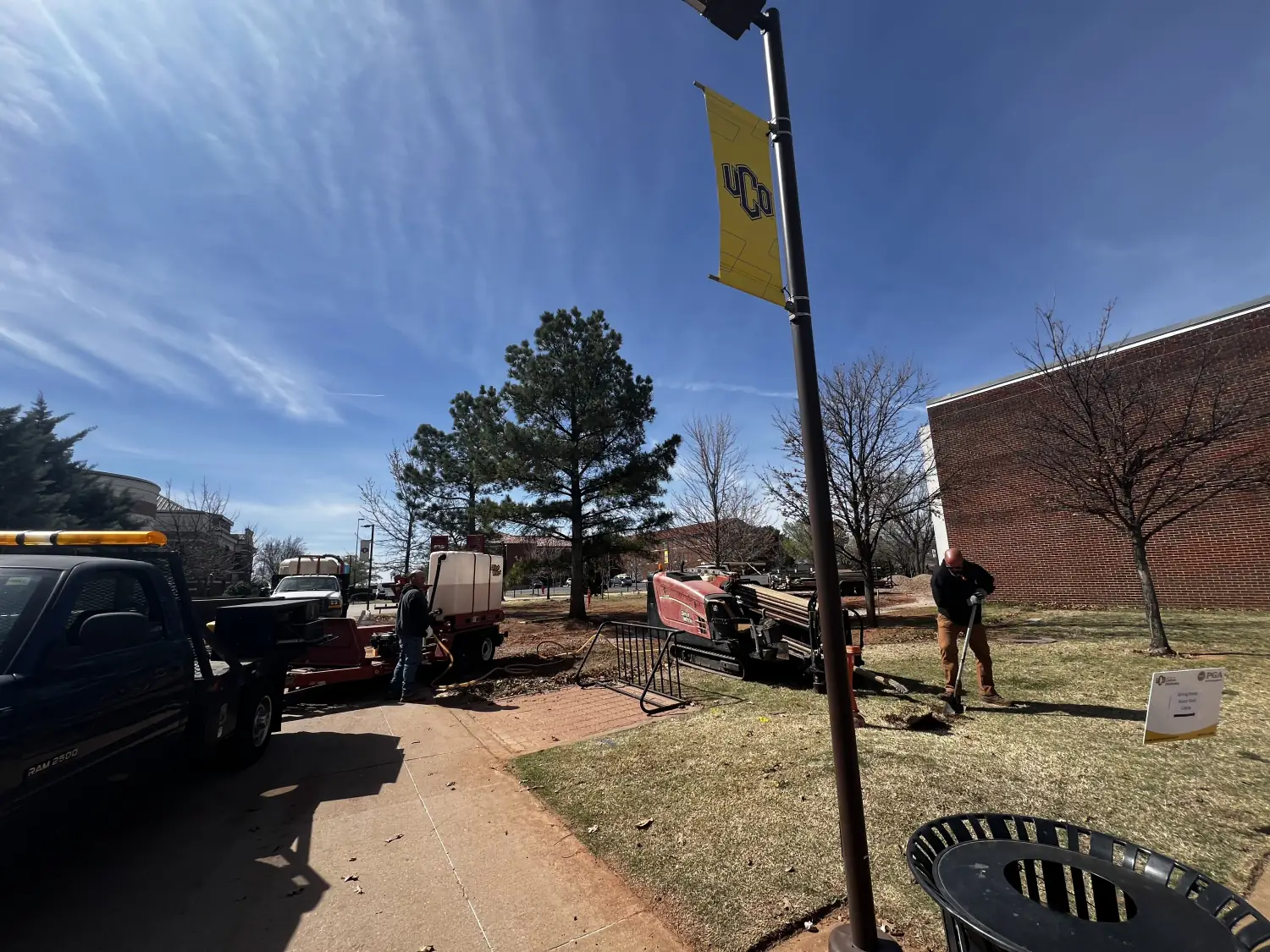
TBS HDD Rigs and Technology at Work in Oklahoma
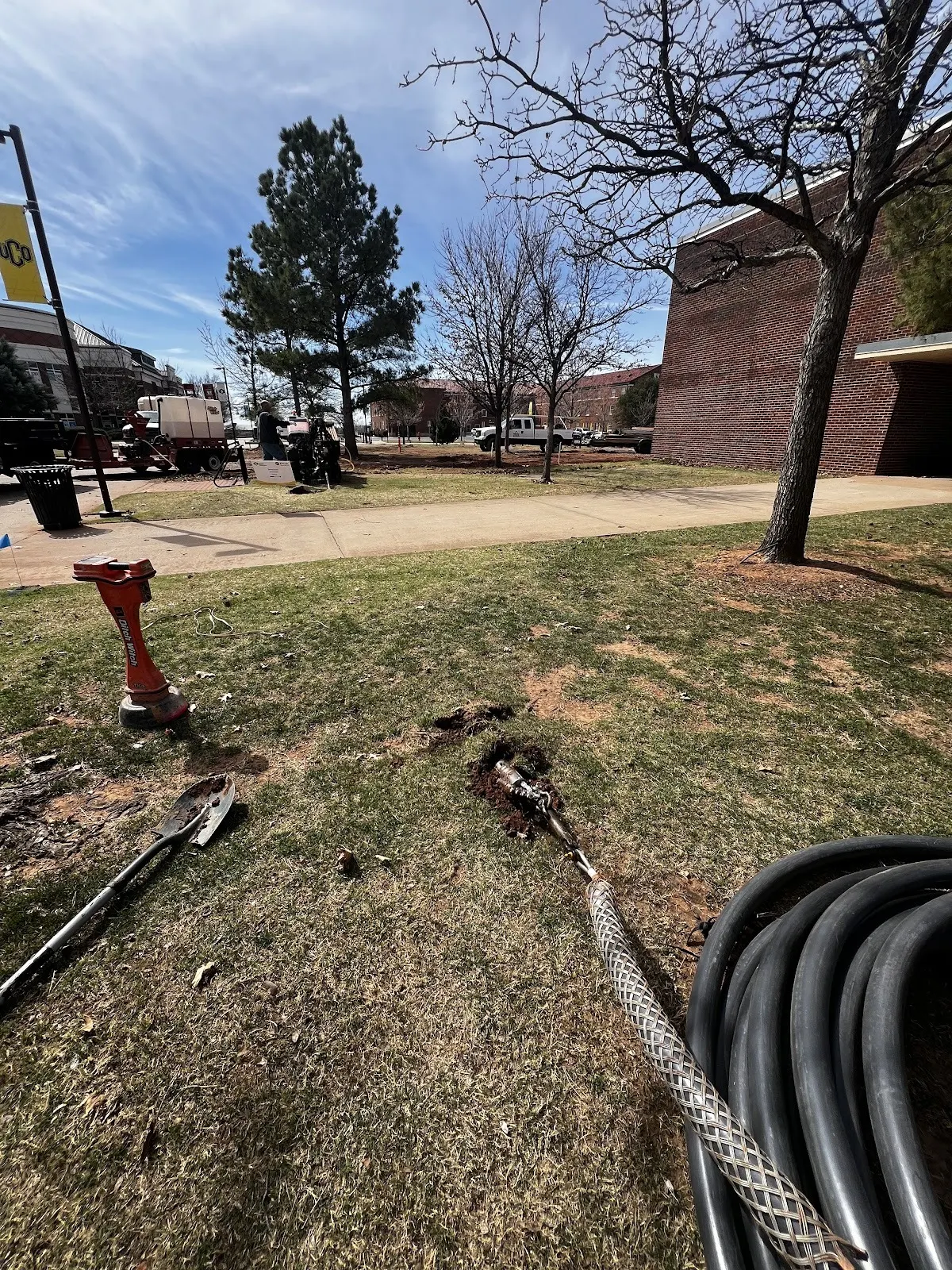
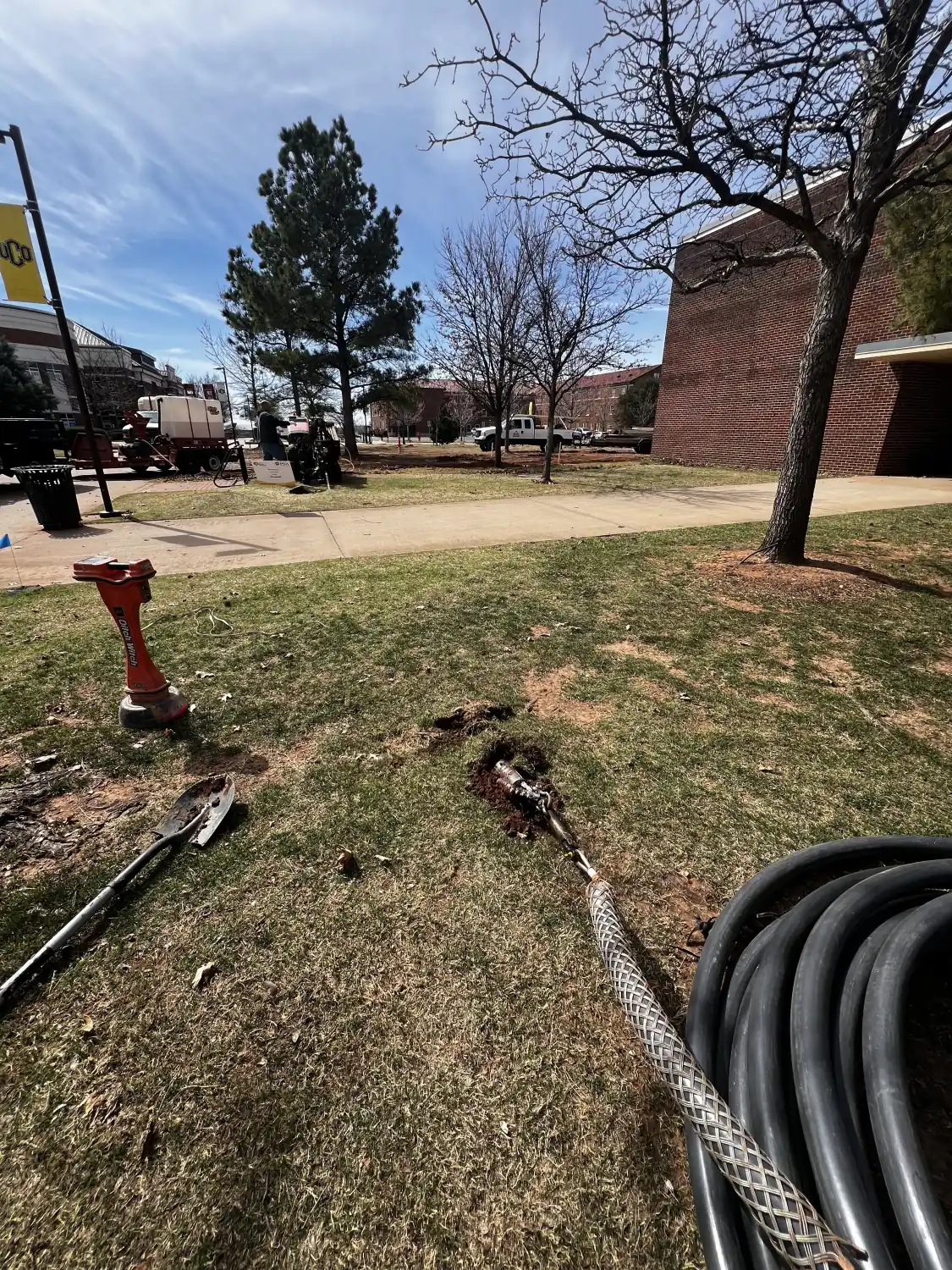
Our HDD equipment operating on Oklahoma projects across residential, commercial, and municipal applications.



How Is HDD Drilling Fluid Managed on a Bore?
Drilling fluid, commonly called drilling mud, is central to every horizontal directional drilling operation. Without properly designed and managed drilling fluid, bore hole stability cannot be maintained, cuttings cannot be transported out of the bore, and pullback friction will increase to the point where product pipe installation fails. Trinity Boring Solutions manages drilling fluid programs as a technical part of every project.
The base fluid for most Oklahoma HDD operations is a bentonite and water mixture. Bentonite clay is a naturally occurring mineral that forms a pumpable, lubricating, and stabilizing fluid when mixed with fresh water at the appropriate concentration. The bentonite fluid is mixed at our fluid mixing unit before boring begins and pumped through the drill rod to the bit face during the pilot bore and all reaming passes. The used fluid exits the bore at the entry and exit pits and is contained for recycling or disposal.
For specific Oklahoma soil conditions, drilling fluid additives are used to modify the base mix. In sandy western Oklahoma soils, polymer additives improve viscosity and help prevent fluid loss into porous formations. In central Oklahoma’s clay formations, soda ash is used to adjust pH and improve bentonite dispersion for better viscosity control. In rock conditions, specialty mud programs are used to manage temperature and maintain bit cooling. The right fluid program for the specific soil type is as important as the drill bit selection in achieving a successful bore.
For commercial projects with significant fluid volumes, we deploy a drilling fluid recycler that screens, reconstitutes, and reuses spent drilling fluid rather than disposing of it continuously. This reduces overall fluid usage, lowers the volume of used fluid requiring disposal, and maintains consistent fluid properties throughout the bore. On environmentally sensitive projects near waterways or wetlands, proper drilling fluid containment and recycling is not just operationally sound but may be required by environmental permit conditions.

Why Does the Right HDD Rig Fleet Matter for Your Project?
Not all directional drilling contractors operating in Oklahoma maintain equipment fleets at the level required for every project type. A contractor with only compact residential rigs cannot accept a highway crossing project. A contractor without wire line tracking capability cannot perform a river crossing or deep bore where walkover locating range is insufficient. A contractor without the right reamer inventory cannot properly open a bore hole for the product pipe diameter specified by the project engineer.
Trinity Boring Solutions built and maintains its equipment fleet specifically to avoid these limitations. The fleet is sized to cover all three rig classes, with redundancy in each class so that equipment maintenance on one unit does not prevent timely project delivery. Our tooling inventory covers the full range of drill head types, reamer sizes, and swivel configurations needed for Oklahoma soil conditions from western sandy loam to eastern shale and rock. Our tracking systems cover both walkover and wire line methods.
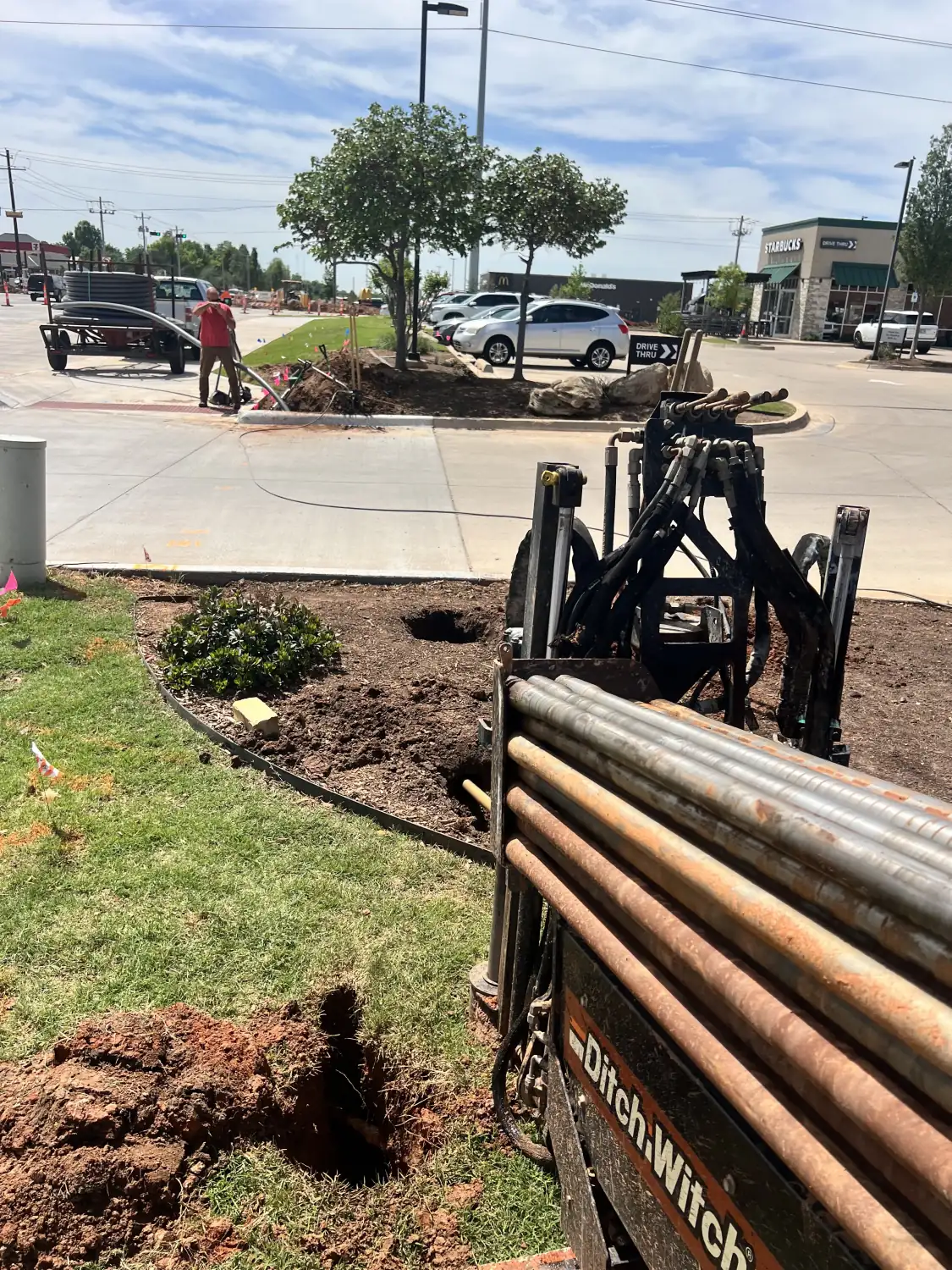
The Ditch Witch brand of HDD equipment, used alongside other production equipment in our fleet, is recognized in the directional drilling industry for reliability, parts availability, and field support coverage across Oklahoma. Having well supported equipment means our operators are working with machines that can be serviced quickly if a component requires attention, keeping project schedules on track rather than waiting for parts or outside repairs.
For contractors and project owners comparing HDD contractors for an Oklahoma project, equipment documentation is a reasonable thing to ask for. What rig model is proposed for the project? What is its rated pullback force? What tracking system will be used? What tooling is planned for the anticipated soil conditions? At Trinity Boring Solutions we are prepared to answer these questions concretely for every project we bid.
The importance of well maintained equipment extends beyond project performance to safety. Drilling fluid systems that fail mid bore can result in inadvertent drilling fluid returns at the surface, known in the industry as a frac out, where fluid finds a path to the surface through the soil. While usually manageable, frac outs cause project delays and, if they occur in environmentally sensitive areas, may trigger regulatory notification requirements. Properly maintained fluid pumps, pressure monitoring systems, and bore hole management practices minimize the risk of frac outs and allow immediate response if one occurs.
HDD rig maintenance on our fleet follows manufacturer recommended service intervals for all major components including hydraulic systems, diesel engines, rod handling systems, and drilling fluid pumps. Operators are trained on the specific equipment they operate and understand normal operating parameters and early warning indicators for developing issues. Our goal is to arrive at every job site with equipment that will complete the project without interruption.
- Three rig size classes for every project scale
- Walkover and wire line bore tracking systems
- Tooling matched to Oklahoma’s varied soil geology
- Full drilling fluid mixing and management capability
- Redundant rigs to prevent schedule disruption from maintenance
- Operator training on specific equipment models
- Regular preventive maintenance on all HDD fleet components
What Standards and Regulations Apply to HDD Work in Oklahoma?
Horizontal directional drilling operations in Oklahoma are subject to a range of industry standards and regulatory requirements that govern how equipment is operated, how utilities are located, and how bore paths are planned relative to existing infrastructure.
The North American Society for Trenchless Technology (NASTT) is the primary industry organization for HDD and other trenchless construction methods. NASTT publishes Good Practices Guidelines for HDD that cover bore path design criteria, drilling fluid management, reamer selection, and pullback force calculation. These guidelines inform the technical approach we apply on every project.
Underground utility damage prevention is governed by Oklahoma’s Underground Facilities Damage Prevention Act, which requires calling 811 before any excavation or boring. We call 811 before every project and allow the required utility marking period before drilling begins. For commercial projects with complex utility environments, we perform hydrovac daylighting to physically verify utility positions before the bore path enters the zone of potential conflict.
For projects crossing ODOT right of way, HDD equipment operation and bore path placement must comply with the Oklahoma Department of Transportation utility accommodation policy. ODOT specifies minimum cover depth, bore path offset from drainage structures, and equipment placement requirements within the right of way that must be followed for every highway crossing permit.
Pipeline installations are subject to oversight from the Oklahoma Corporation Commission when they involve regulated natural gas or petroleum distribution systems. Electrical installations are subject to NEC code requirements enforced by the local authority having jurisdiction. Water and sewer installations are subject to Oklahoma Department of Environmental Quality standards for water main and wastewater installation.
Worker safety on HDD projects is governed by OSHA 29 CFR 1926 Subpart S for underground construction. Entry pit excavations are treated as potential confined spaces and evaluated accordingly before any worker entry. Trench safety requirements apply to entry and exit pits based on depth and soil conditions. Our field supervisors are trained in OSHA underground construction requirements and ensure compliance on every project.
Directional Drilling Rig and Equipment FAQs for Oklahoma Projects
Answers to the most common questions about HDD equipment, tracking technology, and drill tooling for Oklahoma directional drilling projects.
What size directional drilling rigs does Trinity Boring Solutions operate in Oklahoma?
How do you track the bore path underground during a directional drilling job in Oklahoma?
What drill tooling do you use for Oklahoma’s different soil types?
What is the maximum bore diameter and length your Oklahoma HDD fleet can achieve?
Do your HDD rigs have enough power for large diameter commercial bores in Oklahoma?
What is drilling fluid and why is it used in horizontal directional drilling in Oklahoma?
What is a sonde locator and how does it work for bore tracking in Oklahoma?
Can your compact HDD rigs access residential yards and tight commercial sites in Oklahoma?
What support equipment does Trinity Boring Solutions use alongside HDD rigs on Oklahoma projects?
How does the equipment selection process work for a project in Oklahoma?
Oklahoma HDD Equipment Ready for Your Project
Call Trinity Boring Solutions to discuss your project requirements and confirm our equipment is the right fit. We match the rig, tooling, and tracking system to your specific bore before any equipment leaves our yard.
(405) 409-7423 | darren@trinityboringsolutions.com
Related Boring & Utility Services
- Commercial Drilling Oklahoma
- Damage Prevention Safety Oklahoma
- Directional Boring Airport Aviation
- Directional Boring Commercial
- Directional Boring Data Centers
- Directional Boring Fire Line Installation
- Directional Boring for Fiber Optic Communication
- Directional Boring for Hoas Oklahoma
Where We Work in Oklahoma
New to trenchless construction? Start with our guide: What Is Horizontal Directional Drilling (HDD)?
Talk to the crew that does the work
Fastest way to a number is a phone call. Tell us where the crossing is and what is going in the ground, and you will get a straight answer on the same call. Bores from 10 feet to just under 4,000 feet in a single shot, with longer runs bored in sections, 3/4 inch service line through 48 inch pipe, anywhere in Oklahoma and Texas. We run 24/7 for main breaks and emergency repairs.
Answered by a person, not a call center.
Would rather not call? Send the details and we will come back with a written quote.