
San Antonio Texas Directional Boring: Newer Streets Get Bored, in Limestone North and Clay South
Quick Answer: Trinity Boring Solutions takes directional boring and horizontal directional drilling (HDD) jobs in San Antonio, Texas and across Bexar County. San Antonio grades its pavement, and on any street that scores 86 or better a utility crossing goes in by boring or jacking, not by a trench. The bore sits at least 36 inches down, water jetting rigs are not allowed, and no pit stays open overnight. North of downtown the drill meets limestone. Under most of the rest of the county it meets dark clay that cracks when it dries. We serve Oklahoma and Texas with Vermeer and Ditch Witch rigs we own. Crews and rigs are based in Yukon, Oklahoma and at a satellite yard in San Antonio run by a partner drilling contractor Trinity has personally vetted.
San Antonio, Texas bores at a glance
- City and county: San Antonio, Texas, the seat of Bexar County. Population 1,548,422 in the 2025 Census estimate.
- City rule: a crossing on a street with a pavement condition index of 86 or higher is bored or jacked
- Bore depth: at least 36 inches from the street surface to the top of the bore
- Not allowed: water jetting boring equipment, or a pit left open at the end of the day
- City permit: one type for street bores of 49 feet or less, another for 50 feet or more
- Ground: limestone under the northern third of the county, dark cracking clay under most of the rest
- Edwards Aquifer: the recharge zone runs across the north side of Bexar County
- Texas811: we file the ticket at least 48 hours ahead, with weekends and holidays not counted
- State roads: TxDOT San Antonio District, 60 inches of cover under the pavement
- Phone answered 24 hours a day: (405) 409-7423
Which San Antonio streets have to be bored?
A San Antonio street has to be bored when its pavement condition index, or PCI, is 86 or higher. The PCI is the score the city gives a street for the shape its pavement is in. The city Utility Excavation Criteria Manual says all utility crossings on any street with a PCI of 86 or higher shall be installed by boring or jacking, unless the Director of Public Works approves something else (San Antonio Utility Excavation Criteria Manual). The manual calls a street at that score a new street.
The reason is in the same manual. A cut in a new street is treated as a 100 percent loss of pavement life, and the repair the city expects is new pavement from block to block and from curb to curb. Next to that, a bore is the small job.
The rule reaches the locating work too. Pothole locates count as excavation, and on a new street they are not allowed unless they are done with keyhole technology or vacuum extraction through a core no wider than 6 inches. So the lines under a good street get found with a vacuum truck and a small core, not a saw cut square.
What does the city expect from the bore itself?
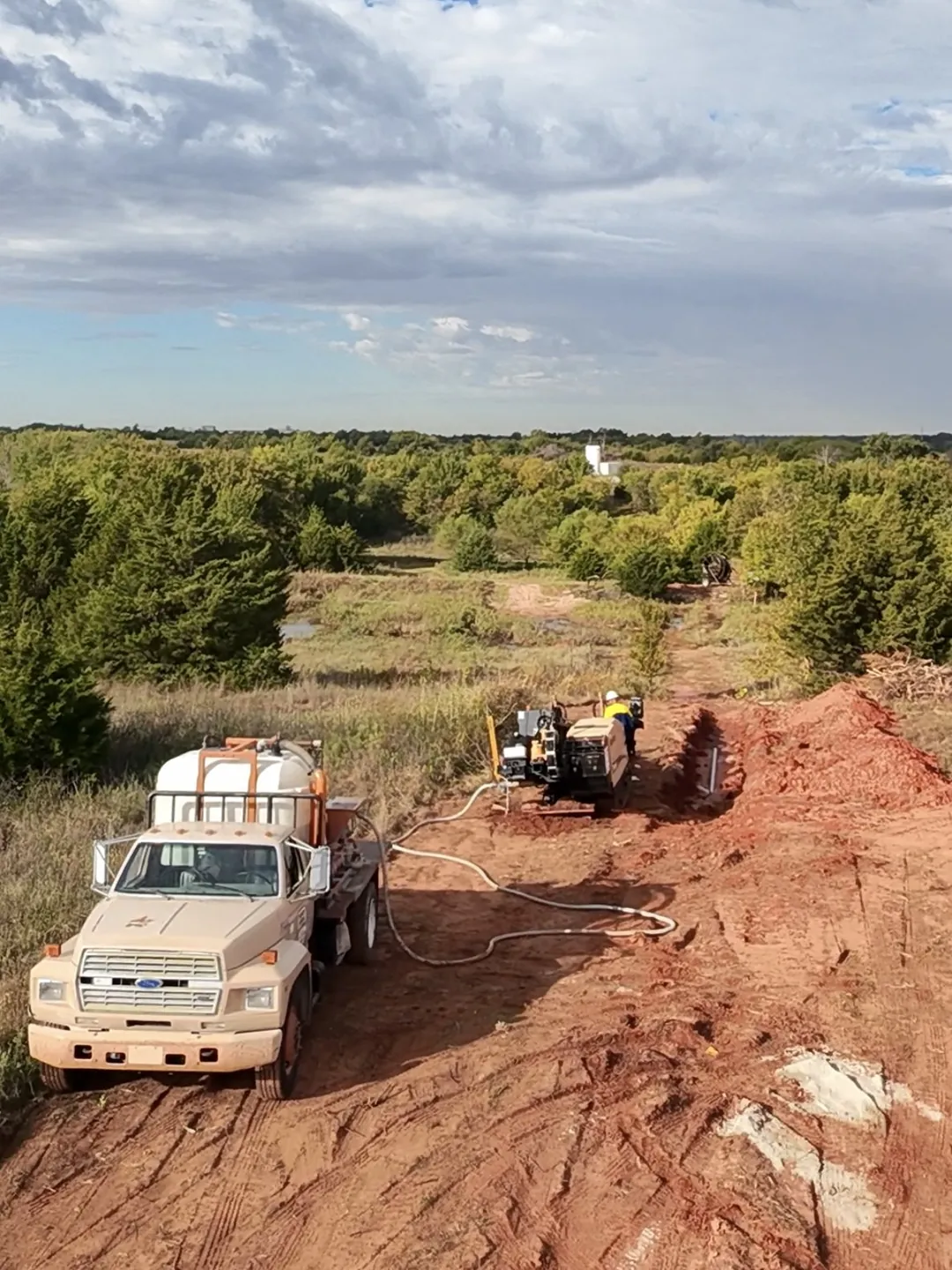
San Antonio expects a street bore to keep at least 36 inches of cover, to start from pits the city has approved and to be drilled without water jetting. Those rules come from the jacking and boring section of the city manual, and these are the parts that change how a job is laid out:
- 36 inches of cover. Bore pits are dug deep enough to keep at least 36 inches between the street surface and the top of the bore.
- The city picks the pit spots with you. Pit locations are approved by the city, and they sit far enough off the roadway that the curb, gutter and shoulder are not undermined.
- No water jetting. Boring equipment that cuts with a water jet is not permitted. The drill head cuts the hole, and drilling fluid carries the cuttings out.
- You find the other lines. The permit holder is responsible for the vertical and horizontal location of the facilities already in the ground.
- Casing is grouted. Where a casing goes in, the space around it is pressure grouted for the full length.
- Nothing stays open overnight. Pits are backfilled right after the work. A pit that cannot be finished that day is temporarily backfilled and plated, or fenced with 6 foot chain link.
- Creeks and ditches. The city prefers a crossing under the channel, with the top of the pipe at least 4 feet below the ultimate flow line.
A city inspector watches the operation, and the backfill gets its own inspection.
Is it a simple permit or a project permit?
A San Antonio street bore of 49 feet or less takes a simple right of way permit, and a bore of 50 feet or more takes a project permit (San Antonio right of way permit types).
| Street bore | Permit | What goes with it |
|---|---|---|
| 49 feet or less | Simple permit | An application fee and an inspection fee |
| 50 feet or more | Project permit | Filed at least 30 days before the start, with site plans, a traffic control plan, a KMZ map file and the city Project Information Form |
The city also asks for a $10,000 bond for each project address, unless a $100,000 bond is already on file. A tie in to San Antonio Water System pipe needs a separate SAWS General Contractors Permit.
Our quotes leave permits out. The owner, the utility or the general contractor takes out the permit, and we drill to what it says. Measure the crossing before you assume which permit applies, because one foot moves a job from the short form to the 30 day review.
What ground will a bore hit in San Antonio?
A bore on the north side of San Antonio hits limestone, and a bore under most of the rest of the city hits dark clay that cracks when it dries. The line between them is the Balcones Escarpment, which crosses Bexar County. The Texas State Historical Association describes the northern third of the county as hilly ground with alkaline soils over limestone, and most of the rest as very dark loamy soils and gray to black cracking clays with a high shrink and swell potential (Handbook of Texas: Bexar County).
| Part of the county | What is down there | What it means for a bore |
|---|---|---|
| The north side, up on the edge of the Edwards Plateau | Thin soil over limestone | A rock bore. Rock tooling, a slower pace and more drilling fluid. Pits take an excavator and sometimes a breaker. |
| The middle of the county, along the fault zone | Limestone and clay broken up by faults | The ground can change part way across. We plan for rock even when the entry pit is in clay. |
| Most of the rest, south and east | Dark clay that swells when wet and cracks when dry | Clay holds a hole well, but it is sticky. The fluid is mixed to keep it from balling up on the reamer. |
The fault zone is not a small detail. The U.S. Geological Survey found the rock in the central and southern parts of the county tilted toward the Gulf and heavily faulted, with single faults traced for as much as 25 miles and offsets of at least 600 feet (U.S. Geological Survey). The same layer of limestone can be near the surface on one side of a fault and far below a bore on the other.
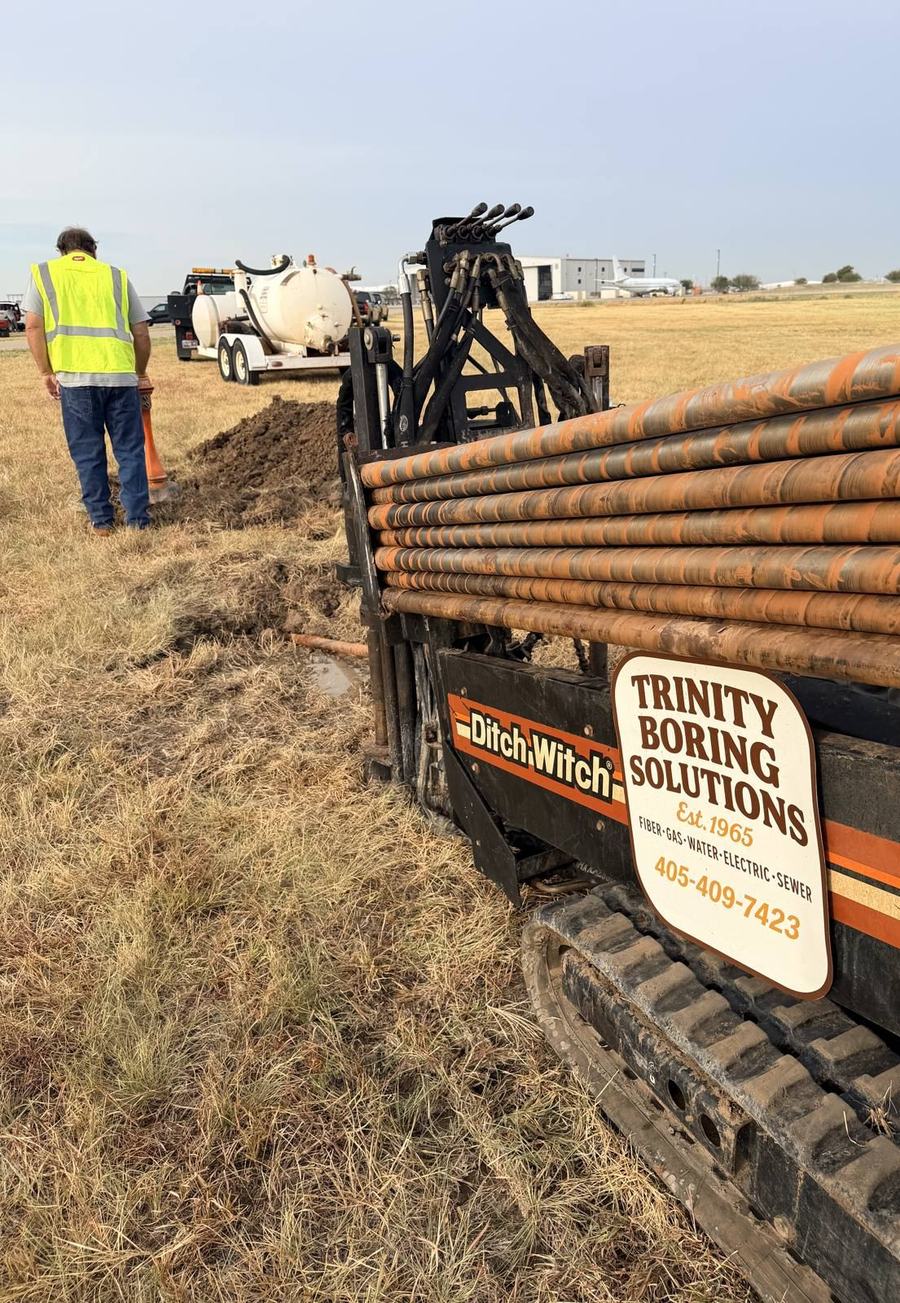
The city writes rock into its cover rule as well. The usual minimum cover in the manual is 30 inches. In rock or limestone, the city can assign a depth that puts the line below any badly weathered layer. Rock is ground we know. The photo above is our Vermeer on a 385 foot bore through sandstone in Guthrie, Oklahoma, and the write up of that job shows how a rock bore is set up.
Does the Edwards Aquifer change a bore on the north side?
A utility bore on the Edwards Aquifer recharge zone in San Antonio needs erosion and sediment controls in place before the work begins, and a sewer line needs a state approved plan as well. The recharge zone is where the aquifer limestone is at the surface and water drops into it through cracks, fissures and caves, and it runs across the north side of Bexar County. The state rules for it are written by the Texas Commission on Environmental Quality (TCEQ guide to the Edwards Aquifer rules).
- Gas, telephone, electric, water and other utility lines that do not carry pollutants are exempt from filing an Edwards Aquifer protection plan.
- They are not exempt from erosion and sediment controls. Those go in before the work begins and stay until the soil is stabilized.
- A sewer line is different. Sewage collection systems on the recharge zone need a plan approved through the state program (TCEQ Edwards Aquifer Protection Program).
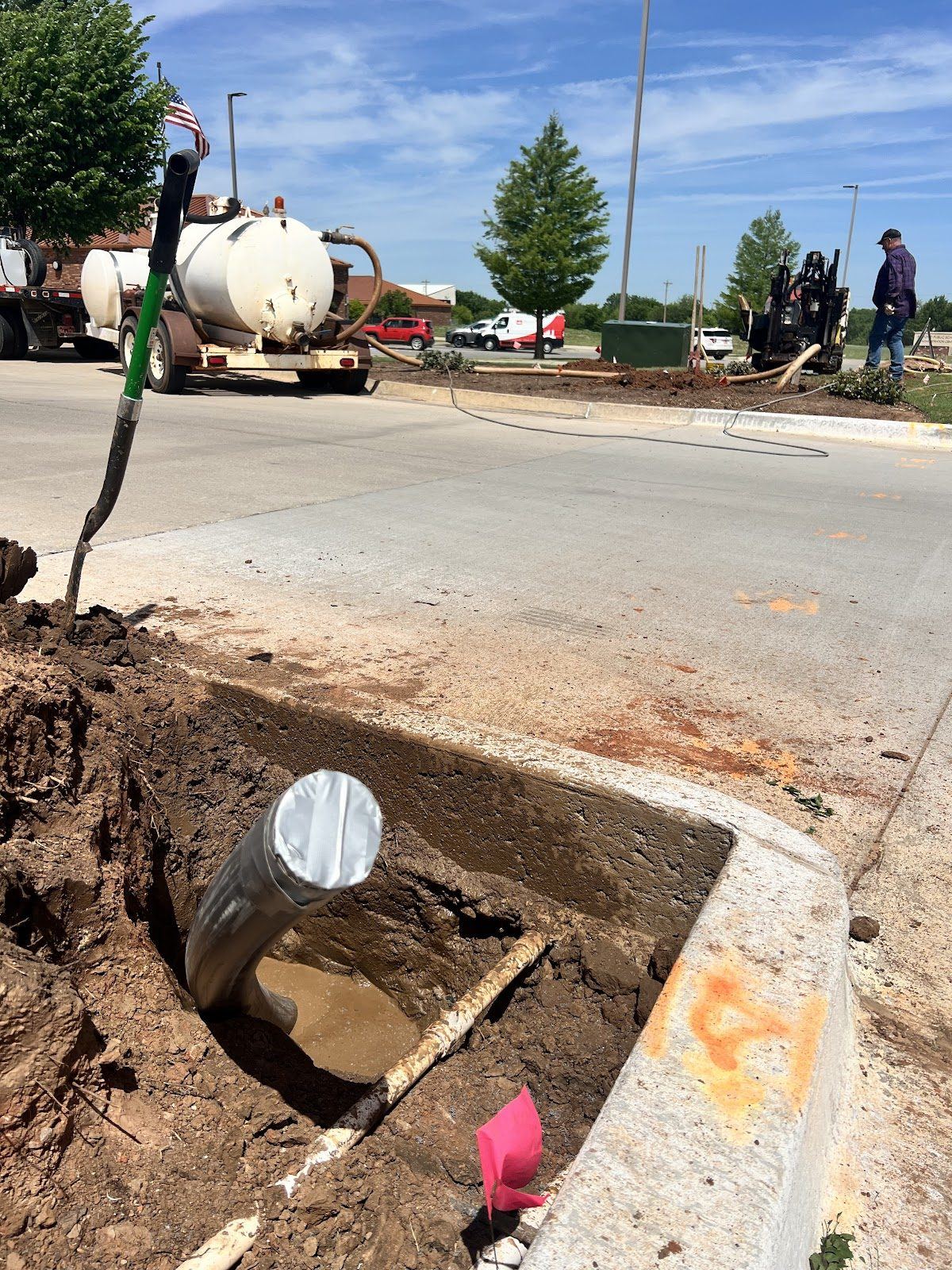
Cracked limestone is also where drilling fluid can leave the hole. On the recharge zone the pits are kept contained and vacuumed, and the fluid coming back is watched all the way across.
Where in San Antonio do we bore?
Trinity takes bores anywhere in San Antonio, inside Loop 1604 and out past it: downtown, the South Texas Medical Center, Stone Oak, Alamo Ranch, Brooks, the Port San Antonio area and the neighborhoods between them. We also take calls from Alamo Heights, Leon Valley, Helotes, Converse, Live Oak, Universal City and Schertz.
Our directional boring services in San Antonio put in water line, sewer force main, gas line, electric conduit and fiber duct. The crossings are streets, driveways, parking lots, drainage channels and the lines already in the ground.
Two parts of town have their own clock. In the Central Business District and the Medical Center, the manual limits excavation work to 9 in the morning through 3 in the afternoon, Monday to Friday, with at least one police officer on site. A bore there is planned around a six hour day.
The Bexar County page covers the county outside the city, and the Texas page has the county map for the rest of the state.
Who owns the lines under a San Antonio street?
Most of the lines under a San Antonio street belong to the city. CPS Energy is owned by the City of San Antonio and carries both electricity and natural gas (CPS Energy). The San Antonio Water System has the water and sewer mains. Phone and fiber companies fill in the rest.
All of them are reached through Texas811, and we file that ticket ourselves for every San Antonio bore. State law wants the locate request in at least 48 hours before digging and no more than 14 days before, and Saturdays, Sundays and legal holidays do not count toward the 48 hours (Texas Utilities Code, Chapter 251). After the paint is down we expose every line the bore crosses with our own hydrovac. That work is part of our price, not an add on.
What does TxDOT require under Loop 410, Loop 1604 and the interstates?
TxDOT requires 60 inches of cover and a steel casing where a utility line crosses under state pavement around San Antonio, which is 24 inches deeper than the city minimum. Bexar County belongs to the TxDOT San Antonio District, which also covers Atascosa, Bandera, Comal, Frio, Guadalupe, Kendall, Kerr, McMullen, Medina, Uvalde and Wilson counties (TxDOT districts).
- State rule says a utility placed under an existing highway goes in by boring or tunneling (43 Texas Administrative Code 21.40).
- The district depth table asks for 60 inches of cover where gas, water, sewer, electric, telephone, television or fiber lines cross under pavement, and lines crossing TxDOT pavement go inside a steel casing (TxDOT San Antonio District depth of cover table).
- The utility permit is filed in the TxDOT online system, known as RULIS (TxDOT utility installation permits).
So the same crossing can be a 36 inch bore under a city street and a 60 inch cased bore one block over under a frontage road. We ask who maintains the road before we give a number.
How does Trinity price a bore in San Antonio?
A San Antonio number starts with the footage and the conduit size, which put the job in a general range. Where it lands in that range comes from the site:
- Limestone or clay, and whether the bore may cross from one into the other
- How many utilities it crosses, since each one is exposed first
- Whether concrete has to be cut out to open a pit
- A creek or drainage channel in the path
- Whether the pits need an excavator and sand backfill
- Whether it is a routine job, a high profile one such as a downtown or Medical Center street, or an emergency
A site far out from the city, with nothing around it, can carry a mobilization charge. You get one price for the whole job. It covers the bore and the hydrovac work on the lines we cross. Permits are not in it. If we cut out concrete we haul it away, and pouring it back is left to your concrete contractor.
San Antonio boring questions, answered
Does Trinity Boring Solutions do directional boring in San Antonio, TX?
Yes. Trinity takes directional boring and horizontal directional drilling (HDD) jobs in San Antonio and across Bexar County. Trinity serves Oklahoma and Texas. Crews and rigs are based in Yukon, Oklahoma and at a satellite yard in San Antonio run by a partner drilling contractor Trinity has personally vetted.
Does San Antonio require utility crossings to be bored?
Yes, San Antonio requires it on its better streets. The city Utility Excavation Criteria Manual says all utility crossings on any street with a pavement condition index of 86 or higher shall be installed by boring or jacking unless the Director of Public Works approves otherwise.
How deep does a bore have to be under a San Antonio street?
A bore under a San Antonio city street has to be at least 36 inches down, measured from the street surface to the top of the bore. Under a TxDOT highway in the San Antonio District the depth table asks for 60 inches of cover under the pavement.
Can a bore pit stay open overnight in San Antonio?
No. The city manual says bore pits shall not remain open at the end of any day. A pit that is not finished is temporarily backfilled and plated, or enclosed with 6 foot chain link fence.
Which permit does a street bore need in San Antonio?
A street bore of 49 feet or less in San Antonio needs a simple right of way permit. A bore of 50 feet or more needs a project permit, which is submitted at least 30 days before the start with site plans and a traffic control plan.
Is San Antonio ground rock or clay?
San Antonio ground is both rock and clay. The northern third of Bexar County has thin alkaline soils over limestone. Most of the rest has very dark loamy soils and gray to black cracking clays. Faults along the Balcones zone can put rock and clay in the same bore.
Do utility bores over the Edwards Aquifer recharge zone need a state plan?
Utility lines that do not carry pollutants, such as gas, electric, telephone and water, are exempt from filing an Edwards Aquifer protection plan. Erosion and sediment controls are still required before work begins. Sewer lines need an approved plan.
What does directional boring cost in San Antonio?
Footage and conduit size give a general range. Limestone or clay, the number of utilities to cross, concrete to cut out, creek crossings, pit work and how urgent the job is set the number within it. Trinity gives one price for the whole job, with permits left out.
Where the San Antonio facts on this page come from
- City of San Antonio: Utility Excavation Criteria Manual, Fifth Edition
- City of San Antonio: right of way permit types
- City of San Antonio: right of way permits
- Texas State Historical Association, Handbook of Texas: Bexar County
- U.S. Geological Survey Water Supply Paper 1588: ground water geology of Bexar County
- Texas Commission on Environmental Quality: rules protecting the Edwards Aquifer
- Texas Commission on Environmental Quality: Edwards Aquifer Protection Program
- Texas Utilities Code, Chapter 251: underground facility damage prevention
- 43 Texas Administrative Code 21.40: underground utilities on state highways
- TxDOT San Antonio District: minimum depth of cover table
- Texas Department of Transportation: districts and their counties
- Texas Department of Transportation: utility installation permits
- CPS Energy: who we are
- U.S. Census Bureau QuickFacts: San Antonio
About the author
Darren Rice is the owner and president of Trinity Boring Solutions in Yukon, Oklahoma. The family business was founded by Dean Rice in 1965, and Darren started its directional boring side in 1982. He has drilled sandstone, red clay and river sand across Oklahoma and Texas, and he wrote this page from the San Antonio excavation manual and the state and federal sources linked above. Reach him at (405) 409-7423.
Get a Quote for a Bore in San Antonio
Send the address, what is going in, the conduit size and the footage, and tell us whether the street is city or state.
Trinity Boring Solutions
9102 NW Expressway, Yukon, OK 73099
(405) 409-7423 | darren@trinityboringsolutions.com
Free Bore Planner
Plan Your Bore in San Antonio, Texas
Type the address of your job in San Antonio. The Bore Planner opens an aerial map at that spot. Drop one pin where the bore starts and one where it ends, tell us what is going in and send the scope to our crew.
Talk to the crew that does the work
Fastest way to a number is a phone call. Tell us where the crossing is and what is going in the ground, and you will get a straight answer on the same call. Bores from 10 feet to 5,000 feet, 3/4 inch service line through 48 inch casing, anywhere in Oklahoma and Texas. We run 24/7 for main breaks and emergency repairs.
Answered by a person, not a call center.
Would rather not call? Send the details and we will come back with a written quote.
County and State Pages for San Antonio
Same county: Converse · Universal City · Live Oak · Timberwood Park · Leon Valley · Helotes · Lackland AFB · Kirby · Selma · Alamo Heights · Fair Oaks Ranch · Schertz. All counties: Texas county list. All seven states: directional boring service area.