
The short answer
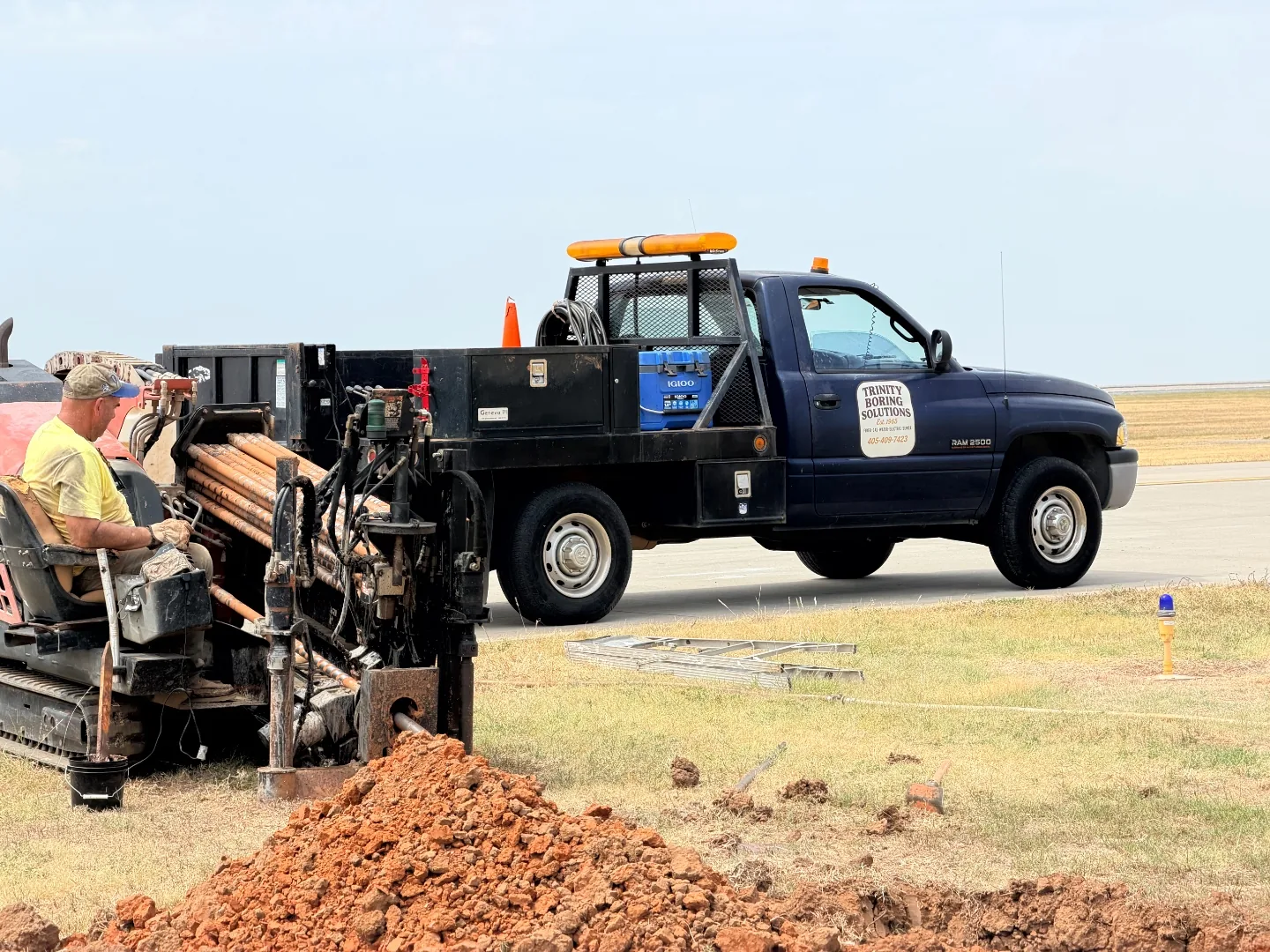
Directional boring is a way to install pipe or conduit underground without digging a trench. A steerable drill head bores a pilot hole along a planned path, the hole is enlarged with a reamer if the pipe needs it, and the new pipe is pulled back through the hole. Done right, the only disturbance is a small entry and exit point and the yard, driveway, parking lot, or road above stays intact.
Trinity Boring Solutions has been doing this since 1965. Our founder started the company after years in the irrigation business because he got tired of cutting driveways to put sleeves under them, and the next generation grew up on these jobs. We have bored 4 feet under a sidewalk and roughly 4,100 feet under the Arkansas River. We have not had a utility strike in over 25 years. This post is what we tell customers on the phone, written down once so you can find it. If you want the quick version of the process, start with our how directional boring works page. If you want the stuff nobody else tells you, keep reading.
Key takeaways
- The paint on the ground from 811 tells you where a line is, not how deep. We hydrovac every crossing before the drill touches dirt.
- Ground east of I-35 is hard. Ground west of it is mostly good drilling. Guessing wrong is the most expensive mistake on a bore.
- Soil, depth, utility crossings, permits, and pipe size set the price, in that order. Footage gives a general range. Every job is quoted on its own conditions, which the cost page explains.
- Pipe 2 inches and under can usually be pulled straight behind the pilot hole. Anything bigger gets reamed first. Skipping that step is how pipe gets broken.
- Trenching wins in open fields with no utilities. Boring wins under concrete, under roads, through rock, across creeks, and anywhere existing utilities have to be crossed.
What happens on a typical directional bore, step by step
Here is what a customer sees on a normal 200 foot electric conduit bore.
- Site walk. We walk the route with you and point out every utility we will have to cross and where lines tie into the building.
- Locates. We call in our own OKIE811 ticket so the ticket references the boring contractor and the actual bore path. Oklahoma law requires at least 48 hours notice, excluding the day of the call, weekends, and holidays, and the ticket expires 14 calendar days after the start date (OKIE811). We explain what each paint color means when the marks show up.
- Potholing. Our hydrovac exposes every critical crossing so we can see the actual depth and decide whether to go over or under it. More on why this matters below.
- Crew arrives on the date we gave you. Always with the hydrovac and the drill. We pick the rig for the job: the bigger machine for long shots and heavy pullback, the smaller one for yards where maneuverability matters and we want to leave less of a footprint.
- Pilot bore. Three people. The operator runs the rig, the locator walks directly over the drill head the whole way, and a third person preps conduit, pull heads, and fluid. We paint each rod as it goes in so we know exact depth at every point, and we keep a bore log you can have on request.
- Ream if needed. For larger pipe we swap the drill head for a reamer and enlarge the hole in one or more passes.
- Pullback. Shackles and a swivel go on, and the pipe comes off the reel trailer and back through the hole.
- Walkthrough and cleanup. Both ends land where they are supposed to. You look at it, we clean up, you sign off.
Most bores up to about 200 feet are a one day job. A 500 foot shot with larger pipe is usually two days: pilot and ream on day one, pullback on day two. The single biggest variable in how long we are on site is not footage. It is how many utilities we have to expose first. We have a separate page on how long directional boring takes.
How does the locator actually steer a bore underground?
This is the part people find hardest to picture, so here is how it works on our crew.
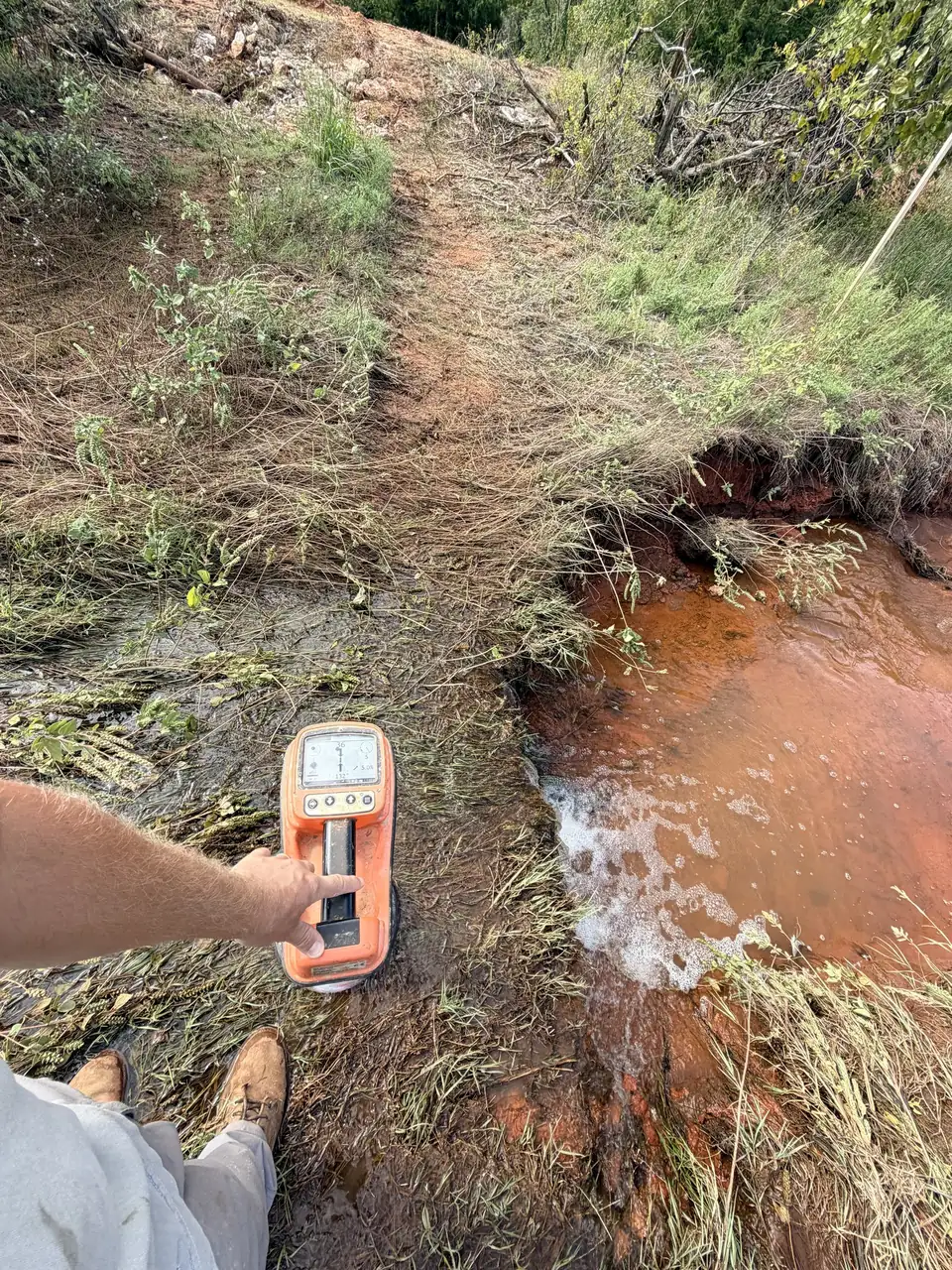
Inside the drill head is a transmitter, called a sonde, that sends depth, pitch, and roll to the locator’s receiver and to the operator’s display on the rig. Before we start, we calibrate the sonde at a measured distance (we use 120 inches, 10 feet) so the depth readings are right.
The drill head has a slanted face. When you rotate the rod string, it bores straight. When you stop rotating and push, the slant steers it. The locator reads the roll position like a clock face:
- 12 o’clock steers up
- 3 o’clock steers right
- 6 o’clock steers down
- 9 o’clock steers left
- 2 o’clock steers up and to the right, and so on
Pitch is read as a percent grade. The math is simple and it matters. Each drill rod is 10 feet long. At 5 percent pitch, one rod changes depth by 6 inches. At 4 percent, 4.8 inches. At 3 percent, 3.6 inches. If a water line is at 50 inches and we need to pass under it with 12 inches of clearance, the locator knows how many rods back we have to start pitching down. On a sewer bore we hold a steady negative grade the entire way because a belly or a hump in a gravity line is a callback.
One more thing the locator has to account for: the finished hole is bigger than the pilot. If we are going to ream to 8 inches, the clearance we need past a utility is measured from the reamer, not the 4.5 inch pilot bit.
How accurate is it? We have popped up inside a hospital where we were told to, and we have hit exit targets the size of a shovel blade. A good locator who is on top of the head the whole time is the difference between a bore that lands and a bore that does not.
Pilot hole, reaming, and pullback: when do you need a reamer?
Our pilot bit cuts a hole about 4.5 to 5 inches in diameter. If the pipe going in is 2 inches or smaller (2 inch, 1.5 inch, 1 inch, 3/4 inch) we usually pull it straight behind the pilot. That is a “punch and pull.”
At 2.5 inch, 3 inch, 4 inch and up, we put a reamer on and enlarge the hole before pullback. Bigger pipe means more reaming passes. On the Arkansas River crossing we pulled 48 inch pipe, which meant a pilot and then pass after pass with progressively larger reamers, pumping fluid the entire time to keep the hole open.
There is one exception to the 2 inch rule. On long shots in sand, even a 2 inch pipe gets a reamer and a polymer rich fluid, because a sandy hole will collapse on a 400 foot pullback and you will tear the pipe.
Here is how to judge a boring crew from the outside: look at the pipe when it comes out of the exit pit. Clean, undamaged pipe means the hole was made right. Scarred, stretched, or broken pipe means somebody skipped a ream pass or ran the wrong fluid. We know because we made those mistakes ourselves decades ago, including losing a drill head under a road by taking too steep a pitch. The pipe and the rods both have limits, and you learn them.
What is drilling mud and why does it matter to the customer?
Drilling fluid is mostly water. The industry rule of thumb is that water makes up about 97 percent of the mix, with additives making up the rest (Trenchless Technology). Those additives do the real work:
- Soda ash goes in first to bring the water to a pH of about 8 to 9 so everything else hydrates properly. Vermeer recommends soda ash for exactly that reason (Vermeer), and typical dosing is a quarter to a half pound per 100 gallons of water (The Driller).
- Bentonite is the base of almost every mix. It builds viscosity to carry cuttings out of the hole and forms a filter cake on the bore wall so fluid stays in the hole instead of soaking into the ground (Vermeer).
- PAC polymer is added in sand and loose ground for extra fluid loss control, so the hole does not oversaturate and collapse (Vermeer).
- PHPA polymer is for reactive clay and shale. It coats the clay so it cannot swell and ball up on the tooling (Vermeer).
- Detergent or soap is sometimes added in sticky clay to keep it from packing on the reamer (Dig Different).
Mixing order matters: water, soda ash, bentonite, dry polymers, then liquid additives (Trenchless Technology).
Why should a customer care? Because the fluid is what keeps the hole open while we pull your pipe through it, and it is what keeps the ground above the bore from settling later. Sandy ground takes two to three times the fluid volume of the soil removed, and reactive clay can take four to five times (The Driller). A crew that runs plain water to save money is the crew whose bores sink the driveway a year later. We also have a short post on whether directional boring uses water.
Oklahoma and North Texas ground: what we actually hit
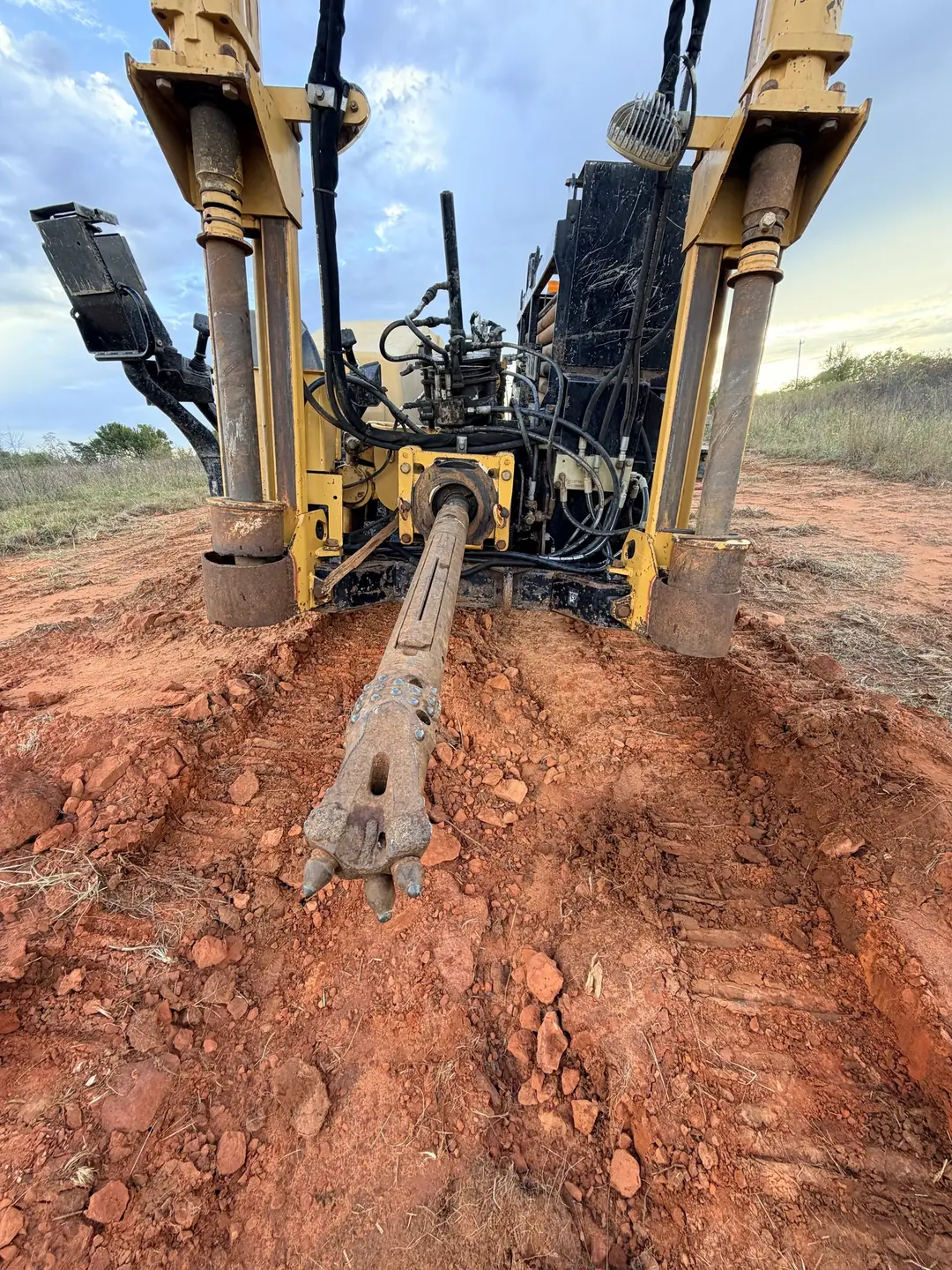
Customers tell us “it’s good drilling dirt” all the time. They are describing the top 12 inches. Utilities go in at 18, 36, 48 inches, and sometimes 6 to 10 feet. The ground down there is a different conversation.
From our jobs:
- Oklahoma City and west: mostly soft, good drilling soil. This is where bores go fast.
- East of I-35, especially north Edmond: hard ground and sandstone. Rock tooling is common here.
- Norman: hit or miss. Soft pockets and hard pockets on the same street.
- Tulsa and eastern Oklahoma: the hardest rock we have ever drilled was in northeast Tulsa.
- Lawton and Altus: the Wichita Mountains change everything. Expect harder ground.
For any larger job, get a geotechnical boring along the route. It costs a little up front and it is the only way to bid rock honestly instead of guessing. We cover the soil side in more depth on our directional boring depth and Oklahoma clay page.
How does rock change a directional bore?
Rock changes the machine, the tooling, the fluid, the speed, and the price.
Our Guthrie sandstone job is a good example. It was a 380 foot shot. In dirt, our Ditch Witch handles 380 feet without a second thought. In sandstone we had to bring the Vermeer D24x40 instead, run a rock head, and bring a larger pump so we could push more water and bentonite to flush the cuttings. The D24x40 S3 is rated at 28,000 pounds of thrust and pullback with 4,200 foot pounds of rotational torque (Vermeer), and in rock you use all of it.
Steering is harder in rock too. Getting the head to pitch down is slow, and getting it to climb back up at the exit is slower. Everything on the rig runs hotter and at higher pressure. Between tooling wear, extra fluid, and time, a rock bore costs well above a dirt bore of the same length, which is why we price rock once we know what we are drilling through. If you are in rock country, read our page on directional boring in rocky and hard soil before you get a quote.
Does weather matter for directional boring in Oklahoma?
Yes, in both directions.
Below freezing: boring is a water based process. Mud pumps, hydrovac tanks, and hoses freeze. On a standard residential job we pause when it drops below 32 degrees. For high priority commercial work we can bring heaters and winterize the equipment daily, but that is extra cost and we tell you up front.
After heavy rain: saturated ground actually drills easier than hardpan, but it ruts. We bring plywood or mats to protect turf and we spend more time on cleanup.
Summer hardpan: slower drilling, but fluid helps. Not usually a schedule problem.
High water table: if a pit hits water we run high capacity dewatering pumps continuously for the duration. That is an added line on the quote, and it is why bore pits near lakes and low ground cost more than the same pit on a hill.
How deep do you bore for electric, water, gas, fiber, and sewer?
We follow whichever is deepest: the engineer’s plans, the utility owner’s standard, the city, ODOT, or the code. For reference, here are the published minimums that come up most often in our work:
| Utility | Common minimum cover | Source |
|---|---|---|
| Electric in PVC conduit, general | 18 inches | NEC Table 300.5 (NFPA) |
| Electric under streets, driveways, parking lots | 24 inches | NEC Table 300.5 (NFPA) |
| Gas distribution main | 24 inches | 49 CFR 192.327 (eCFR) |
| Gas transmission line, Class 2 to 4 locations | 36 inches | 49 CFR 192.327 (eCFR) |
| Public water main, Oklahoma DEQ | 30 inches | OAC 252:626 (Oklahoma DEQ) |
| Water main in Oklahoma City residential areas | 4 feet | OKC Design Requirements Manual (City of OKC) |
| Residential exterior water service, OKC | 24 inches | OKC amendments to the IRC (City of OKC) |
| Utilities crossing ODOT highways, top of casing | 60 inches below pavement, 30 inches below ditch bottom | ODOT Form M-4-a (ODOT) |
| Electric crossing ODOT highways | 48 inches below ditch flow line, in conduit | ODOT Form M-4-a (ODOT) |
Those are floors, not targets. Under pavement we go deeper than the minimum because shallow bores crack concrete. A common design rule of thumb is one foot of depth for every inch of pipe diameter (Iowa SUDAS). When we have to pass under a house or a building, we go as deep as 15 to 20 feet to clear everything, or we recommend routing around it.
What pipe can be installed by directional boring?
HDPE is what we pull most, and it is what the method was built for. It is fused into one continuous piece with no joints to pull apart, and it flexes around the bore path. We also install restrained joint PVC, steel casing, and other materials when plans call for them.
When casing is required. Water and sewer lines under city streets get a casing so a future leak cannot wash out the roadbed. Oklahoma City requires steel encasement for pipe crossings and does not allow HDD at all for public wastewater mains or services (City of OKC). ODOT requires encased crossings to run right of way line to right of way line, sealed and vented (ODOT). We also recommend a sleeve for irrigation lines under driveways. If that line ever leaks, the water runs out the end of the sleeve instead of undermining your slab. See our jack and bore steel casing page for how casings get installed.
How far can one directional bore go?
Farther than most people need. The practical limits are:
- Rod capacity and pullback. Our Vermeer D24x40 runs 10 foot rods with a 108 foot minimum bend radius and 28,000 pounds of pullback (Vermeer). The Series II version carries 500 feet of rod on board (Vermeer spec via Interempresas). Our Ditch Witch JT20 runs 17,000 pounds of thrust and 20,000 pounds of pullback with 2,200 foot pounds of torque on 10 foot rods (Ditch Witch), typically with a 400 foot pipe basket. More rod can be staged for longer shots.
- Fluid returns. The longer the bore, the harder it is to keep cuttings moving back to the entry. That is where soil type and mud program decide the outcome.
- Locating depth. Walkover locating has practical depth limits. Deep river crossings use wireline guidance instead.
- Pipe strength. The pipe itself has a maximum pull load. Bigger, longer, and in sand all push toward more reaming and better fluid.
- Setback room. A bore has to get to depth gradually. Compact rigs enter the ground at a shallow angle and the rods can only bend so far, so the deeper you need to be at the curb, the farther back the rig has to sit. If you need to be 10 feet deep at the street, we need real room behind it. Our space requirements page has the numbers.
In suitable ground, a crew can install up to about 180 meters, roughly 600 feet, in a workday (NYSDOT). Our Arkansas River crossing at roughly 4,100 feet and the Fort Cobb lake intake, where we bored out into the middle of the lake and sent divers down to change the reamer, were planned over months, not scheduled over the phone. We wrote about the longest bores on record in our longest directional bore post.
When should you NOT use directional boring?
We turn down bores, and we tell people when trenching is the right call. HDD is a poor fit when:
- The pipe is a gravity sewer with a tight grade and no margin. HDD can hold grade with a good locator, but engineering guides warn it is not the right tool where a high degree of grade accuracy is required (Iowa SUDAS). Oklahoma City prohibits it for public wastewater (City of OKC).
- The ground is cobbles, boulders, or heavy gravel. Loose gravel over about 3 inches cannot be carried out by the fluid and deflects the head. Caltrans lists soil with more than 50 percent gravel or rock larger than 3 inches as unsuitable for HDD (Caltrans).
- There is no room to set up. Every bore needs setback behind the entry and room to lay out the pipe string.
- Cover is too shallow. Shallow bores under pavement crack it and frac out.
- It is a long open field run with nothing to cross. Trenching is cheaper and faster there. More on that next.
Directional boring vs trenching: which one wins?
| Situation | Our call | Why |
|---|---|---|
| Hundreds of feet across an open field, no utilities, good dirt | Trench | Faster and cheaper per foot |
| Irrigation system install | Trench | You are opening the ground for heads and valve boxes anyway |
| Under a driveway, sidewalk, or parking lot | Bore | No cutting, no patching, no three week cure |
| Under a road or highway | Bore | Traffic keeps moving, no lane closures |
| Crossing existing utilities | Bore | We steer over and under what we have potholed |
| Rock | Bore with rock tooling | A trencher in sandstone is slower and leaves a scar |
| Creek or pond crossing | Bore | No dewatering the channel, no bank disturbance |
| Inside or under a building | Bore | We can land under a footing at an exact spot |
The honest version: trenching is the right answer for lots of footage with nothing in the way. Boring is the right answer any time there is something on top of the ground or in it that you do not want to disturb. We break down the economics on directional boring vs trenching and bore vs open trench cost.
Directional boring vs jack and bore: which do road crossings call for?
These are apples and oranges. Jack and bore (auger boring) digs a pit to the exact depth, sets the machine on rails, and augers straight across at zero grade while welding steel casing behind the auger. It cannot steer, but it holds a dead flat line from a pit right at the edge of the road. HDD steers, needs setback room to reach depth and flatten out, and can also pull steel casing if the plans call for it.
Most ODOT and city crossing plans we see specify auger bore with steel casing. Some specify HDD. Often it is just what the agency prefers. We do both, and we explain the tradeoffs on jack and bore vs directional drilling.
To us, a “road bore” is anything under pavement that vehicles use, including parking lots. Cities differ on what they require. Oklahoma City requires the contractor to be prequalified, submit a site plan showing alignment and depth, pothole and protect all public and private utilities, and keep all traffic lanes open from 7 to 9 a.m. and 4 to 6 p.m. (City of OKC). We have been through the city’s bore and paving contractor class so we know what the inspector expects before we show up.
Can you bore under a highway, railroad, creek, pool, or house?
Yes to all of them. The difference is who has to approve it.
- State highways. ODOT issues utility permits through its online portal using Forms M-4 and M-4-a (ODOT). Crossings under the roadway must be bored, and drilling fluid is only allowed if the bore is at least 6 feet below the top of pavement (ODOT). The Turnpike Authority has its own license and wants pipe at least 48 inches below subgrade (OTA).
- Railroads. BNSF requires a utility license agreement, applications through its rail permitting site, a $2,000 application fee, contractor safety training, and a flagger when working within 25 feet of track. HDD crossings must be at least 12 feet below base of rail, pits must sit at least 30 feet from track centerline, and the head must run at zero or negative grade for the 25 feet on either side of the track (BNSF). Plans need a professional engineer’s seal in several cases (BNSF Utility Accommodation Policy). See our railroad boring page.
- Creeks, rivers, and lakes. Crossings of waters of the United States fall under Corps of Engineers nationwide permits: NWP 12 for oil and gas, NWP 57 for electric and telecom, NWP 58 for water and other substances (USACE). Many districts require a frac out contingency plan with the notification. Gas pipe under a navigable waterway needs 48 inches of cover in soil (eCFR). Our highway and river crossing page covers this work.
- Pools and houses. No agency permit for the bore itself in most cases, but this is where unknown private lines live. We go deep, we pothole, and sometimes we recommend going around.
Who pulls the permit depends on the job. We pull road bore permits when we can. Plumbers usually pull meter permits, electricians pull electrical permits, and railroad and turnpike licenses are often handled by the utility owner. Our permits page sorts it out.
Why 811 is not enough, and what hydrovac potholing catches
OKIE811 is a notification center. It does not mark anything. Each utility owner sends its own locator to mark its own lines (OKIE811). That means:
- Private lines are not marked. Anything past the meter is the property owner’s. Gas to a shop or pool heater, propane, irrigation, landscape lighting, the water line from the meter to the house, and the sewer from the house to the main are all private and will not be marked by a member company (OKIE811).
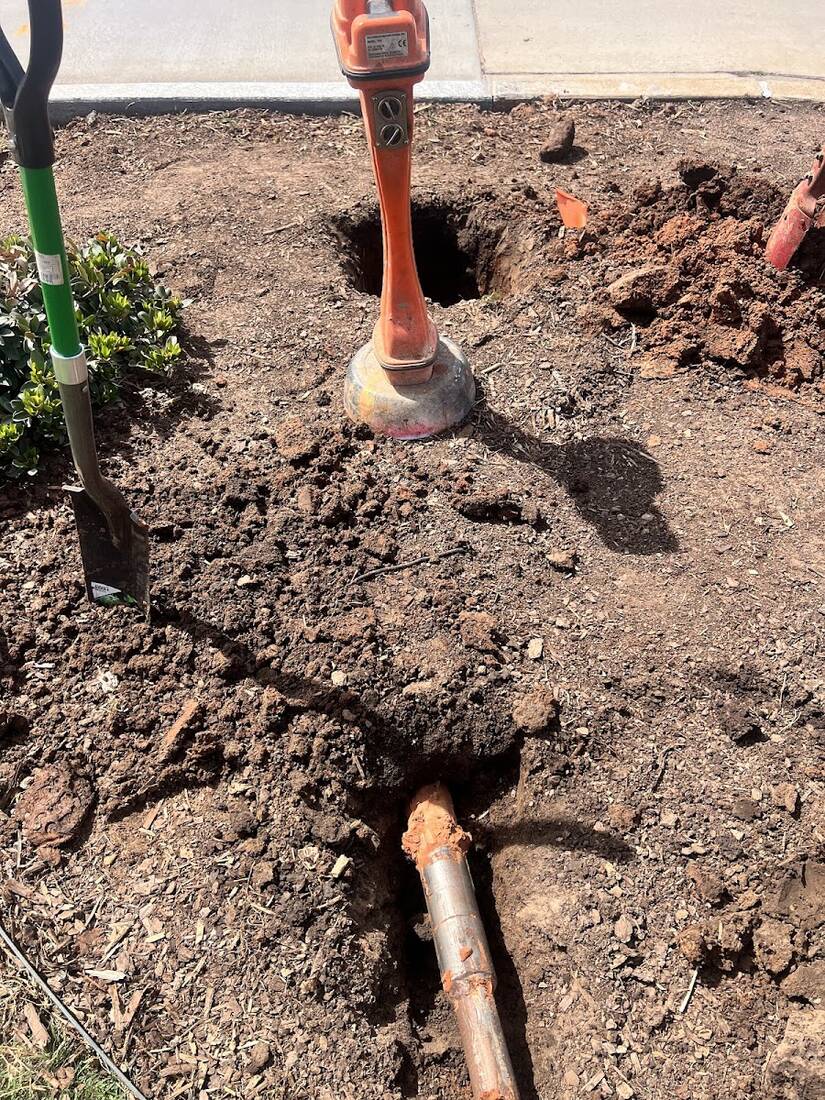
- Paint is horizontal only. The law requires operators to mark the approximate location so the excavator can hand dig to find the exact one (OKIE811). Nobody tells you depth.
- Locators are fast and human. They miss things.
The week we wrote this, we were on an emergency gas line bore at a truck stop in Oklahoma City. We called in locates, then hydrovacked the pit, and found several unmarked lines before the drill touched dirt. That is normal. Light pole circuits, abandoned gas, old electric, old sewer, and irrigation are the usual suspects.
So our rule is: every crossing in the bore path gets exposed with the hydrovac before we drill. We also run our own private locator for lines 811 will not touch, and we ask questions. When was the building built? What used to be here? Who does the maintenance? The groundskeeper knows where the old lines are.
Our contract covers unforeseen, unmarked private utilities so there is no argument after the fact. But the reason we have not had a utility strike in over 25 years is not the contract. It is the hydrovac. Read more on hydrovac daylighting.
What does directional boring cost per foot in Oklahoma?
The honest answer is that footage only gives us a general range. An 8 foot bore under a sidewalk can cost more than a 100 foot bore across an open yard, because locates, potholing, setup, pullback and cleanup cost about the same either way. Our cost page walks through it. Most residential driveway and yard crossings are a one day job. Here is what moves the number, roughly in order:
- Soil and rock. The biggest single factor. A rock bore costs well above the same footage in dirt because of the rig, the tooling, the fluid volume, and the time, so we price it once the ground is known.
- Depth. Deeper bores take longer to reach grade and need more setback room.
- Number of utility crossings we have to pothole before drilling.
- Permits and whatever they require (casing, traffic control, inspection).
- Pipe size. Bigger pipe means reaming passes, more bentonite, more time.
- Footage. Longer bores cost more in total but usually less per foot.
- Who furnishes the pipe. We are happy to supply it, but a Trinity furnished job carries material cost up front.
- Mobilization. Usually the smallest line, unless the job is out of state.
One more thing worth saying plainly. People sometimes ask for a $600 or $800 bore. We understand the instinct, but the insurance, the rigs, the hydrovac, the tooling, and the crew are what make the bore land in the right place without hitting anything. The alternative to boring under a sidewalk is cutting it, trenching it, pouring it back, and waiting three weeks for it to cure. We price on the higher end of fair because we are the crew people call when it has to go right. See cost to bore under a driveway for a typical small job.
How to get an accurate quote fast
Send us:
- The address
- What is being installed and what size pipe or conduit
- Approximate footage and where it starts and ends
- Plans or a sketch if you have them, photos if you do not
- A phone number. We want to talk through it with you.
Quotes get revised after we arrive for two reasons: the footage was not what we were told (50 feet turns out to be 80), or the utilities were not where we were told. If you do not know, say so. We will come look, call locates, and quote it right. More on how to get a directional boring quote.
From yes to pipe in the ground
- We send a contract that spells out scope, inclusions, exclusions, and who is responsible for what. Pipe can be customer furnished or Trinity furnished.
- We call in our own 811 ticket.
- We pull the road bore permit if it is ours to pull, and we coordinate with the plumber, electrician, railroad, or agency if it is theirs.
- We show up on the date we gave you with the drill and the hydrovac.
- You do nothing. You are welcome on site, and we send photos as we go.
- You get pipe in the ground, ready to hook up.
How to spot a bad boring contractor
- Track marks, torn curbs, and trailer scrapes on the way in.
- Cracked pavement over the bore because they went shallow.
- “Just drill it.” No potholing, no questions about what is in the ground.
- A price that is dramatically below everyone else.
- No certificate of insurance, or one that does not name you.
- A yard that looks worse when they leave than when they came.
Our page on how to hire a directional boring contractor goes deeper.
What insurance should a boring contractor carry?
Ask for the certificate before anyone shows up. Ours, as of this writing, shows:
- Commercial general liability: $1,000,000 per occurrence, $4,000,000 aggregate
- Excess liability: $5,000,000 per occurrence and aggregate
- Pollution liability: $1,000,000
- Commercial auto: $1,000,000 combined single limit
- Workers’ compensation: statutory, with $1,000,000 employer’s liability
We issue certificates naming the customer as additional insured with waiver of subrogation when the contract calls for it.
Credentials, and why customers rank us where they do
- An NASTT member with OSHA 30 trained supervision, a written safety and health program, and years of work under ODOT, city, and railroad utility permits.
- Background check ready. Our crews get badged onto secured sites. This year that has included FAA navigational aid conduit under the taxiways at Will Rogers World Airport, hospital campus work, and a current contract for conduit crossings at Naval Air Station Joint Reserve Base Fort Worth. See our military and federal facility page.
- Zero utility strikes in over 25 years. Ask our insurance carrier.
- 5.0 stars across 53 Google reviews, every one of them five stars. One contractor put it this way: “The best directional boring company in the state of Oklahoma hands down. Reliable, efficient, and fair prices.” Another, after an emergency road bore: “Easily the best directional drilling contractor we’ve worked with.” We would rather let customers say it than say it ourselves.
A note on where this trade comes from
Directional boring has Oklahoma roots. The Charles Machine Works in Perry built the first compact service line trencher in 1949 and sold it under the name Ditch Witch, and the same company introduced the first compact horizontal directional drill built for utility work in the late 1980s (Oklahoma Historical Society, Underground Infrastructure). We have been putting pipe in the ground in this state since 1965. The machines got better. The job is the same: know what is down there, make a clean hole, and leave the place better than you found it.

Frequently asked questions
What is directional boring?
Directional boring, also called horizontal directional drilling or HDD, is a trenchless method of installing pipe or conduit underground. A steerable drill head bores a pilot hole along a planned path, the hole is reamed larger if needed, and the pipe is pulled back through it. The surface above stays intact.
How deep is a directional bore?
It depends on the utility and who governs it. Electric conduit is typically 18 to 24 inches minimum under the NEC, gas mains 24 inches under federal rules, Oklahoma water mains at least 30 inches, and ODOT highway crossings 60 inches below pavement. We go deeper than minimums under pavement and as deep as 15 to 20 feet under buildings.
How much does directional boring cost per foot?
We base the price for a bore on a general range that comes from footage and conduit size. Soil and rock, what the bore crosses, grade, existing utilities, depth and access move the job up or down within it.
How long does a directional bore take?
Most bores up to 200 feet are done in one day. A 500 foot bore with larger pipe usually takes two. Exposing utility crossings with the hydrovac takes longer than the drilling itself.
Does 811 mark private lines?
No. OKIE811 member utilities mark only their own lines up to the meter. Irrigation, landscape lighting, gas to outbuildings, and the water and sewer lines on your side of the meter are private and will not be marked. We pothole and use a private locator for those.
Can you bore through rock?
Yes. We change to a rock head, bring the larger Vermeer rig and a bigger pump, and run more fluid. It is slower and harder on tooling, so rock is priced once we know the ground, not off a dirt rate.
Can you bore under a road or highway?
Yes. City streets require a bore permit from the city and usually a prequalified contractor. State highways require an ODOT utility permit. Many crossings call for steel casing.
Directional boring or trenching, which is cheaper?
Trenching is cheaper for long runs across open ground with nothing to cross. Boring is cheaper once you count concrete removal, patching, traffic control, and landscape repair for anything under pavement or across existing utilities.
What size pipe can be installed by directional boring?
From 3/4 inch service lines up to very large diameters. We have pulled 48 inch pipe under the Arkansas River. Pipe 2 inches and under usually pulls straight behind the pilot; larger pipe gets reamed first.
What is a frac out?
A frac out is drilling fluid finding a path to the surface through a crack or loose soil. It is most common in the first and last stretch of a bore where cover is shallow (NJ DRBC filing). We watch fluid returns constantly and keep the hydrovac on site to clean one up if it happens.
Who is responsible if an unmarked private line is hit?
Our contract addresses unforeseen, unmarked private utilities before work starts. In practice we pothole every known crossing and run a private locator so it rarely comes up.
Ready to talk through your bore?
Call (405) 409-7423 or request a quote. Send the address, what is going in, rough footage, and a phone number, and we will give you a real price. Serving Oklahoma City, Tulsa, Norman, Guthrie, and the Dallas Fort Worth area.
About Trinity Boring Solutions. Trinity Boring Solutions, Inc. is a family owned directional boring, auger boring, and hydrovac contractor based in Yukon, Oklahoma, founded in 1965. Our crews work across Oklahoma, Texas, and beyond on utility, municipal, telecom, railroad, airport, and federal projects, including river, lake, highway, and hospital campus crossings. More about Trinity.
Talk to the crew that does the work
Fastest way to a number is a phone call. Tell us where the crossing is and what is going in the ground, and you will get a straight answer on the same call. Bores from 10 feet to 5,000 feet, 3/4 inch service line through 48 inch casing, anywhere in Oklahoma and Texas. We run 24/7 for main breaks and emergency repairs.
Answered by a person, not a call center.
Would rather not call? Send the details and we will come back with a written quote.
Latest from the crew
More field reports and guides from Trinity Boring Solutions.
- Case Study: Emergency Gas Line Bore at the TA Truck Stop on Council Road and I 40 in Oklahoma City
- Storm Drain Replacement in Moore: What the $18 Million Bond Vote Means for Utility Lines
- Data Center Site Utilities in Oklahoma: What Goes Underground Before the Servers Arrive
- Trenchless Culvert Installation After Oklahoma’s October 2026 Road Washouts
- Case Study: 6 Inch PVC Sleeve Bored Under NE 24th Street and a Water Main in Oklahoma City
- Case Study: 385 Foot Sandstone Rock Bore Under Creeks, Wetland and a Dam in Guthrie, OK