
Arlington Texas Directional Boring: Every Concrete Street and Driveway Is a Bore
Quick Answer: Trinity Boring Solutions takes directional boring and horizontal directional drilling (HDD) jobs in Arlington, Texas, between Fort Worth and Dallas in Tarrant County. Arlington does not leave boring up to the contractor. Its right of way rules say all concrete driveways and streets shall be bored, not open cut. The bore runs at least 48 inches under the street, the pits stay 5 feet back from the road, and every utility in the way is exposed by vacuum excavation. The rock under the city is the Woodbine, soft sandstone and clay with hard iron layers in it. Trinity serves Oklahoma and Texas with Vermeer and Ditch Witch rigs it owns. Arlington work is run from our main yard in Yukon, Oklahoma and from a satellite yard to the east in Dallas, run by a partner drilling contractor Trinity has personally vetted.
Arlington, Texas bores at a glance
- City and county: Arlington, Texas, in Tarrant County. Population 402,134 in the 2025 Census estimate.
- City rule: facilities under concrete driveways and streets are installed by boring, not open cut
- Depth: at least 48 inches below the street
- Pits: at least 5 feet from the roadway, and no jetting equipment
- New asphalt: no pavement cuts for 60 months after a street is built, rebuilt or resurfaced
- Finding lines: vacuum excavation, plus a second locate request to the city for its own lines
- Ground: Woodbine sandstone and clay under most of the city, black clay over shale to the southeast
- Texas811: Trinity files the ticket at least 48 hours before digging, weekends and holidays aside
- State roads: TxDOT Fort Worth District
- Phone answered 24 hours a day: (405) 409-7423
Does Arlington require boring under streets and driveways?
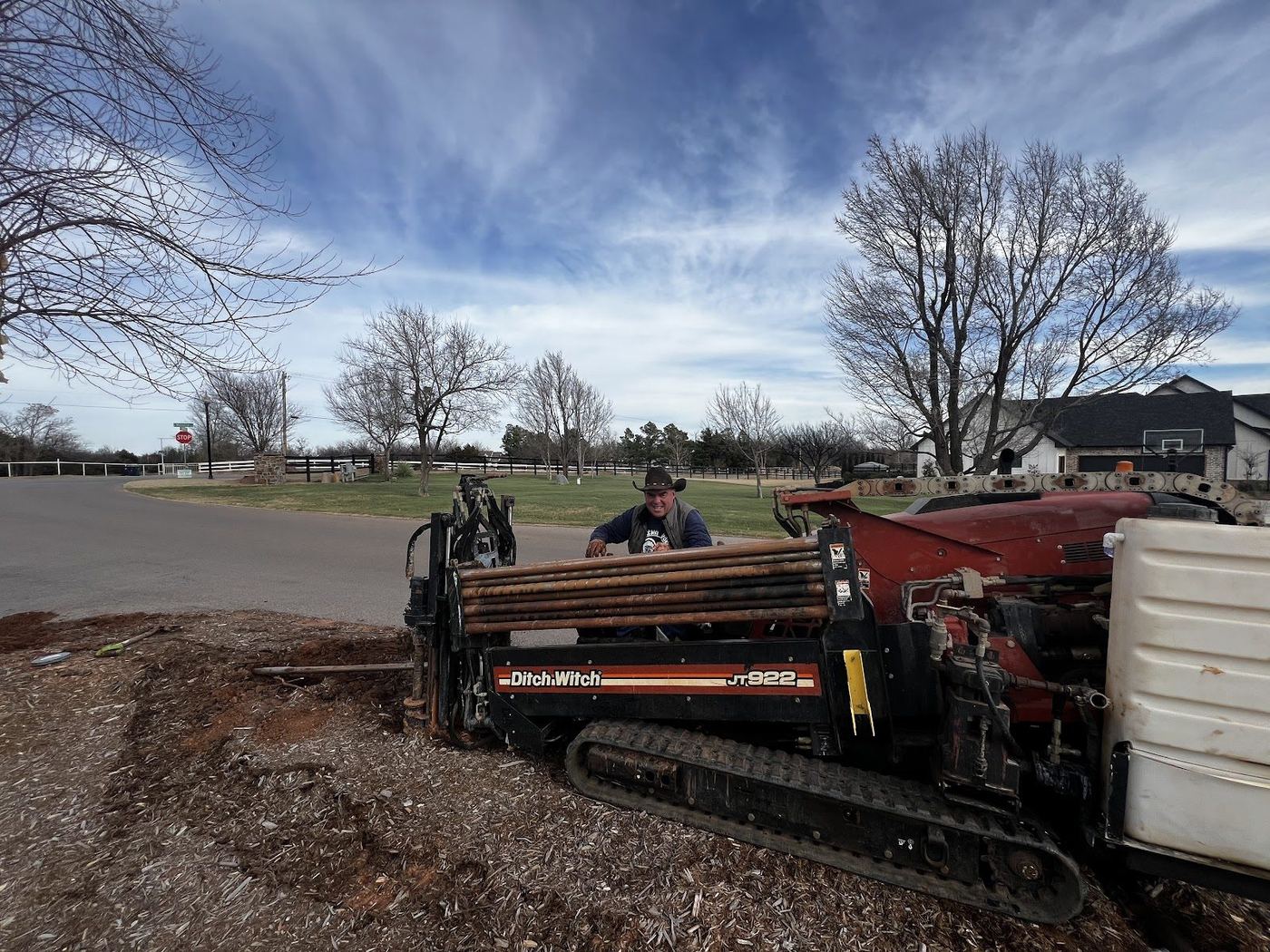
Arlington requires boring under every concrete street and concrete driveway. The Right of Way Management chapter of the city code says all concrete driveways and streets shall be bored rather than open cut (Arlington Right of Way Management ordinance). The city construction manual repeats it and adds a detail most cities leave out: the bore has to be long enough for the street the city plans to have, not only the one that is there today (Arlington Right of Way Permitting and Construction Manual).
That means checking the Thoroughfare Development Plan before the footage is set. If a two lane road is planned as a four lane road, the bore is drawn for the full planned width unless the right of way to do it is not there. A crossing measured off the existing curbs can come up short.
Asphalt streets get a different kind of protection. After an asphalt street is newly built, rebuilt or resurfaced with more than an inch of new surface, the city allows no pavement cuts in it for 60 months. For five years a bore is the only way across.
What numbers does a bore have to hit in Arlington?
A bore in Arlington has to run at least 48 inches below the street, with its pits at least 5 feet from the roadway. The city manual is specific, and this is the short list we lay a job out from.
| Item | What Arlington asks for |
|---|---|
| Depth of the bore | At least 48 inches below the street |
| Bore pits | At least 5 feet from the roadway, and deep enough to hold the 48 inches |
| Equipment | Jetting type boring equipment is not allowed |
| Crossing or running beside a city utility | Plans show at least 3 feet of horizontal and 2 feet of vertical separation |
| Conduits near city facilities | At least 2 feet below or above them |
| Work hours | Monday to Friday, 7:00 in the morning to 5:00 in the evening, unless the city approves other hours in writing |
| Rush hour on thoroughfare streets | No interference with traffic from 7 to 9 in the morning or 4 to 6 in the evening |
The rush hour rule takes four hours out of a ten hour window on the busy streets. A crossing on one of those streets is set up so the rig, the pits and the trucks are off the lanes during those hours, or the work is planned for the six hours in between.
Why does Arlington need two locate requests?
Arlington needs two locate requests because the city marks its own lines and is not reached through the Texas811 ticket. The manual has Texas811 cover the other utility owners. City water, sewer, streetlights, traffic signals, communication lines and median irrigation are requested separately through the Ask Arlington app or the city website, at least two working days ahead.
The state side is ours. Trinity files the Texas811 ticket for the bore, and it works the way it does everywhere in Texas. The request goes in no later than 48 hours before the digging starts and no earlier than 14 days before, with Saturdays, Sundays and legal holidays left out of the count (Texas Utilities Code, Chapter 251). Arlington adds its own timing on top: the permit guide wants locates requested within two weeks of the start, and the permit applied for at least five days before it (Arlington dry utility permit guide).
Miss the city request and a traffic signal cable or a median irrigation line can go unmarked, right where a street crossing comes up.
How are the lines exposed before the drill passes?
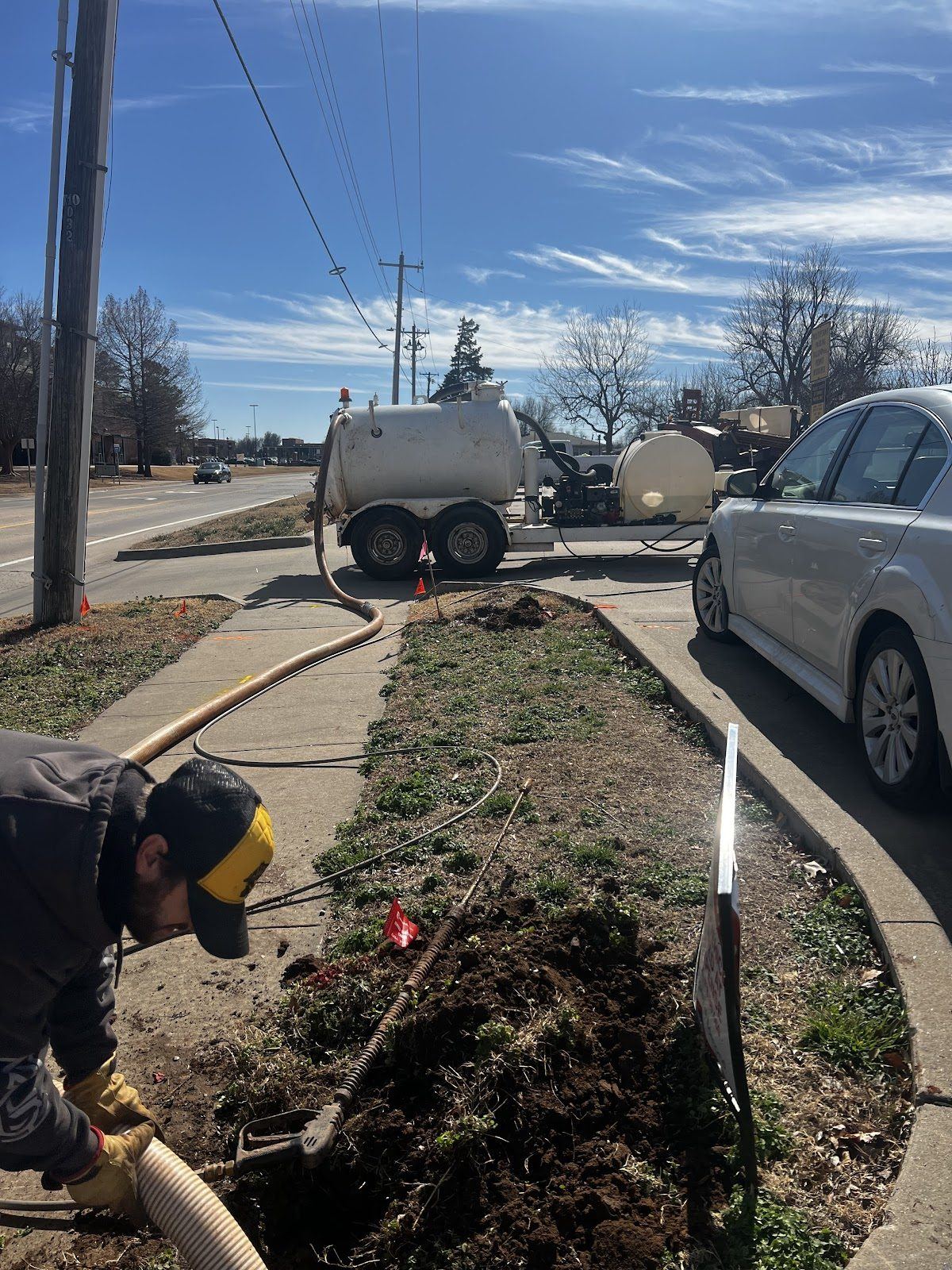
In Arlington the lines in the path are exposed by vacuum excavation before the drill passes. The city manual says all utilities are to be excavated for depth verification by vacuum excavation unless the city permits another way. Hand digging with a shovel is not the default here.
That suits how we work. Trinity runs its own hydrovac, and exposing each line the bore crosses is part of our price on every job. In Arlington it is also how the 2 feet of vertical separation from a city main gets proven, because the measurement is taken from a pipe you can see.
What ground will a bore hit in Arlington?
Under Arlington the drill meets sandstone and clay in layers, and the city gave its name to one of them. Geologists at Southern Methodist University mapped the Arlington area and found the rock under it belongs to two formations, the Woodbine and the Eagle Ford (SMU: Stratigraphy of the Woodbine Formation in the Arlington Area).
- The Woodbine. About 250 feet thick here and at the surface in many places. From the bottom up it is a basal clay, a lower sandstone about 87 feet thick, an upper clay about 105 feet thick and an upper sandstone. Sand and clay take turns, so a bore can pass from one to the other.
- The Arlington Member. The top of the Woodbine is named for a road cut in the 2000 block of West Park Row. The U.S. Geological Survey lists it as tan to reddish brown sandstone, fine grained and crumbly, held together by iron cement, with thin clay partings (U.S. Geological Survey Geolex).
- The Eagle Ford. Mostly shale that weathers easily, so it is nearly everywhere hidden under soil. That soil is the dark clay of the Blackland Prairie, which the Handbook of Texas places in the southeast part of Tarrant County (Handbook of Texas: Tarrant County).
- Creek and river bottoms. Along the Trinity River, Johnson Creek and Village Creek the rock is covered by floodplain and terrace deposits.
For a driller the Woodbine is mostly kind. Crumbly sandstone cuts fast. The iron is the catch. Where iron has cemented the sand into a hard band, a drill head that was moving easily slows down and wants to ride along the band instead of through it. That is the reason to bring rock tooling to Arlington, even on a job that looks like a sand bore.
The surface matches the rock. The sandy strip through eastern Tarrant County is the Eastern Cross Timbers, a narrow belt of deep loamy soil and post oak that separates the black prairie on the east from the Grand Prairie on the west (Handbook of Texas: Cross Timbers). In the black clay the fluid is mixed to keep the cuttings from sticking. In the sand it is mixed to hold the hole open.
Where in Arlington do we bore?
Trinity takes bores across Arlington: downtown and the University of Texas at Arlington, the Entertainment District around AT&T Stadium and Globe Life Field, the industrial ground near the General Motors assembly plant, north Arlington toward the Trinity River and south Arlington toward Mansfield. Next door we take calls from Grand Prairie, Mansfield, Kennedale, Pantego and Dalworthington Gardens.
As a boring contractor in Arlington we put in water lines, sewer lines, gas lines, electric conduit and fiber conduit. A parking lot, a sidewalk or a creek channel gets the same treatment as a street: a pit on each side and nothing cut in between.
Arlington sits about 12 miles east of downtown Fort Worth and 20 miles west of downtown Dallas (Wikipedia: Arlington, Texas), so a lot of Arlington jobs are part of a bigger run of work. Our Fort Worth and Dallas pages cover those cities, and the Tarrant County page covers the county.
Who gets the Arlington permit?
The Arlington permit goes to the owner of the line, not to the driller. Arlington uses the term Public Service Provider for the company whose facilities are going in. The provider registers with the city, and the provider or its authorized representative obtains the permit. The provider, the prime contractor and every subcontractor also need a business registration with the city, and that includes the boring contractor.
Trinity does not include permits in its quotes. We give the provider what the application needs to say about the bore, and the provider or the prime carries the permit. The city Real Estate Services office runs right of way permitting (Arlington Real Estate Services).
What about Interstate 20, Interstate 30 and State Highway 360?
Interstate 20, Interstate 30, State Highway 360 and US 287 in Arlington belong to the state, so a crossing under them takes a TxDOT permit. Tarrant County is in the TxDOT Fort Worth District with Erath, Hood, Jack, Johnson, Palo Pinto, Parker, Somervell and Wise counties (TxDOT districts).
The state rule has utilities under an existing highway put in by boring or tunneling, with the crossing encased the way the rule lays out (43 Texas Administrative Code 21.40). The permit is requested through the TxDOT online system (TxDOT utility installation permits). If the job touches both a state road and a city street, Arlington wants the approved TxDOT permit attached to the city application. Some surface streets carry state route numbers too, so we check who maintains the road before a permit is drawn up.
What goes into the price of an Arlington bore?
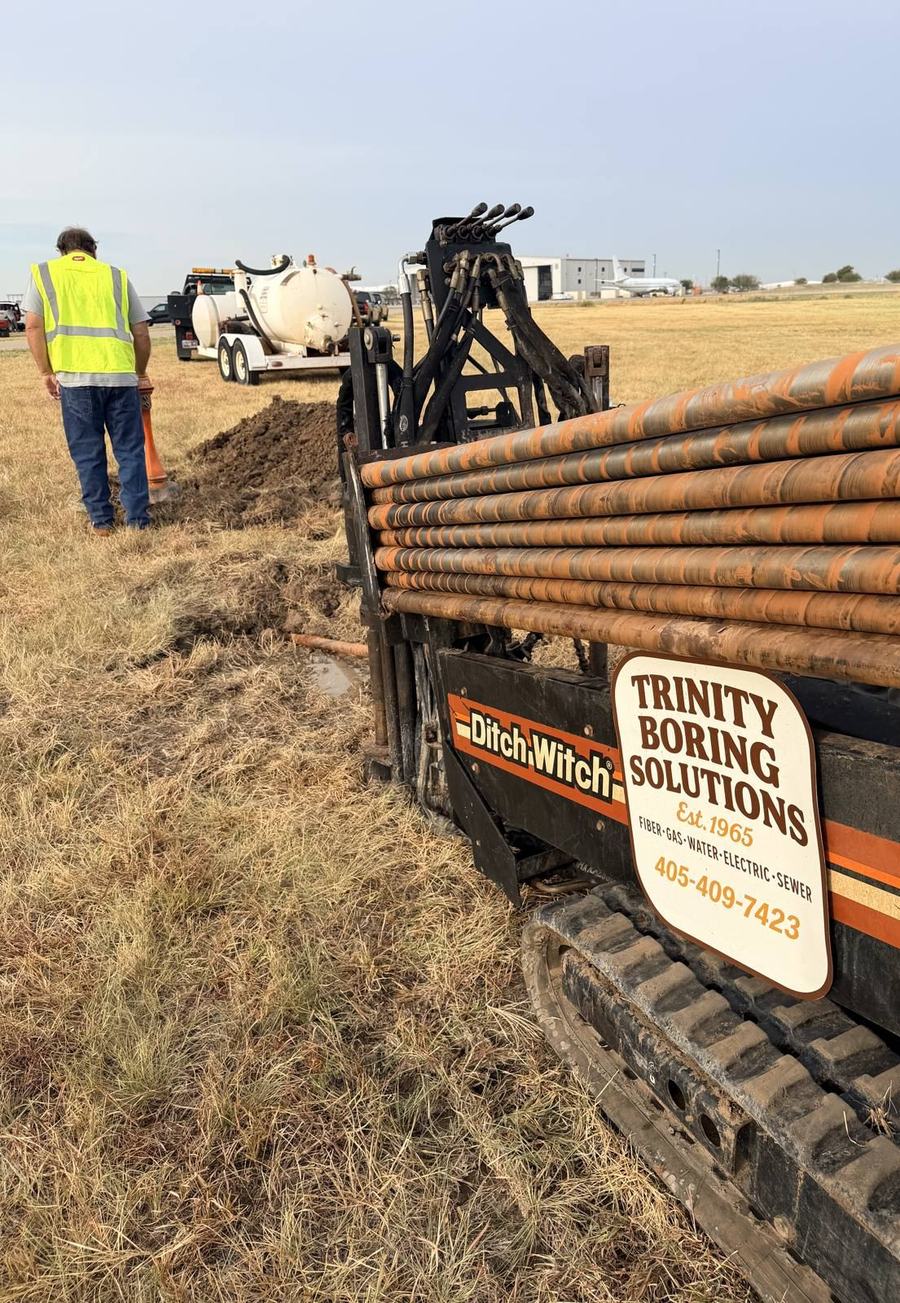
The length and the conduit size tell us roughly where an Arlington bore will fall. That gives a general range. The number inside that range is set by what the bore has to deal with:
| What we look at | Why it matters in Arlington |
|---|---|
| Soil | Loose sand, sticky black clay or an iron cemented band each drill at a different pace |
| Length | The city wants the bore sized for the planned street width, which can be longer than the street you see |
| Utilities to cross | Each one is exposed by vacuum, and the city has its own lines on top of the Texas811 ones |
| Concrete | If a pit has to go through a concrete drive or walk, we cut it out and haul it off |
| Creeks | A pass under Johnson Creek or a drainage channel runs deeper and longer |
| Pits | Deep pits may call for an excavator and sand backfill |
| Kind of job | Routine, high profile such as the stadium district, or an emergency |
Then you get one price for the whole job. The hydrovac work on crossed utilities is in it. Permits are not, and neither is pouring back concrete we remove.
Arlington boring questions, answered
Does Trinity Boring Solutions do directional boring in Arlington, TX?
Yes. Trinity takes directional boring and horizontal directional drilling (HDD) jobs in Arlington and across Tarrant County. Trinity serves Oklahoma and Texas. Its crews work out of Yukon, Oklahoma and out of a Dallas satellite yard run by a partner drilling contractor Trinity has personally vetted.
Does Arlington require boring under concrete streets and driveways?
Yes. The Arlington Right of Way Management ordinance says all concrete driveways and streets shall be bored rather than open cut. The bore is sized for the planned full width of the street in the Thoroughfare Development Plan.
How deep does a bore have to be under an Arlington street?
Arlington wants a bore at least 48 inches below the street. Bore pits are kept at least 5 feet from the roadway and dug deep enough to hold that depth.
Can you cut a newly paved street in Arlington?
A newly paved asphalt street in Arlington cannot be cut for 60 months. The city manual allows no pavement cuts in asphalt streets that were newly constructed, reconstructed or resurfaced with more than one inch of asphalt in the last 60 months.
Does Texas811 mark city utilities in Arlington?
No. City water, sewer, streetlights, traffic signals, communication lines and median irrigation are requested separately through the Ask Arlington app or the city website at least two working days ahead. Other utilities are reached through Texas811, and Trinity files that ticket for its bores.
Is vacuum excavation required in Arlington?
Yes. The city manual says all utilities shall be excavated for depth verification by vacuum excavation unless the city permits otherwise.
What rock is under Arlington?
The rock under Arlington is the Woodbine Formation, about 250 feet of sandstone and clay, and the Eagle Ford shale. The top of the Woodbine is called the Arlington Member, a crumbly sandstone with iron cement named for a road cut on West Park Row.
What does directional boring cost in Arlington?
Length and conduit size put a job in a general range. Soil, the planned street width, utility crossings, concrete, creeks, pit work and the kind of job set where it lands. Trinity gives one price for the whole job and does not include permits.
Where the Arlington facts on this page come from
- City of Arlington: Public Right of Way Permitting and Construction Manual, 2026 update
- City of Arlington: Right of Way Management chapter of the city code
- City of Arlington: right of way dry utility permit application guide
- City of Arlington: Real Estate Services
- Southern Methodist University, Field and Laboratory: Stratigraphy of the Woodbine Formation in the Arlington Area
- U.S. Geological Survey Geolex: Arlington Member of the Woodbine Formation
- U.S. Geological Survey: geologic units in Tarrant County
- Texas State Historical Association, Handbook of Texas: Tarrant County
- Texas State Historical Association, Handbook of Texas: Cross Timbers
- Texas Utilities Code, Chapter 251: underground facility damage prevention
- 43 Texas Administrative Code 21.40: underground utilities on state highways
- Texas Department of Transportation: districts and their counties
- Texas Department of Transportation: utility installation permits
- U.S. Census Bureau QuickFacts: Arlington
- Wikipedia: Arlington, Texas
About the author
Darren Rice is the president and owner of Trinity Boring Solutions, a family business in Yukon, Oklahoma that Dean Rice started in 1965. Darren brought directional boring into the company in 1982 and has run bores in sandstone, clay and sand across Oklahoma and Texas since. The city rules on this page come straight from the Arlington manual and ordinance linked above. His number is (405) 409-7423.
Get a Quote for a Bore in Arlington
Send the address, what is going in, the conduit size and the footage, and tell us if the street or drive is concrete.
Trinity Boring Solutions
9102 NW Expressway, Yukon, OK 73099
(405) 409-7423 | darren@trinityboringsolutions.com
Free Bore Planner
Plan Your Bore in Arlington, Texas
Type the address of your job in Arlington. The Bore Planner opens an aerial map at that spot. Drop one pin where the bore starts and one where it ends, tell us what is going in and send the scope to our crew.
Talk to the crew that does the work
Fastest way to a number is a phone call. Tell us where the crossing is and what is going in the ground, and you will get a straight answer on the same call. Bores from 10 feet to 5,000 feet, 3/4 inch service line through 48 inch casing, anywhere in Oklahoma and Texas. We run 24/7 for main breaks and emergency repairs.
Answered by a person, not a call center.
Would rather not call? Send the details and we will come back with a written quote.
County and State Pages for Arlington
Same county: Grand Prairie · Mansfield · North Richland Hills · Euless · Grapevine · Bedford · Keller · Haltom City · Hurst · Southlake · Saginaw · Colleyville. All counties: Texas county list. All seven states: directional boring service area.