
Directional Boring Contractors in Montague County, TX
Trinity Boring Solutions is a directional boring contractor serving Montague County, Texas, installing water, sewer, gas, electric and fiber lines without an open trench in Montague, Bowie, Nocona and St. Jo. The Trinity main office in Yukon, Oklahoma is about 158 road miles from Montague, the county seat. Most Montague County bores go under US 82 and US 287, Salt Creek and Union Pacific track. Call (405) 409-7423 any time.
Free Bore Planner
Plan Your Bore in Montague County, Texas
Type the address of your job in Montague County. The Bore Planner opens an aerial map at that spot. Drop one pin where the bore starts and one where it ends, tell us what is going in and send the scope to our crew.
What Should You Know Before Boring in Montague County?
Montague County covers 931 square miles, has about 21,890 residents and sits in the TxDOT Wichita Falls District.
| County seat | Montague |
|---|---|
| Population | 21,890 (2024 Census estimate), up 9.4% since 2020 |
| Land area | 931 square miles |
| Largest cities and towns | Bowie (6,054), Nocona (3,236) and St. Jo (950) |
| TxDOT district | TxDOT Wichita Falls District |
| 811 center | Texas811 (call 811), two working days of notice |
| Electric utilities | Oncor Electric Delivery Company, Texas-New Mexico Power, Cooke County Electric Cooperative Association and Wise Electric Cooperative |
| Interstate and US highways | US 82, US 287 and US 81 |
| State Highways | 59, 101 and 175 |
| State loops and spurs | Spur 511 |
| Creeks and other streams | Salt Creek, Farmers Creek, Belknap Creek, Panther Creek, Denton Creek, East Belknap Creek, West Belknap Creek and Brushy Creek |
| Lakes | Lake Nocona, Lake Amon G Carter and Bowie Lake |
| Railroads | Union Pacific and BNSF Railway, about 52 main line miles |
| Average precipitation | 35.7 inches a year (1991 to 2020) |
| New housing units permitted | 20 in 2025 |
| Road distance from Trinity main office | About 158 miles from Yukon, Oklahoma to Montague |
| Trinity insurance | General liability of $1,000,000 per occurrence and $4,000,000 aggregate, plus $5,000,000 excess liability |
Sources: Census Bureau (2024 population, 2025 building permits, TIGER/Line roads and water), EIA Form 861 (2025), NOAA 1991 to 2020 precipitation, federal rail network map, TxDOT districts, OpenStreetMap routing. Checked November 2026.
What Does a Bore Have to Cross in Montague County?
A bore in Montague County most often has to cross a highway such as US 82, US 287 or US 81, a stream such as Salt Creek or Farmers Creek and Union Pacific or BNSF Railway track. State Highways 59, 101 and 175 also run through the county, along with Spur 511. The Census map names 25 larger streams in Montague County, led by Salt Creek, Farmers Creek, Belknap Creek, Panther Creek, Denton Creek and East Belknap Creek. The rest are West Belknap Creek, Brushy Creek, Victoria Creek, Middle Belknap Creek, Cottonwood Creek, Clear Creek, Dry Valley Creek, Big Sandy Creek, Village Creek, Pecan Creek, Beaver Creek, Willawalla Creek, Jones Creek, Mountain Creek, Polecat Creek, West Farmers Creek, Braden Branch, Barrel Spring Creek and Mallard Creek. Lake Nocona, Lake Amon G Carter and Bowie Lake are the main mapped lakes. The federal rail map shows about 52 miles of main line track in Montague County: Union Pacific about 33 miles and BNSF Railway about 19.
What Is the Ground Like for Directional Boring in Montague County?
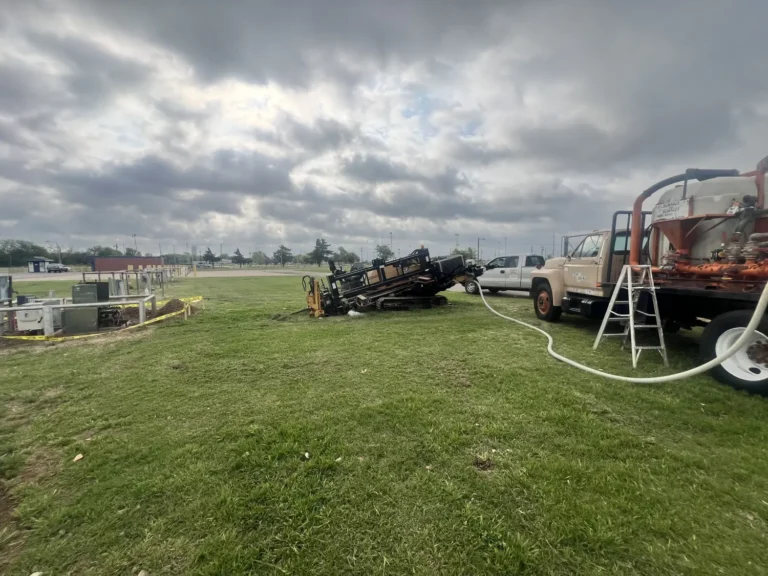
Clay is the main thing to plan for in Montague County: the federal soil survey records a clay rich layer in the top five feet on about 50 percent of the county and bedrock within five feet on about 28 percent. Clay in Montague County swells and sticks when wet, so the drilling fluid is mixed to keep cuttings moving. May is the wettest month in Montague County at 5.0 inches on average and January the driest at 1.7. Montague County averages 35.7 inches of precipitation a year, so rain delays are occasional.
- Most common soils: Windthorst (17%), Duffau (12%) and Renfrow (7%).
- Surface texture: most often fine sandy loam (44%) or loam (18%).
- Bedrock within 5 feet: about 28% of the county. It is a mix of hard rock and softer weathered rock.
- Clay rich layer (35% clay or more) in the top 5 feet: about 50% of the county.
- Sandy layer (70% sand or more) in the top 5 feet: about 22% of the county.
- Gravelly, cobbly or stony surface soil: about 12% of the county.
Source: USDA Natural Resources Conservation Service, Soil Survey Geographic Database, Montague County, Texas (survey area TX337, version 23, September 3, 2026), through Web Soil Survey. Percentages are shares of mapped county area.
Who Permits a Bore in Montague County?
The TxDOT Wichita Falls District permits bores under state highways in Montague County, the Montague County Commissioners Court handles county roads, and Bowie, Nocona and St. Jo each handle their own streets.
- State highways. US 82, US 287, US 81, the other numbered state routes and the farm to market roads in Montague County are on the state system. The utility owner files a TxDOT utility permit in RULIS.
- Texas811 locates. Texas811 needs at least two working days of notice before digging (Texas811 FAQ; Texas Utilities Code, Section 251.151).
- Railroads. A bore under Union Pacific or BNSF Railway track in Montague County needs a crossing agreement from the railroad that owns it, which sets the casing, depth and flagging.
- Water crossings. A bore under Salt Creek or Lake Nocona is checked for U.S. Army Corps of Engineers jurisdiction while the path is planned.
Statewide rules are on the Directional Boring Texas page, and Trinity supplies the bore plan and profile for the permit package.
Which Electric Utilities Serve Montague County?
Oncor Electric Delivery Company, Texas-New Mexico Power, Cooke County Electric Cooperative Association and Wise Electric Cooperative serve Montague County, according to 2025 filings with the U.S. Energy Information Administration. Oncor Electric Delivery Company and Texas-New Mexico Power are investor owned utilities; Cooke County Electric Cooperative Association and Wise Electric Cooperative are member owned cooperatives. The owner of the line sets the conduit size, depth and inspection steps, so it is confirmed before a conduit bore in Montague County is planned. More on electric line boring for electric cooperatives.
How Much New Construction Is There in Montague County?
Montague County permitted 20 new housing units in 2025, 16 of them single family homes, according to the Census Bureau Building Permits Survey. The population of Montague County went from 20,011 in 2020 to 21,890 in 2024, a gain of 9.4 percent. Bore work in Montague County is a mix of new services and replacement of older lines.
Which Cities and Towns in Montague County Does Trinity Serve?
Trinity takes directional boring work in all 3 incorporated places in Montague County and at sites outside city limits, and Bowie is the largest with about 6,054 residents.
| City or town | 2024 population |
|---|---|
| Bowie | 6,054 |
| Nocona | 3,236 |
| St. Jo | 950 |
Source: U.S. Census Bureau 2024 estimates, counting only the part of each city inside Montague County.
Montague County borders Clay County, Cooke County, Jack County, Wise County, Jefferson County, Oklahoma and Love County, Oklahoma; every county is on the Directional Boring in All 254 Texas Counties page. The neighboring county seats are Henrietta (Clay), Gainesville (Cooke), Jacksboro (Jack) and Decatur (Wise).
Which Directional Boring Services Are Available in Montague County?
Every Trinity service is available in Montague County: horizontal directional drilling from 3/4 inch service lines to 48 inch casing, auger boring, hydrovac potholing, trenching and 24 hour emergency response, all listed under Underground Utility and Boring Services.
- Road, highway, railroad, creek and river bore crossings, including US 82, US 287 and Salt Creek
- Bores under Union Pacific and BNSF Railway track, built to the railroad boring requirements of the owner
- Drinkable water line boring and sewer force mains in Bowie or Nocona and on rural water systems
- Underground conduit in Oncor Electric Delivery Company and Texas-New Mexico Power territory, see electric line boring
- Fiber optic boring for ISPs and broadband builders along US 82
- Municipal boring services for cities such as Bowie, Nocona and St. Jo
The free Bore Planner sizes a Montague County job before you call.
Montague County Directional Boring FAQs: What Do Customers Ask?
Does Trinity Boring Solutions work in Montague, Texas?
Yes. Trinity Boring Solutions takes work in Montague, Bowie, Nocona and St. Jo and the rural parts of Montague County. Trinity works in Texas with its own crews and from satellite yards run by partner drilling contractors Trinity has personally vetted.
Who approves a bore under US 82 in Montague County?
The TxDOT Wichita Falls District. The utility owner files the permit in the TxDOT RULIS system. County roads go through the Montague County Commissioners Court and city streets through the city.
Is there rock in Montague County?
Yes, in places. The federal soil survey records bedrock within five feet of the surface on about 28 percent of Montague County, a mix of hard and soft, weathered rock. Potholing confirms it on the actual bore path.
Can a line be bored under Salt Creek in Montague County?
Yes. A drill is steered below the bed of Salt Creek from a pit on each bank and the pipe is pulled back through, so the channel is not opened. Federal jurisdiction over the crossing is checked first.
Which railroads have track in Montague County?
Union Pacific and BNSF Railway, with about 52 miles of main line track on the federal rail map. Each requires its own crossing agreement before a bore goes under the rails.
Is Trinity insured for work in Montague County?
Yes. Trinity Boring Solutions carries general liability of $1,000,000 per occurrence and $4,000,000 aggregate, plus $5,000,000 excess liability. Ask for a certificate with the quote.
How much does directional boring cost in Montague County?
The footage and the pipe size give a general range to start from. Depth, the crossings and the ground set the number, and heavy clay is a factor on many Montague County jobs.
How Do You Get a Bore Quote in Montague County?
Call (405) 409-7423 any time or send the address in Montague County, the utility, the length and what it crosses. Trinity has bored since 1965 and is family owned.