
Haskell Texas Directional Boring: Rotan Clay Loam, US 277, Rice Springs Branch
Quick Answer: Rotan clay loam is the main mapped ground in Haskell; we take directional boring, also called horizontal directional drilling (HDD), for crossings such as US 277. Our Yukon, Oklahoma main office is 240 road miles from Haskell, where Rice Springs Branch runs through the city. The USDA soil survey maps clay at about 40 inches across 79 percent of the area. That sticky ground can cling to a reamer, so we plan staged passes.
Haskell bores at a glance
- County seat of Haskell County, Texas. Population 3,067 (Census Bureau 2024 estimate).
- Road distance from our Yukon, Oklahoma main office: 240 miles, about 4.7 hours of driving.
- Ground: Rotan soil is mapped on 48 percent of the area, with clay about 40 inches down.
- Rock: no bedrock is mapped in the top 60 inches.
- Highways inside the boundary: US 277, US 380, US 277 Business, FM 600 and FM 2163. State permit office: TxDOT Abilene District.
- Railroad track inside the boundary: none mapped.
- Named streams inside the boundary: Rice Springs Branch.
- Public water: City of Haskell, surface water bought from another system.
- Texas811: locate request at least two working days before a bore and no more than 14 days ahead.
- Range: 3/4 inch service lines to 48 inch casing, 10 feet to 5,000 feet.
- Phone answered 24 hours a day: (405) 409-7423
Who can I call for directional boring on Haskell Avenue East?
We take directional boring work in Haskell, the county seat of Haskell County. We plan underground work around the Census Bureau Vintage 2024 estimate of 3,067 residents in Haskell, the Haskell County seat. We install water, sewer, gas, electric conduit and fiber lines, including routes along Avenue East or connections that need to pass beneath US 277.
Our main office is in Yukon, Oklahoma, and Haskell work is done with our own crews and from satellite yards run by partner drilling contractors Trinity has personally vetted. We began directional boring in 1982. Four decades of work matter in Haskell because Rotan clay loam can load a reamer with sticky cuttings. Our family business started in 1965.
What kind of ground does Haskell’s Rotan soil present?
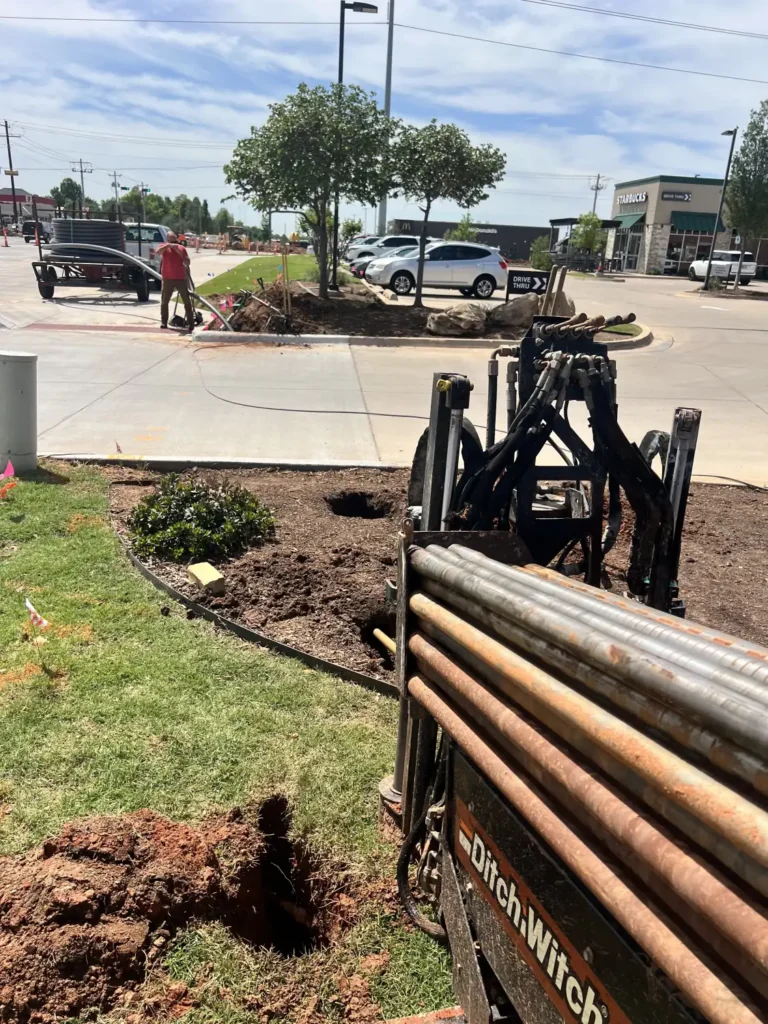
The USDA soil survey maps Rotan clay loam across 48 percent of Haskell, with 0 to 1 percent slopes. Wichita clay loam is mapped across 22 percent at 0 to 1 percent slopes and 9 percent at 1 to 3 percent slopes. Clay makes up 79 percent of mapped soil texture at about 40 inches below the surface, while average clay content there is 38 percent. Rotan, Wichita, Abilene, and Miles map patterns indicate clay loam at the surface; we treat them as patterns, not test borings. Sticky clay can ball up on a reamer and grip the pipe.
| USDA soil survey, inside the Haskell city limits | What is mapped |
|---|---|
| Soil series mapped | Rotan 48 percent, Wichita 31 percent, Abilene 9 percent, Miles 7 percent and Veal 6 percent |
| Texture at the surface | clay loam 88 percent, fine sandy loam 7 percent and loam 6 percent |
| Texture about 40 inches down | clay 79 percent, clay loam 15 percent and sandy clay loam 7 percent |
| Engineering class about 40 inches down | lean clay (CL) 93 percent and clayey sand (SC) 7 percent |
| Average clay content about 40 inches down | 38 percent |
| Bedrock mapped within 60 inches | None mapped |
| Seasonal water table within 60 inches | 0 percent of the area |
| Flood prone soils | 0 percent of the area |
| High corrosion risk for uncoated steel | 88 percent of the area |
Bedrock is not mapped in the top five feet of Haskell, and seasonal water table and flood prone soils are not mapped. That does not rule out deeper rock. High steel corrosion risk is mapped across 88 percent of the area, so the line owner should consider casing and tracer wire materials. The geologic map includes Quaternary age Quartz Sand Disintegration Residuum and Permian sedimentary rock. The sand and sandstone fragments in the mapped unit make actual ground checks important before choosing tooling.
How do we bore Haskell’s clay ground?
Haskell’s mapped clay can hold an open hole but stick to the reamer. Around Rotan and Wichita clay loam, we control fluid, open the bore in stages and keep the pullback plan ready.
- Rotan clay loam is sticky, so we use a thinner drilling fluid with polymer and open the Haskell bore in stages to limit reamer buildup.
- Where clay at about 40 inches is mapped under Haskell, we watch fluid returns closely so pressure does not lift pavement along US 277.
- Before drilling near the City of Haskell water system or county electric lines, we hydrovac pothole marked utilities to learn their depth.
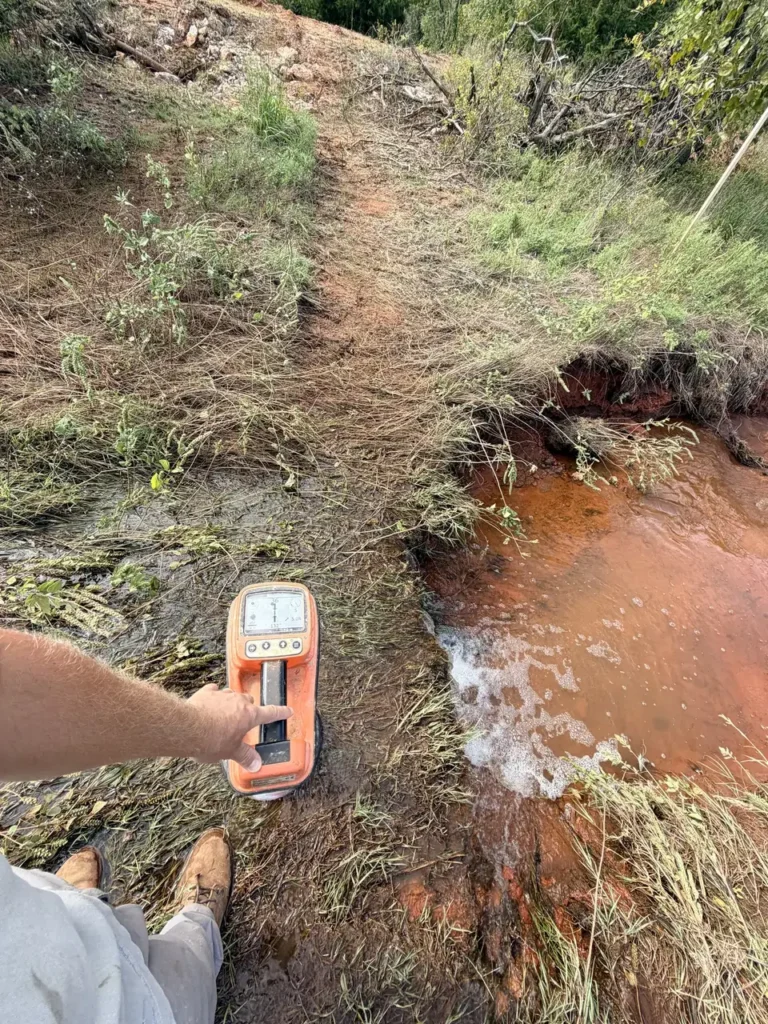
- At Rice Springs Branch, we track the drill head from the surface, log depth and pitch, and plan the crossing under the channel.
Which roads, tracks or creeks can a Haskell bore cross near US 277?
US 277, US 380 and US 277 Business run within Haskell, along with FM 600 and FM 2163. A highway crossing needs a planned bore route that fits the right of way and pavement. Avenue East is the longest named street at 4.18 miles in the city. 1st Street runs 3.85 miles and Avenue H runs 3.76 miles. Those long routes can mean a service line needs to pass under pavement or other marked utilities rather than follow an open trench.
| Crossing | Type | Mapped extent | Who has a say |
|---|---|---|---|
| US 277 | US highway | 2.4 roadway miles inside | State highway office |
| US 380 | US highway | 2.2 roadway miles inside | State highway office |
| US 277 Business | US highway | 2.1 roadway miles inside | State highway office |
| FM 600 | State highway | 0.5 roadway miles inside | State highway office |
| FM 2163 | State highway | 0.3 roadway miles inside | State highway office |
| Rice Springs Branch | Stream | 2.28 channel miles inside | Checked for Corps of Engineers jurisdiction |
| Buffalo Creek | Stream nearby | 0.7 miles outside | Checked for Corps of Engineers jurisdiction |
No railroad is mapped inside Haskell or within one mile outside its limits, and no street and rail crossing is mapped. Rice Springs Branch runs 2.28 channel miles through the city, with 11 mapped street crossings of named streams. A bore near the branch needs a route planned around its channel, and the crossing is checked for U.S. Army Corps of Engineers jurisdiction. Rice Springs Branch is mapped inside Haskell, while no lakes or ponds are mapped within one mile; we plan crossings accordingly.
Whose permission does a bore in Haskell County need?
For work under US 277, US 380, US 277 Business, FM 600 or FM 2163, TxDOT utility cover depths help set the bore profile. Electric and communication lines need 60 inches at a highway crossing and 48 inches along the right of way; water needs 60 inches at crossings and 36 inches along it. Pressurized sewer needs 60 inches at crossings. The line owner files the utility permit in TxDOT’s RULIS system, and the TxDOT Abilene District reviews it. We prepare the bore plan and profile for the owner’s filing and work under its permit. On Avenue East, 1st Street, Avenue H, and 3rd Street, we treat these as city owned streets when planning boring. Rice Springs Branch is checked for federal jurisdiction during planning.
Read the rules for yourself: Texas Utilities Code Chapter 251 on notice to Texas811, the Texas811 questions and answers page, the TxDOT Utility Accommodation Rules, 43 TAC 21.40 and TxDOT utility permits in RULIS.
Which utilities are near the City of Haskell water lines?
The City of Haskell public water system uses purchased surface water and reports 2,104 service connections serving 3,431 people. In Haskell County, AEP Texas North, Big Country Electric Cooperative and Tri-County Electric Cooperative report electric service. The provider at a specific address still needs to be confirmed. Before a conduit bore near the City of Haskell water system or electric lines, we expose marked utilities by hydrovac so their depth is known.
| Line owner | What it is | Source | Size |
|---|---|---|---|
| City of Haskell | Public water system | Surface water bought from another system | 2,104 connections, 3,431 people served |
| AEP Texas North, Big Country Electric Cooperative and Tri-County Electric Cooperative | Electric utilities reporting service in Haskell County | EIA Form 861 | Confirm the line owner by address |
The American Community Survey 2019 to 2023 five year estimates put Haskell’s median housing year at 1956; 57 percent of homes were built before 1960, 35 percent from 1960 to 1999 and 8 percent in 2000 or later. Work along Avenue East may involve replacing older pipe or adding a new service. We pothole marked lines before drilling near them, because surface marks do not show depth.
Where is Haskell near Rule and other towns?
Haskell is the incorporated county seat in Haskell County, at an elevation of 1,583 feet and with 3.6 square miles of land. ZIP code 79521 serves Haskell, so we use that location reference when coordinating underground boring near Avenue A. Rule is 9.5 miles west; Stamford is 11.1 miles southeast; Weinert is 11.8 miles north; and Rochester is 12.9 miles northwest. From our Yukon, Oklahoma main office, Haskell is 240 road miles away and a 4.7 hour drive, so we plan mobilization accordingly. Those miles matter when planning mobilization for a bore on US 277 or a rural route outside Haskell.
Places near Haskell
- Directional boring in Rule: 9.5 miles west
- Directional boring in Stamford: 11.1 miles southeast
- Directional boring in Weinert: 11.8 miles north
- Directional boring in Rochester: 12.9 miles northwest
- Directional boring in O’Brien: 16.5 miles northwest
What boring work comes up around Haskell Avenue H?
- Highway crossing: A bore beneath US 277 keeps the pavement intact while the route follows the permit profile and required cover.
- Water service: A new connection near the City of Haskell water system can pass under Avenue East without cutting the street.
- Fiber route: Conduit along Avenue H can be bored beneath driveways and sidewalks, with marked utilities exposed before drilling nearby.
- Creek crossing: A route beneath Rice Springs Branch keeps the channel bank uncut and is checked for federal jurisdiction during planning.
- Electric conduit: Near US 380, we confirm the line owner and conduit requirements before laying out a bore under the roadway.
- Rural service: A route from Haskell toward Rule can connect an outlying site while avoiding open cuts across access roads.
More on each kind of work: water line boring, electric line boring, fiber optic boring, road, railroad and creek crossings and municipal boring.
What drives the price of a Haskell bore near Rice Springs Branch?
For a Haskell quote, start with where the work is, such as an address on Avenue East or a map pin near Rice Springs Branch. Then tell us what will go in the ground, such as water or fiber, how big the pipe or conduit is, and how long the bore runs. A sketch or plans help show the route and crossings.
Rotan clay loam comes first in the planning because sticky clay can slow reaming and hold onto pipe. The number of utilities to expose also matters, especially along Avenue H or near the City of Haskell water system. US 277 pavement, creek crossings at Rice Springs Branch, pits and excavator time can add work. Pipe size, bore length, backfill and mobilization from Yukon also shape the price for a Haskell job.
Questions people ask about boring in Haskell
Does Trinity Boring Solutions take directional boring jobs in Haskell County, and how are crews assigned?
Yes. We take directional boring work in Haskell County, serving the city and routes toward Rule. Our own crews handle jobs, and partner drilling contractors Trinity has personally vetted can work from satellite yards. Whichever crew handles the crossing, we keep one point of contact from first call through the bore log for work near FM 600.
Who approves a bore under US 277 in Haskell, and which state office reviews it?
The utility owner applies for the TxDOT permit for a bore under US 277, and the TxDOT Abilene District reviews it. The filing goes through RULIS. We prepare the bore plan and profile for the owner, and the permit sets the approved route and cover requirements.
Can a line be bored under Rice Springs Branch in Haskell?
A line can be planned beneath Rice Springs Branch, which runs 2.28 channel miles through Haskell. When we plan a crossing near US 380, we check whether the route falls under US Army Corps of Engineers jurisdiction. The route and depth need to account for the channel, and boring can avoid cutting the creek bank.
As we plan work in Haskell County, does the City of Haskell run its public water system with purchased surface water?
The City of Haskell owns its public water system and uses purchased surface water; we account for that utility context when planning near Avenue D. The system reports 2,104 service connections and 3,431 people served. For a bore near a water line on Avenue East, we confirm and expose marked utilities before drilling close to them.
Which electric companies report service in Haskell County, and who confirms conduit specifications?
AEP Texas North, Big Country Electric Cooperative and Tri-County Electric Cooperative report electric service in Haskell County. The specific line owner must be confirmed before a conduit bore near US 380, and that owner confirms the conduit specifications for its line.
Who is responsible for Haskell streets such as Avenue H, and does a bore require cutting one?
Avenue H is a city street, so Haskell’s city government is responsible for its streets. A bore can pass under pavement without cutting it; where the route crosses a highway such as US 277, TxDOT rules require boring or tunneling beneath existing pavement.
Does Trinity cover Haskell, Rule and rural sites outside the city limits?
Yes. We take work in Haskell and nearby areas such as Rule, 9.5 miles west, as well as rural sites outside the city limits. The Yukon, Oklahoma main office is 240 road miles from Haskell, so distance and access are part of planning a job near Rule.
How much notice does Texas811 need for a bore along Haskell’s Avenue East, and what if marks change?
For a bore along Avenue East, the locate request must be made at least 48 hours before excavation, excluding Saturdays, Sundays and legal holidays, and no earlier than 14 days ahead. For planned work along Avenue B, if our start slips more than 14 days past the original notice, we submit a new request. Before work resumes near Buffalo Creek, we have worn or moved marks refreshed through Texas811.
How do Rotan and Wichita soil conditions affect our directional bore cost under US 277 in Haskell?
The main factors are bore length, pipe or conduit size, Haskell’s sticky clay, utilities to expose, and pavement or creek crossings. A US 277 route can require highway permit planning, while Rice Springs Branch adds channel crossing considerations. Pits, backfill, equipment time and mobilization from Yukon also affect the job scope.
Where the Haskell facts on this page come from
- USDA Natural Resources Conservation Service, Soil Data Access: soil survey map units inside Haskell
- U.S. Census Bureau, TIGER/Line 2024: Haskell boundary, roads, rail lines and streams
- U.S. Census Bureau, Vintage 2024 population estimates: Haskell
- U.S. Census Bureau, American Community Survey 2019 to 2023: Haskell housing units and year built
- Macrostrat geologic map compilation: map units under Haskell
- U.S. EPA Safe Drinking Water Information System: public water systems serving Haskell
- U.S. Energy Information Administration, Form EIA 861: electric utilities serving Haskell County
- U.S. Geological Survey, Elevation Point Query Service: Haskell elevation
- OpenStreetMap road network through the OSRM router: road miles from Yukon, Oklahoma to Haskell
- Texas Utilities Code Chapter 251, Underground Facility Damage Prevention and Safety
- TxDOT Utility Accommodation Rules, 43 Tex. Admin. Code 21.40: underground utilities
- Texas Department of Transportation: Right of Way Utility and Leasing Information System (RULIS) utility permits
About Trinity Boring Solutions
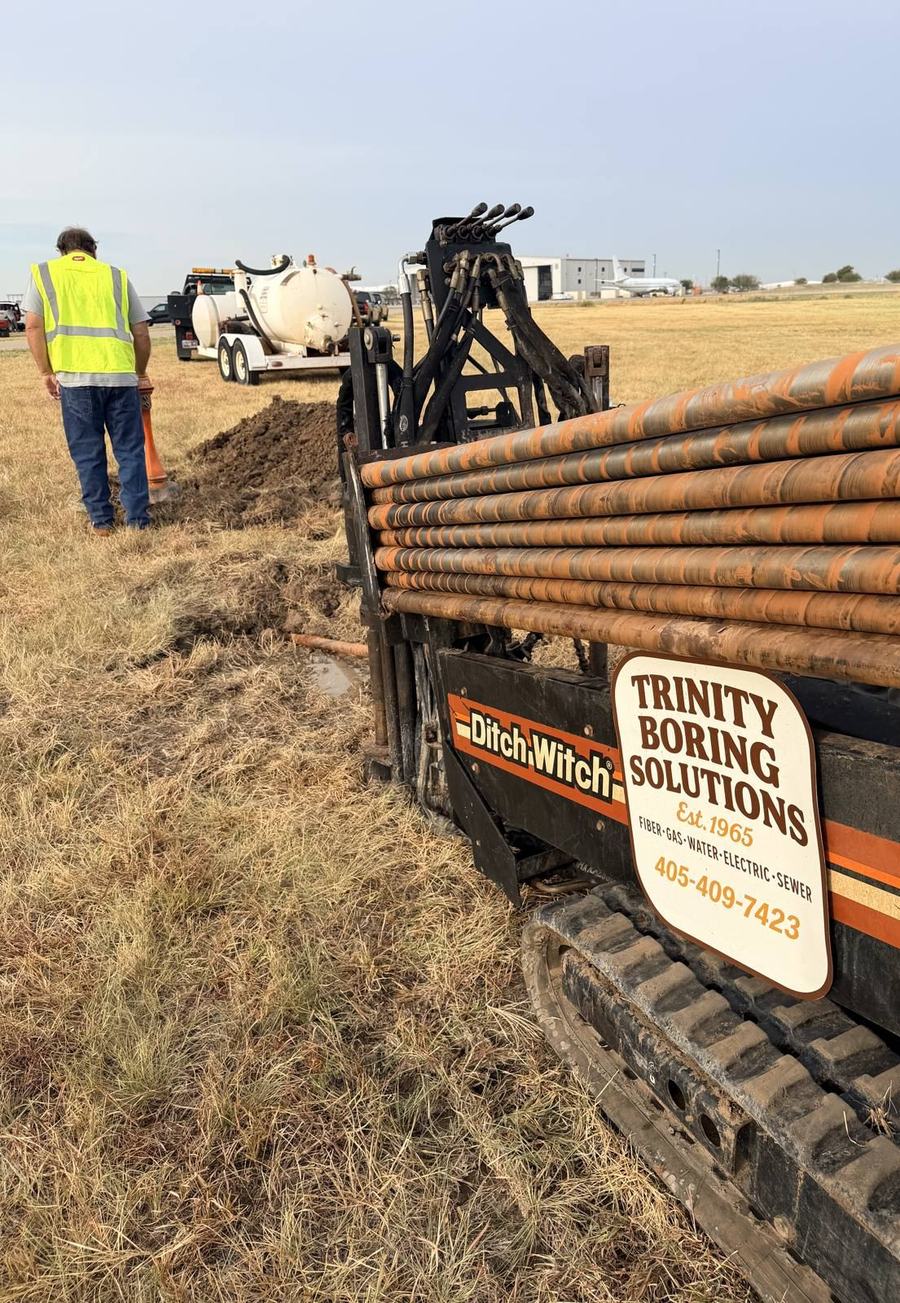
Trinity Boring Solutions is a family business in Yukon, Oklahoma, founded by Dean Rice in 1965 and owned today by Darren Rice, who started its directional boring side in 1982. The company bores across Oklahoma and Texas. No bore is too big or too small: 4 foot sidewalk sleeves to roughly 4,100 feet under the Arkansas River in Tulsa. Reach us at (405) 409-7423.
Get a Quote for a Bore in Haskell
Send the address, what is going in, the size and the footage.
Trinity Boring Solutions
9102 NW Expressway, Yukon, OK 73099
(405) 409-7423 | darren@trinityboringsolutions.com
Free Bore Planner
Plan Your Bore in Haskell, Texas
Type the address of your job in Haskell. The Bore Planner opens an aerial map at that spot. Drop one pin where the bore starts and one where it ends, tell us what is going in and send the scope to our crew.
Talk to the crew that does the work
Fastest way to a number is a phone call. Tell us where the crossing is and what is going in the ground, and you will get a straight answer on the same call. Bores from 10 feet to 5,000 feet, 3/4 inch service line through 48 inch casing, anywhere in Oklahoma and Texas. We run 24/7 for main breaks and emergency repairs.
Answered by a person, not a call center.
Would rather not call? Send the details and we will come back with a written quote.
County and State Pages for Haskell
All counties: Texas county list.