Industry Texas Directional Boring: Klump Sandy Loam, West Mill Creek, Texas State Highway 159
Quick Answer: Industry is a small incorporated city in Austin County, so its city streets belong to the city; we use directional boring, also called horizontal directional drilling (HDD), for lines beneath Main Street. The Yukon main office is 430 road miles away, and Texas State Highway 159 is one route through Industry. USDA soil survey maps show sandy clay loam at 40 inches across 56% of the city. That clay rich ground can hold a hole open but may stick to a reamer and grip pipe.
Industry bores at a glance
- Incorporated city in Austin County, Texas. Population 290 (Census Bureau 2024 estimate).
- Road distance from our Yukon, Oklahoma main office: 430 miles, about 8.6 hours of driving.
- Ground: Klump soil is mapped on 23 percent of the area, with sandy clay loam about 40 inches down.
- Rock: bedrock is mapped within 60 inches on 15 percent of the area.
- Highways inside the boundary: Texas State Highway 159 and FM 109. State permit office: TxDOT Yoakum District.
- Railroad track inside the boundary: none mapped.
- Named streams inside the boundary: West Mill Creek.
- Texas811: locate request at least two working days before a bore and no more than 14 days ahead.
- Range: 3/4 inch service lines to 48 inch casing, 10 feet to 5,000 feet.
- Phone answered 24 hours a day: (405) 409-7423
Does anyone provide directional boring near West Mill Creek in Industry?
Industry is a small incorporated city in Austin County, with 290 residents in the Census Bureau Vintage 2024 estimate. We install water, sewer, gas, electric conduit and fiber, with routes that can follow Fordtran Boulevard or connect properties along Main Street. Boring can place those lines beneath pavement and other surface features without opening a trench across the route.
Our main office is in Yukon, Oklahoma, and Industry work is done with our own crews and from satellite yards run by partner drilling contractors Trinity has personally vetted. For a service line near Ernst Parkway, our range runs from 3/4 inch service lines to 48 inch casing and from 10 feet to 5,000 feet. We are a family business that started in 1965 and has done directional boring since 1982.
What kind of ground does Industry have around Klump soil?
The USDA soil survey maps Klump as the leading soil series in Industry, at 23% of the area. Klump sandy loam, with 3 to 5 percent slopes, is mapped across 19%. At about 40 inches below the surface, sandy clay loam covers 56% of the mapped area and clay covers 24%; average clay content at that depth is 36%. These are mapped soil patterns, not test borings. Clay can keep a bore open, but it can build on a reamer and tighten around pipe.
| USDA soil survey, inside the Industry city limits | What is mapped |
|---|---|
| Soil series mapped | Klump 23 percent, Knolle 13 percent, Tremona 11 percent, Carbengle 9 percent and Latium 7 percent |
| Texture at the surface | sandy loam 23 percent, loamy fine sand 22 percent and clay loam 19 percent |
| Texture about 40 inches down | sandy clay loam 56 percent, clay 24 percent and bedrock 13 percent |
| Engineering class about 40 inches down | lean clay (CL) 43 percent, fat clay (CH) 21 percent and clayey sand (SC) 19 percent |
| Average clay content about 40 inches down | 36 percent |
| Bedrock mapped within 60 inches | 15 percent of the area (3 percent hard rock, 12 percent weathered rock) |
| Seasonal water table within 60 inches | 16 percent of the area |
| Flood prone soils | 4 percent of the area |
| High corrosion risk for uncoated steel | 41 percent of the area |
The soil survey maps bedrock within 40 inches across 13% of Industry and within 60 inches across 15%; typical mapped depth is 32 inches. That can bring a bore into rock sooner on some routes, while the Fleming Formation, a Miocene clay and sandstone unit, points to changing ground conditions. Seasonal water tables are mapped within 60 inches across 16%, which can put water in pits. Flood prone soils cover 4%. High steel corrosion risk is mapped across 41%, so the line owner should choose any casing or tracer wire protection.
How is a bore run through Industry sandy clay loam?
Industry soil maps show sandy clay loam at about 40 inches and clay in some areas. We adjust the drilling fluid and reaming to the ground, and keep the route in view along streets such as Main Street.
- Klump soil and mapped clay can load up a reamer, so we use a thinner drilling fluid, ream in stages and plan to pull pipe soon after opening the hole.
- Because heavy clay is mapped in Industry, we watch fluid returns near pavement on Main Street to limit the chance of pressure lifting the surface.
- Seasonal water tables are mapped within 60 inches in parts of Industry, so we keep pits small and pump them if water collects near West Mill Creek.
- We expose every marked utility with hydrovac before drilling near it; for example, a line on Fordtran Boulevard is checked before the drill approaches.
What does a bore have to cross on Industry Main Street?
Texas State Highway 159 has 1.9 mapped roadway miles inside Industry, and FM 109 has 1.6. Both are state highways, so a bore crossing their right of way has a state permit path. Main Street is the longest named street at 2.02 miles in the city. Fordtran Boulevard runs 1.7 miles, and Ernst Parkway runs 0.95 miles. A route beneath these streets can be bored rather than opened across the pavement, subject to the road owner’s requirements.
| Crossing | Type | Mapped extent | Who has a say |
|---|---|---|---|
| Texas State Highway 159 | State highway | 1.9 roadway miles inside | State highway office |
| FM 109 | State highway | 1.6 roadway miles inside | State highway office |
| West Mill Creek | Stream | 0.26 channel miles inside | Checked for Corps of Engineers jurisdiction |
| Pastoren Creek | Stream nearby | 0.1 miles outside | Checked for Corps of Engineers jurisdiction |
| Post Oak Point Creek | Stream nearby | 0.1 miles outside | Checked for Corps of Engineers jurisdiction |
| Sawmill Creek | Stream nearby | 0.7 miles outside | Checked for Corps of Engineers jurisdiction |
| West Fork Mill Creek | Stream nearby | 0.7 miles outside | Checked for Corps of Engineers jurisdiction |
No railroad is mapped inside Industry or within one mile outside its limits, so there is no mapped local track crossing to plan around. West Mill Creek runs 0.26 channel miles within the city, and one mapped street crossing crosses a named stream. The city also has 1.58 miles of unnamed drainage. Those water routes can affect bore depth and pit placement; creek crossings are checked for U.S. Army Corps of Engineers jurisdiction during planning.
Who approves a bore on Industry roads in Austin County?
Industry is incorporated, so its city streets belong to the city. Texas State Highway 159 and FM 109 are state routes, and work in their right of way needs a TxDOT utility permit reviewed by the TxDOT Yoakum District. The utility that owns the line files through TxDOT’s online RULIS system; we prepare the bore plan and profile and work under the permit issued to that utility owner. TxDOT requires boring or tunneling beneath an existing highway. A West Mill Creek crossing is checked for federal jurisdiction during planning.
Read the rules for yourself: Texas Utilities Code Chapter 251 on notice to Texas811, the Texas811 questions and answers page, the TxDOT Utility Accommodation Rules, 43 TAC 21.40 and TxDOT utility permits in RULIS.
Who owns the utility lines in Austin County near Industry?
The water provider for a specific Industry address cannot be matched from the available EPA drinking water records. Confirm the provider with the city, Austin County or the local water district before planning a bore. EIA records report CenterPoint Energy, Bluebonnet Electric Cooperative, Fayette Electric Cooperative and San Bernard Electric Cooperative as serving Austin County. We confirm the electric line owner before planning a conduit bore near Texas State Highway 159.
| Line owner | What it is | Source | Size |
|---|---|---|---|
| CenterPoint Energy, Bluebonnet Electric Cooperative, Fayette Electric Cooperative and San Bernard Electric Cooperative | Electric utilities reporting service in Austin County | EIA Form 861 | Confirm the line owner by address |
The American Community Survey 2019 to 2023 five year estimates put Industry’s median housing year at 1982; 29% of homes were built before 1960, and 17% were built in 2000 or later. A replacement route along Fordtran Boulevard may meet older buried services as well as newer connections. Before drilling near a marked line, we expose it with hydrovac potholing; paint shows its position, not its depth.
Do you cover Industry and nearby New Ulm?
Industry is in Austin County, at an elevation of 302 feet, and covers 1.07 square miles. The city’s ZIP code is 78944. New Ulm is 5.8 miles south, Fayetteville is 11.5 miles west, and Bellville, the county seat, is 14.3 miles east. Brenham, the nearest larger city, is 14.5 miles northeast. From our Yukon, Oklahoma main office, the road distance is 430 miles and the drive is 8.6 hours. Those distances matter when setting crew mobilization for work near Texas State Highway 159.
Places near Industry
- Directional boring in New Ulm: 5.8 miles south
- Directional boring in Fayetteville: 11.5 miles west
- Directional boring in Round Top: 13.6 miles northwest
- Directional boring in Bellville: 14.3 miles east
- Directional boring in Brenham: 14.5 miles northeast
What boring work comes up near Industry Fordtran Boulevard?
- Highway crossing: A line beneath Texas State Highway 159 needs a bore plan that fits the state right of way and TxDOT permit conditions.
- Street service: A water or sewer service along Main Street can pass beneath pavement while keeping the street surface intact.
- Fiber conduit: A conduit route near Ernst Parkway can connect properties without an open trench along the road.
- Creek crossing: A bore near West Mill Creek needs a route and depth planned around the channel and the jurisdiction check.
- Utility replacement: A replacement line near Fordtran Boulevard starts with locating and exposing marked services before the drill nears them.
- Drainage crossing: A route near Industry’s unnamed drainage should account for the mapped flow path and space for pits.
More on each kind of work: water line boring, electric line boring, fiber optic boring, road, railroad and creek crossings and municipal boring.
What should I send for a quote on Industry Bermuda Street?
For a bore near Bermuda Street, send the address or map pin, what will go in the ground, the pipe or conduit size and the footage; a sketch or plans help. Marking the route against Main Street or another named road gives us a clearer picture of crossings, access and where the bore pits may fit.
A short, clearly described route near Bermuda Street is simpler to scope than a route with several crossings or difficult pit access. The work’s length, pipe size, soil and rock, marked utilities to expose, pavement, creek or drainage crossings, and excavator time all affect the price. Klump soil and clay mapped at depth can change reaming. A crossing of Texas State Highway 159 brings TxDOT requirements into the plan, and the 430 road miles from Yukon affect mobilization.
Questions people ask about boring in Industry
Does Trinity Boring Solutions take Industry jobs in Austin County, and who does the work?
Yes. We take directional boring work in Industry, Austin County, and the job is handled by our own crews or crews from satellite yards run by drilling contractors we have vetted. You work with Trinity through the bore log, even when a partner crew is on site near Main Street.
Who controls Ernst Parkway in Industry, and can a bore avoid cutting the street?
Industry is incorporated, so its city streets belong to the city. A bore along or beneath Ernst Parkway can be planned to avoid opening the street surface. The route and access still need to be worked out for that location, including where the bore pits fit.
Does Industry housing age near Fordtran Boulevard affect replacement bores?
It can affect what the crew needs to locate and expose. The American Community Survey 2019 to 2023 estimates put the median housing year at 1982, with 29% of homes built before 1960. A replacement bore near Fordtran Boulevard needs marked utilities exposed before drilling close to them.
Are groundwater or flood prone soils a problem for bore pits near Industry’s West Mill Creek?
They can be a planning issue. The USDA soil survey maps seasonal water tables within 60 inches across 16% of Industry and flood prone soils across 4%. Near West Mill Creek, pit placement and pumping may need attention, and a creek crossing is checked for federal jurisdiction during planning.
Does Klump soil in Industry pose a corrosion concern for steel pipe?
The soil survey maps high steel corrosion risk across 41% of Industry, so the line owner should select any protection for steel casing or tracer wire. Klump soil is one mapped series in the city. HDPE is another pipe option when the line design allows it.
What ground will a bore pass through in Industry’s Klump soil?
The USDA soil survey maps Klump across 23% of Industry. At about 40 inches, sandy clay loam covers 56% of the mapped area and clay covers 24%. That clay rich ground can hold an open hole but may stick to the reamer, so the drilling plan may use staged reaming.
Can I reach Trinity after hours about an urgent bore near Industry’s Ernst Parkway?
Yes. Someone answers Trinity’s phone 24 hours a day at (405) 409-7423. An urgent request near Ernst Parkway still needs the address or map pin, line type and size, and route details so we can understand the work and any nearby crossings.
How much notice does Texas811 need for an Industry bore along Main Street, and what if marks move?
The locate request must be made at least 48 hours before excavation, excluding Saturdays, Sundays and legal holidays, and no earlier than 14 days before it. For a Main Street bore, request refreshed marks through Texas811 if they wear off or move before work continues.
What affects the cost of directional boring in Industry near Texas State Highway 159?
The scope drives the price: length, pipe or conduit size, ground conditions, utilities to expose, pavement, creek or drainage crossings, pit work and mobilization all matter. A route through clay near Texas State Highway 159 may require a different plan from a simple street service, and distance from Yukon also affects mobilization.
Where the Industry facts on this page come from
- USDA Natural Resources Conservation Service, Soil Data Access: soil survey map units inside Industry
- U.S. Census Bureau, TIGER/Line 2024: Industry boundary, roads, rail lines and streams
- U.S. Census Bureau, Vintage 2024 population estimates: Industry
- U.S. Census Bureau, American Community Survey 2019 to 2023: Industry housing units and year built
- Macrostrat geologic map compilation: map units under Industry
- U.S. Energy Information Administration, Form EIA 861: electric utilities serving Austin County
- U.S. Geological Survey, Elevation Point Query Service: Industry elevation
- OpenStreetMap road network through the OSRM router: road miles from Yukon, Oklahoma to Industry
- Texas Utilities Code Chapter 251, Underground Facility Damage Prevention and Safety
- TxDOT Utility Accommodation Rules, 43 Tex. Admin. Code 21.40: underground utilities
- Texas Department of Transportation: Right of Way Utility and Leasing Information System (RULIS) utility permits
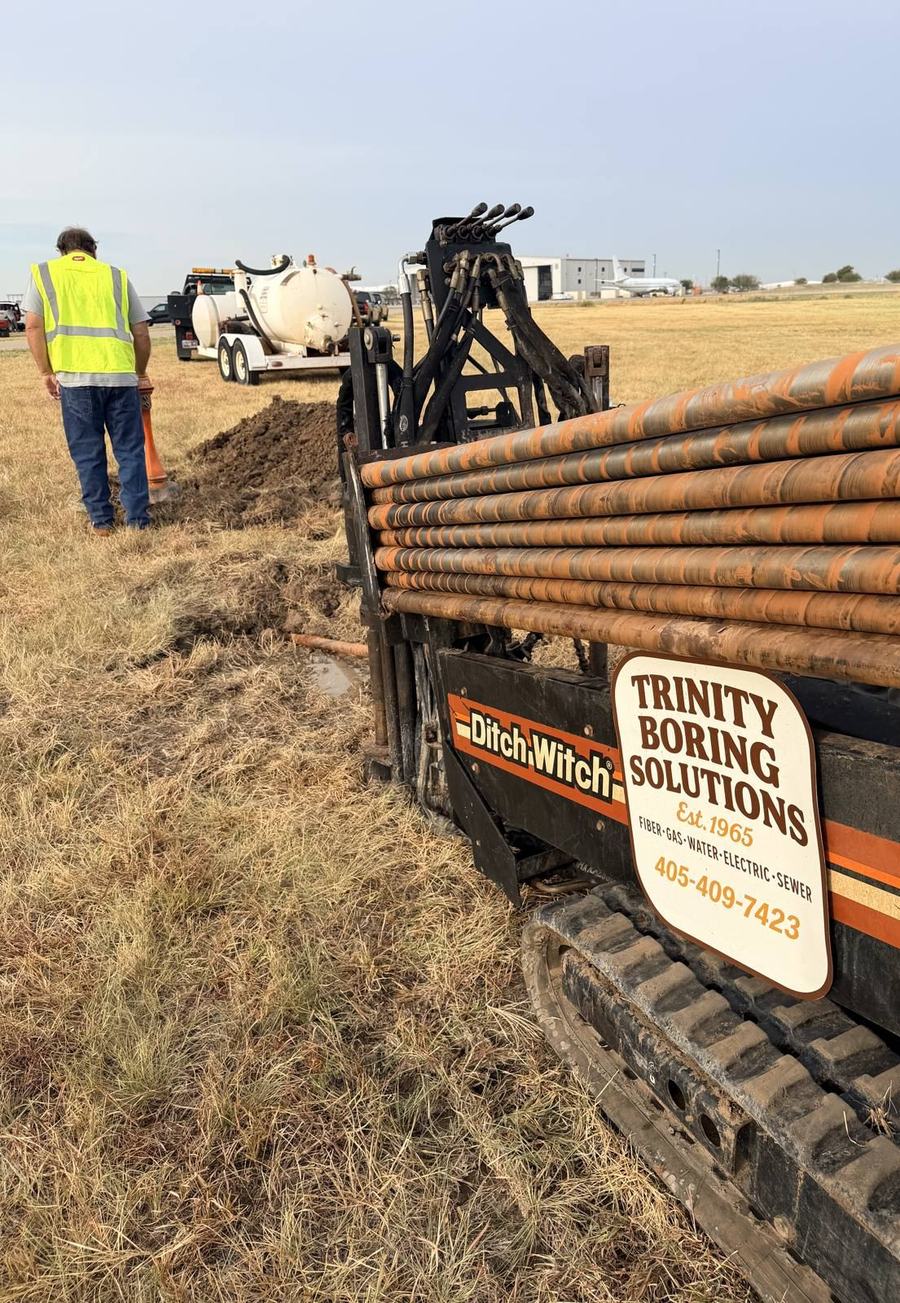
About Trinity Boring Solutions
Trinity Boring Solutions is a family business in Yukon, Oklahoma, founded by Dean Rice in 1965 and owned today by Darren Rice, who started its directional boring side in 1982. The company bores across Oklahoma and Texas. No bore is too big or too small: 4 foot sidewalk sleeves to roughly 4,100 feet under the Arkansas River in Tulsa. Reach us at (405) 409-7423.
Get a Quote for a Bore in Industry
Send the address, what is going in, the size and the footage.
Trinity Boring Solutions
9102 NW Expressway, Yukon, OK 73099
(405) 409-7423 | darren@trinityboringsolutions.com
Free Bore Planner
Plan Your Bore in Industry, Texas
Type the address of your job in Industry. The Bore Planner opens an aerial map at that spot. Drop one pin where the bore starts and one where it ends, tell us what is going in and send the scope to our crew.
Talk to the crew that does the work
Fastest way to a number is a phone call. Tell us where the crossing is and what is going in the ground, and you will get a straight answer on the same call. Bores from 10 feet to 5,000 feet, 3/4 inch service line through 48 inch casing, anywhere in Oklahoma and Texas. We run 24/7 for main breaks and emergency repairs.
Answered by a person, not a call center.
Would rather not call? Send the details and we will come back with a written quote.
County and State Pages for Industry
Same county: Sealy · Wallis · San Felipe · Brazos Country · South Frydek. All counties: Texas county list.