
Home / Services / Rural Water District Boring in Oklahoma and Texas
Government and agency work
Rural Water District Boring in Oklahoma and Texas
Rural water district boring starts with a simple question: are we extending the district main or installing the line from the meter to a building? On a county road that distinction can change the drawing, the pipe and who accepts it. We quote the crossing itself, or the crossing and its tie ins if the plans put them in our scope.
Quick summary
- We bore public water mains, service lines and replacement crossings under roads, driveways and waterways.
- We work in Oklahoma and Texas from 9102 Northwest Expy, Yukon, OK 73099.
- Our largest pipe was a 48 inch HDPE intake. Our longest single shot was 4,100 feet. We bore longer runs in sections.
- Your team pulls permits and arranges traffic control. We provide the bore plan and profile, method and equipment details, and as built records for the package.
- Send the utility plan and crossing location or call (405) 409-7423 to discuss the scope.
Rural water district boring: who reviews the route
Start with the utility’s design and acceptance requirements. Then identify separate approval for the water system, permission to use the road or land, and any water crossing review the job needs. Use this table to assign each decision before the bore is released.
| Decision | What the authority says | What to bring to the bore review | Primary source |
|---|---|---|---|
| Identify the serving utility | The PUCT viewer maps water Certificates of Convenience and Necessity, or CCNs, to identify the utility’s service area. | Confirm the address with the mapped utility, then ask it to identify the main and proposed meter. | PUCT CCN mapping |
| Oklahoma public main extension | Oklahoma DEQ lists water distribution lines under construction permitting. For the standard permit route, work begins only when the applicant has the signed permit and approved plans and specifications. | Supply the route, profile and bore method for the drawing set. | Oklahoma DEQ construction permitting |
| Oklahoma rural extension exception | The rural district exception excludes an extension over, through or under any stream, lake, pond, marsh or existing wastewater collection line. It also excludes extensions over one mile and extensions to lines that already received an exception. | Ask the district to check eligibility before scoping the route. An application is not the exception itself. | OAC 252:626 permit exception rule |
| Oklahoma exception drawing | The DEQ application requires a plan drawing showing the proposed waterline location and calls for existing and proposed diameters, pressure, length and material. | Get the point of connection and pipe data from the owner or engineer rather than assuming them in the quote. | Oklahoma DEQ extension exception form |
| Texas significant distribution change | The public water system uses Form 21038 to submit plans and specifications for a significant change under 30 TAC 290.39(j)(1)(D). | On a water body crossing, identify the design and its sheet number for the form. | TCEQ Form 21038 |
| Texas change not defined as significant | Form 21037 is the notification for a distribution change not defined as significant under the same rule. | Have the system and engineer determine the notification path. Do not use bore footage to decide. | TCEQ Form 21037 |
| Texas political subdivision review | Form 21036 applies to qualifying political subdivision approval under 30 TAC 290.39(j)(3)(A) and the applicable agreement with TCEQ. This is not automatic for every special utility district. | Ask the owner’s engineer to identify the applicable agreement and the approval record. | TCEQ Form 21036 |
| Oklahoma water main crossing a sewer | The state rule specifies 24 inches of vertical separation at a water main and sewer crossing and addresses pipe joints and support. The rule includes provisions where the required separation cannot be achieved. | Show actual utility elevations and flag a conflict for the engineer before a pilot bore is made. | OAC 252:626 distribution standards |
| Texas water main near wastewater | The general separation is nine feet measured from outside surfaces. If that cannot be met at a crossing, the checklist calls for a profile identifying the separation, pipe material and wastewater pressure rating. | Get the crossing detail accepted rather than assuming a standard casing resolves the conflict. | TCEQ water distribution checklist |
| Oklahoma underwater crossing | The state rule sets a two foot minimum cover over the pipe for underwater crossings. A defined channel bottom more than 15 feet wide triggers additional pipe, isolation valve and testing access provisions. | Give the designer a surveyed channel and identify both working areas. | OAC 252:626 surface water crossing rule |
| Texas trenchless stream crossing | TCEQ’s October 2026 guidance describes when a trenchless water main can be an alternative to separate watertight encasement. It calls for a fusible pipe system, isolation valves, sampling provisions, and design for scour, buoyancy and loading. | Get the approved profile and specify who handles testing and records. Do not treat the guidance as a blanket casing waiver. | TCEQ trenchless stream crossing guidance |
| Oklahoma state highway right of way | ODOT’s utility portal generates M 4 for federal or state highways and M 4a for interstate freeways. | Confirm the road owner, permit class and approved crossing profile separately from DEQ paperwork. | ODOT utility permit forms |
| Texas state highway right of way | TxDOT says the utility company representative submits the application and final location as built records in RULIS. A consultant may not submit the permit. | Have the utility name its submitter. We supply the data the driller is responsible for. | TxDOT RULIS FAQ |
Facts checked November 2026. Tell us if something has changed.
Work we have done that is like this
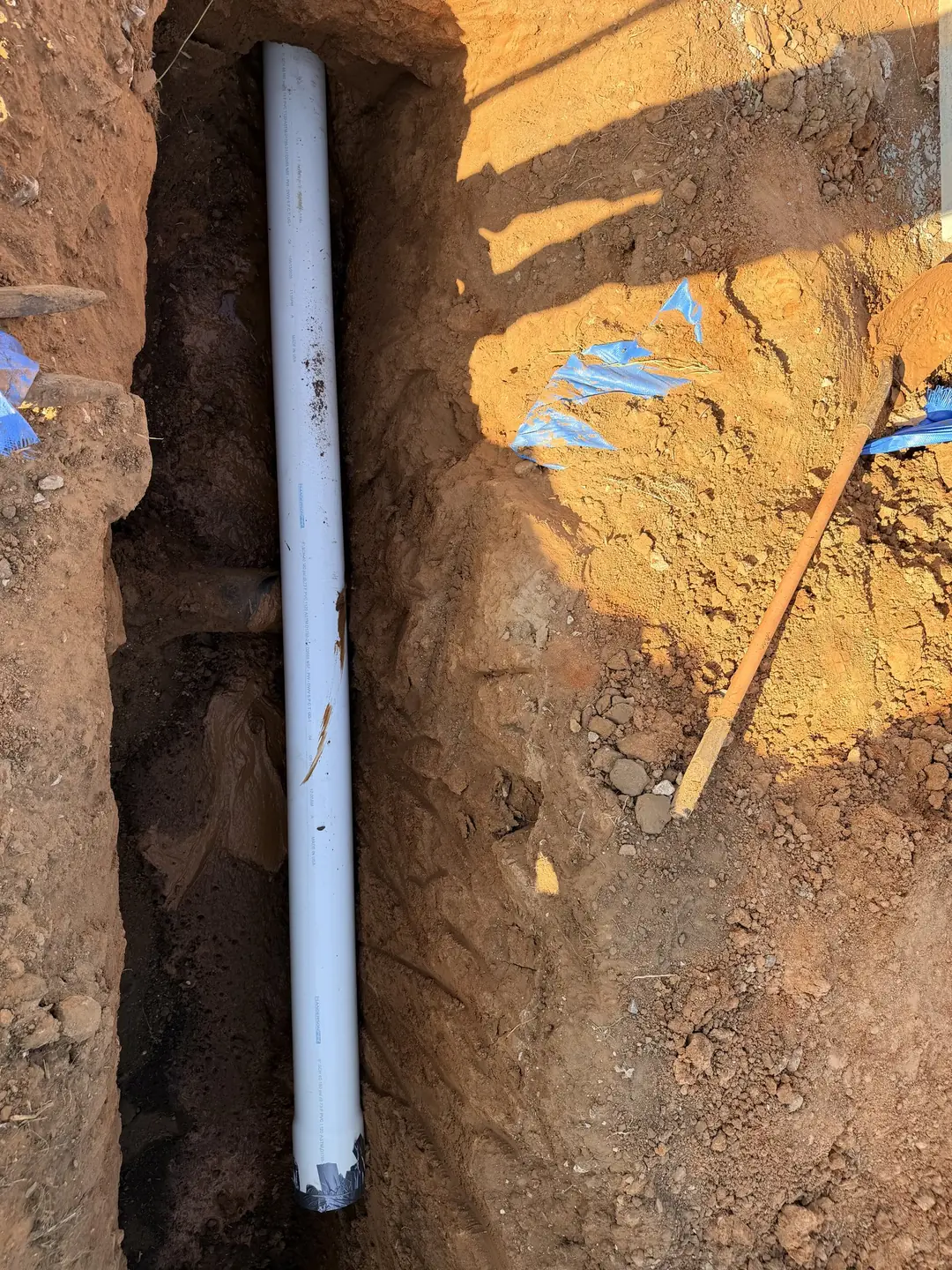
These are the same kind of water crossing a rural water district plans. We do not list any of them as district work.
- A lake intake. We installed a 48 inch HDPE water intake line out to the middle of Fort Cobb Lake, and divers changed the reamer at the lake end. Fort Cobb Lake is a Bureau of Reclamation reservoir in Caddo County, part of the Washita Basin Project, not a Corps lake.
- A long river shot. We bored a single shot of 4,100 feet under the Arkansas River.
- A sleeve under a street and a water main. At the Clara Luper Center in Oklahoma City, we bored a 6 inch PVC sleeve under NE 24th Street and a live water main for a general contractor.
Start with the district or water supply corporation
In LeFlore County, Oklahoma, Rural Water District No. 17 lists an operator location check, hydraulic approval from an engineer and a notarized easement for new service that needs a main extension and tap. That is one district’s process, not a rule for every district.
In Coupland, Texas, Manville Water Supply Corporation asks for an address to confirm territory and evaluates undeveloped property for an existing water line and enough capacity. In Seguin, Springs Hill Special Utility District points new applicants to its application and service policy. These examples show where to start, not where Trinity has done work.
For a Texas water supply corporation, start with the PUCT water supply corporation FAQ and the utility’s tariff for membership and service terms. Whether it is a corporation or a special utility district, get the utility’s written connection point, meter location, pipe specification and inspection requirements. A service area map does not tell us which ditch bank the main is on.
What we bring to this kind of job
Dean Rice started Trinity in 1965. We have worked underground since 1982. The largest pipe we have installed was a 48 inch HDPE water intake at Fort Cobb Lake. For a rural water district plan, the records we want to see first are the pipe specification, the profile, and the space shown for handling the pipe at the pull end.
Our longest single shot was 4,100 feet under the Arkansas River. That is a completed bore, not a length we assume for your job. We also bored through sandstone beneath creeks, a wetland and a dam at Guthrie. We would rather see the geotechnical log at your crossing than estimate tooling from the name of the nearest town.
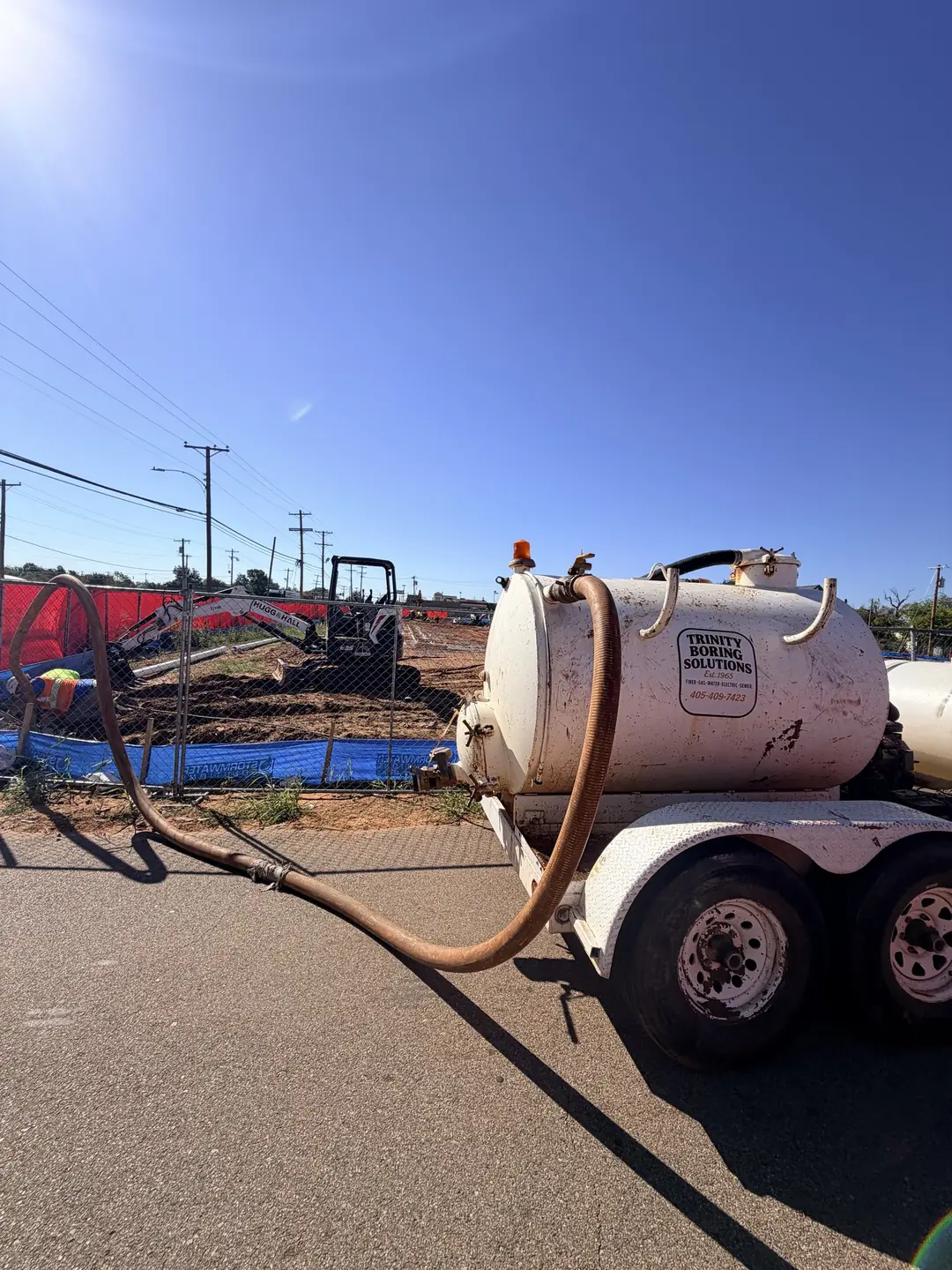
We can quote water line work with horizontal directional drilling or jack and bore with steel casing, depending on the approved design. We own auger machines. Where the plans show a tight conflict, we can scope hydrovac daylighting and utility potholing so the team can verify what is actually in the proposed path.
Water main road bores and creek crossings
We look at what the water main needs to clear and how it has to reach the tie in point. A straight cased crossing gives us different pit and staging requirements from a directional bore with a curved profile. Send the contract detail for the utility crossing rather than telling us only the road width. A dry ditch can still be the low point that controls the profile. At the Clara Luper Center in Oklahoma City, our 6 inch PVC sleeve went under NE 24th Street and a live water main.
For a public main, put the pressure test, disinfection, flushing, samples and tie in on the schedule before setting the bore date. Oklahoma’s acceptance rule calls for safe bacteriological samples on two consecutive days before the line goes into service. Texas’s water distribution notes call for disinfection, flushing and sampling before service. Tell us who performs and witnesses each step and who can authorize the connection.
The customer or general contractor pulls permits and arranges traffic control. We supply the bore plan and profile, equipment and method description, and as built records the permit package needs from the driller. That is separate from engineering approval and from a utility owner’s authority to authorize access, shut down a live main or accept a new line.
What we need from you to quote it
Give us one drawing set and mark the sheet the quote should follow. If you are bidding the project as general contractor, identify where your crew’s work stops and ours starts.
- Approved drawings: Send the plan and profile, crossing station or mile reference, connection elevations, and the drawings showing pits or proposed entry and exit points. If the plans are not approved yet, tell us which details remain open.
- Pipe and scope limits: Give carrier material, diameter, dimension ratio or pressure class as specified, and footage. Note casing, spacers, end seals, valves and fittings if called for. Tell us whether the quote stops at the installed pipe or includes pits, connections or restoration.
- Road, stream and land access: Send the permit conditions you have, a marked easement or working limits, and the traffic plan if the crossing affects a road. Include room to stage the drill and lay out pipe, and identify any gate, fence or driveway that must stay open.
- Ground and existing utilities: Share boring logs or rock notes, groundwater observations and utility records. Point out private services, irrigation and any sewer or storm pipe that crosses the proposed profile. Flag locations that need physical verification.
- Utility acceptance and schedule: Name the utility inspector and the person placing the line in service. Include outage windows and the planned test, sampling and tie in sequence. Tell us who is providing water for testing and where flushing water may be discharged.
Rural water line boring questions
How do I get water service from a rural water district?
Start by asking the district if it serves the property and can supply the proposed connection. Get the approved meter location and ask whether you need a new tap, a main extension or just the private line from the meter. Manville Water Supply Corporation uses a site evaluation for undeveloped property to check the existing line and capacity.
How do I find my water supply corporation or special utility district in Texas?
Look up the address in the PUCT water service area viewer, then confirm coverage with the mapped utility. Ask about that parcel, not just the road or ZIP code. The utility still needs to tell you where a meter could go and whether there is a usable main to connect to.
Who owns the water line after the meter?
Ask the utility where its ownership ends, since the utility’s service policy controls the handoff. The PUCT water supply corporation FAQ says the corporation retains ownership of its meter and distribution lines. Get the customer side connection point in writing before we quote the route to a building.
Do I need a DEQ permit to extend an Oklahoma rural water main?
Normally the project needs DEQ construction approval unless a valid alternative or exception applies. The rural district exception rule excludes an extension that crosses a stream or an existing wastewater collection line. If the district is pursuing an exception, Oklahoma DEQ asks for a location drawing and pipe data; do not start on the basis of an application alone.
Does a Texas water main extension need TCEQ plan review?
It depends on how the public water system’s change is classified. TCEQ has separate distribution change forms for significant changes, changes not defined as significant and qualifying political subdivision review. Give the engineer the complete project scope. A short bore may be part of a larger change, and length alone does not set the filing path.
How deep does a water main road bore have to be?
Use the approved crossing profile, not the general minimum for an ordinary main. Oklahoma requires 30 inches of cover or sufficient insulation to prevent freezing for water mains. Texas requires at least 24 inches and placement below the frost line. The road owner and utility may require different crossing details, including deeper cover.
Can I bore a drinking water line under a creek?
Yes, if the approved design and required authorizations allow it. Texas trenchless guidance covers conditions such as isolation valves and design for scour. Oklahoma’s underwater crossing rule gives a minimum cover and additional provisions for wider defined channels. Give us the channel survey, the profile and bank access limits, not just a creek name.
What if a new water line crosses an existing sewer?
Send the crossing to the project engineer if the planned separation cannot be met. Oklahoma’s water distribution rules address vertical clearance, pipe joints and support. In Texas, the distribution checklist calls for the crossing profile and details including the sewer pressure rating where general separation cannot be met. Ask the owner to confirm the conflict’s actual elevation before drilling.
Do I need a road permit to bore a water line under the highway?
Treat highway authorization as separate from water system approval. For an Oklahoma state highway, start with the ODOT utility portal. In Texas, the utility representative submits the permit in TxDOT RULIS. For a local road, identify the road owner and get its crossing conditions.
Will 811 mark my private water line?
Do not assume it will. Texas811’s FAQ notes that utilities may not mark a water line running from the meter onto private property. For normal tickets, OKIE811 calls for at least three business days of notice and Texas811 calls for two working days, excluding weekends and applicable holidays in both states. Flag private services and arrange a separate locate when needed.
Do you pressure test the water line before it goes into service?
We quote testing only when it is part of the requested drilling scope. The owner’s plans should say who runs and witnesses tests and who supplies the records. For a trenchless stream crossing, TCEQ’s guidance calls for recording hydrostatic tests and making those records available to TCEQ on request.
What affects the cost of boring a rural water line under a road?
The quote depends on the pipe and casing design, bore length, ground and room to set equipment. The work changes if the pits fall outside the usable easement or a sewer needs to be exposed before drilling. Send the profile, utility information and which items the general contractor will handle so we can quote the actual drilling scope.
Get a quote for the crossing
Call (405) 409-7423 or send the crossing plans. Tell us which water system owns the line and whether the bore profile is approved. For other utility planning references, see the Underground Utility Data Library.
Talk to the crew that does the work
Fastest way to a number is a phone call. Tell us where the crossing is and what is going in the ground, and you will get a straight answer on the same call. Bores from 10 feet to 4,100 feet in a single shot, with longer runs bored in sections, 3/4 inch service line through 48 inch pipe, anywhere in Oklahoma and Texas. We run 24/7 for main breaks and emergency repairs.
Answered by a person, not a call center.
Would rather not call? Send the details and we will come back with a written quote.