
Home / Services / USDA Rural Water and Broadband Boring
Government and agency work
USDA Rural Water and Broadband Boring
For USDA rural water and broadband boring, send us the crossing sheet and the approved route together. A line on a map tells us where the utility goes. The crossing sheet tells us whether there is room for our rig, where we can stage pipe and how the line clears the ditch or the utilities already in it. We quote that crossing, not the whole funding application.
Quick summary
- Work we quote: Bores for rural water mains and buried broadband conduit, with hydrovac to expose existing utilities.
- Where we work: Oklahoma and Texas, out of our shop at 9102 Northwest Expy, Yukon, OK 73099.
- What we have installed: A 48 inch HDPE water intake at Fort Cobb Lake and 840 feet of conduit under airport runways. We bore longer runs in sections.
- Permits and records: The customer or general contractor pulls permits and arranges traffic control. We supply the bore plan and profile, equipment and method description, and as built records.
- To get a number: Call (405) 409-7423 or send the crossing sheet with the pipe size, limits and proposed dates.
USDA rural water and broadband boring: who needs what from the driller
On a water job, the engineer may need a profile that holds cover at the ditch and reaches an existing main at a fixed elevation. On broadband, the duct may need to come up next to a handhole inside a narrow easement. In both cases we want to know the latest approved drawing number. It gives the owner, the inspector and our crew the same place to start.
USDA Rural Development describes different funding paths for water distribution and sewer systems and for rural broadband facilities under ReConnect. The reference below takes separate requirements and puts them in the order a crossing actually gets bought, released and accepted. The driller column is our recommended handoff, not a list of forms that USDA requires every driller to file.
Crossing handoff reference for Oklahoma and Texas
| When the question comes up | Who acts and which rule applies | What to put in the crossing package | Primary source |
|---|---|---|---|
| Water alignment is ready for bid | The owner is responsible for engineering, environmental and inspection services under Part 1780. The design must meet applicable federal, state and local requirements. | Give us the engineer’s crossing sheet, pipe specification and applicable approvals. Point out design limits on joints, bend or cover. | 7 CFR 1780.54 and 1780.57 |
| ReConnect route is ready for bid | USDA’s environmental FAQ calls for project maps or site plans identifying the cable routes and associated facilities. The applicant supplies them to USDA. | Give us the approved route, handholes, cleared work areas and limits on how the route can be built. Mark separate access for the rig or hydrovac. | USDA ReConnect environmental mapping FAQ |
| Crossing enters an Oklahoma state highway | ODOT uses its online utility portal for work in its right of way and lists separate utility permit forms for federal or state highways and controlled access interstates. | The customer or general contractor coordinates filing with the utility owner. We supply the proposed line, pit locations, profile and installation method for the permit package. | ODOT utility permit forms |
| Broadband enters a TxDOT highway | TxDOT directs underground broadband in its highway property to the underground utility requirements in 43 TAC 21.40. | Send the approved roadway section and permit conditions. Show whether the road or ditch controls cover and whether the detail calls for casing. | TxDOT broadband technical specifications |
| The prime lets a ReConnect subcontract | For Rural Utilities Service construction contract Forms 257, 395 and 515, the ReConnect guide directs the parties to use Form 282 for subcontracts and follow the applicable contract conditions. | Have the prime confirm the award and contract form before issuing the subcontract. Attach the bore limits, supplied materials and required records to the scope. | USDA ReConnect Construction Procedures, Subcontracts |
| Pipe, duct or casing is being ordered | Federal Buy America rules cover infrastructure categories including water and broadband. Check the award terms and any applicable waiver with the recipient. | Identify who supplies each item and what evidence the recipient wants before purchase. Put the exact product and permitted substitutions in writing. | 2 CFR Part 184 |
| A utility conflict moves a water bore | Part 1780 says all contract change orders require Agency concurrence and changes in development plans require Agency review and approval. | Stop work on the affected crossing. Send a sketch of the conflict, revised profile and any change to quantity or time. Wait for the owner to release the approved change. | 7 CFR 1780.75(h) and 1780.76(h) |
| A ReConnect crossing shifts | USDA’s construction monitoring materials tell awardees to check that construction routes are covered by environmental clearance and discuss clearance for new proposed routes. | Send the old and new alignment and pit limits together. Have the awardee determine whether the change needs additional review before releasing the segment. | USDA ReConnect construction monitoring handout |
| A water crossing is inspected | Part 1780 normally requires full time resident inspection unless USDA grants a written exception. The resident inspector keeps daily records. | Agree on what the inspector must see before a pit closes. Show field measurements and installed quantities against the drawing or bid item. | 7 CFR 1780.76(c) and (d) |
| A ReConnect segment is ready for closeout | USDA’s monitoring materials list as built staking sheets, map details and visual verification among construction records it reviews. USDA says reporting is specific to each award. | Give the prime or awardee a record keyed to the crossing and route. Confirm file format and which photos and quantities it needs before backfill. | USDA monitoring handout and ReConnect reporting guidance |
Facts checked November 2026. Tell us if something has changed.
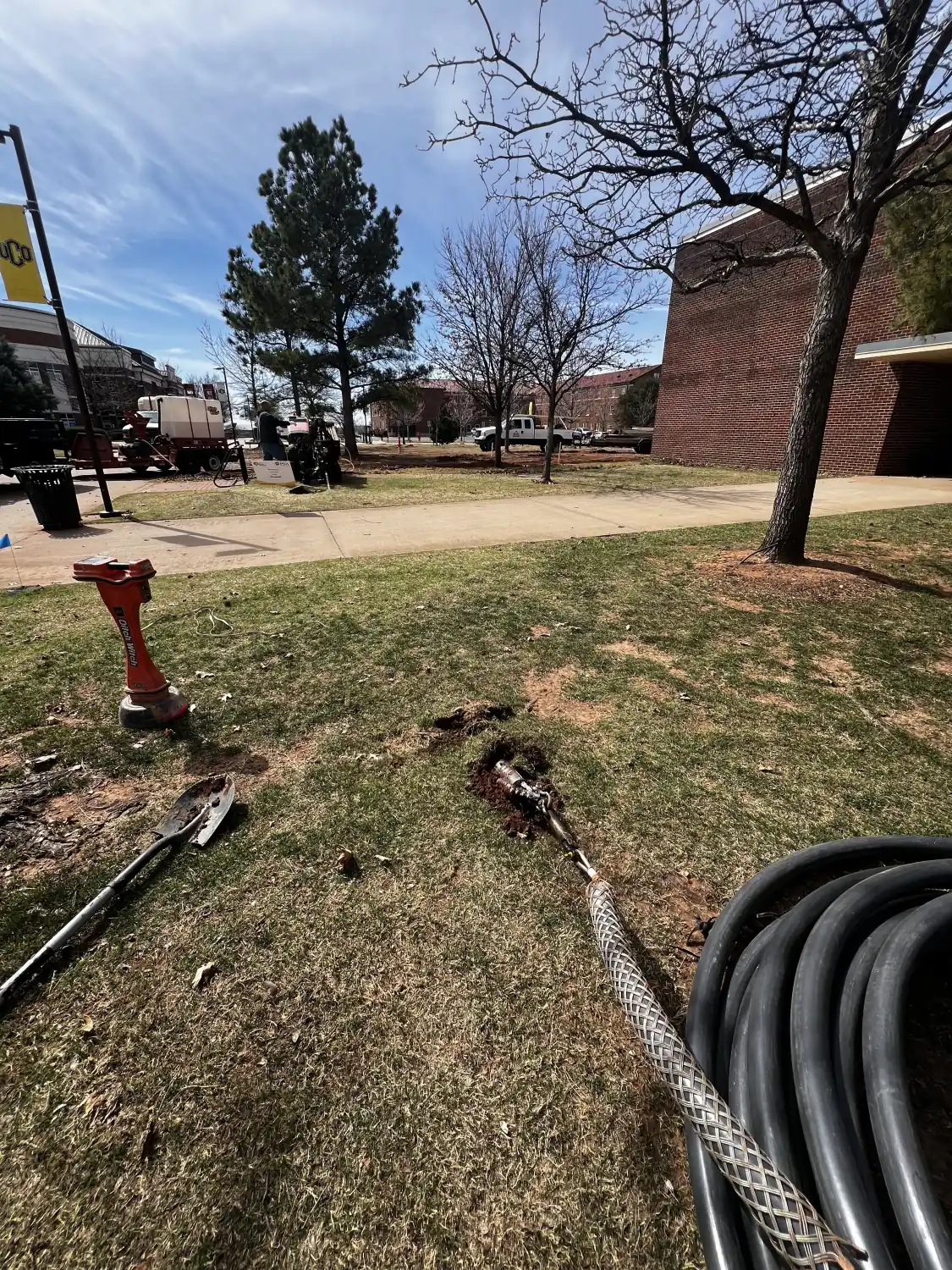
Work we have done that is like this
These are the same kind of water and fiber work a USDA funded project involves. We do not list any of them as a USDA job.
- A lake intake. We installed a 48 inch HDPE water intake line out to the middle of Fort Cobb Lake, and divers changed the reamer at the lake end. Fort Cobb Lake is a Bureau of Reclamation reservoir in Caddo County, part of the Washita Basin Project, not a Corps lake.
- Fiber with a handhole. We installed 615 feet of fiber optic line for a credit union on Northwest Expressway in Oklahoma City, with a handhole set partway along the run.
- Rock under creeks, a wetland and a dam. Our Guthrie sandstone bore ran 385 feet through hard sandstone beneath two small creeks, a wetland and a dam for a 4 inch HDPE electrical conduit.
What we bring to the crossing
Dean Rice founded Trinity Boring Solutions in 1965. We have worked in underground construction since 1982, and Darren Rice owns the company today. Here is what we have done on other crossings where the place above the bore or the connection at the end mattered. We are not presenting these as USDA contracts.
At Fort Cobb Lake we installed a 48 inch HDPE water intake. That is our largest pipe installation. A water main crossing is a different job, but it brings up the same early question about where the pipe can be laid out before it goes in. If the design calls for a continuous pull, send us the available length of the laydown area, not just the footage under the road. On our water line work we want to know where the line ends and who handles the tie in before we talk through the pull.
At Will Rogers World Airport in Oklahoma City we bored 840 feet of FAA conduit under runways. For fiber optic conduit work, we want to know what must stay open above the route and where the duct has to come out. If the handhole sits inside a fence or next to a ditch, show us that on a site photo. Moving the exit to make life easier for the crew is not an option unless the owner can clear the change. On a 615 foot fiber optic installation for a credit union on Northwest Expressway in Oklahoma City, we set a handhole partway along the run.
We also bored sandstone at Guthrie beneath creeks, a wetland and a dam. We ask for the available soil and rock information early because the same length drawn through rock and through loose ground describes two different jobs. We offer horizontal directional drilling and own the equipment for jack and bore with steel casing. We can use hydrovac daylighting to show what is in the way where the proposed alignment crosses existing lines.
Rural water funding and ReConnect projects in Oklahoma and Texas
In Oklahoma, USDA announced support for Payne County Rural Water District No. 4 to replace and upgrade waterline. On a replacement job of that kind, tell us which line stays live during the bore and whether the new main can be pulled and tested before the operator makes the tie in.
In Texas, USDA lists Dell Telephone Cooperative’s ReConnect fiber deployment in Hudspeth County. An award notice describes the project, not the construction method at any one crossing. To scope a bore, we need the drawing that shows which road or entrance the duct crosses and where the duct ends. These are examples of USDA funding in the region, not Trinity contracts.

What we need from you to quote it
Send one packet if you can. Give each crossing a name or station that matches the plan, so a photograph and a permit can be matched to the same location. We can price the bore separately from work that belongs to the pipe crew, utility owner or prime contractor.
- Drawings: Provide the plan and profile, revision date, utility or carrier size, material, casing detail and proposed length. Show cover or grade at the controlling point, such as the ditch bottom.
- Permits and limits: Send roadway and easement conditions, environmental restrictions and approval status. Identify the customer or general contractor responsible for traffic control. Add who can approve a change if the route moves.
- Soil and groundwater: Include geotechnical logs, test holes or observations from nearby work. Mark where the ground report was taken. Tell us about water in the pits or any limits on drilling fluid and spoils.
- Existing utilities and access: Send record drawings and any existing locate or pothole information. Mark the gate, haul route, pit limits and space for a full length of pipe or a reel.
- Schedule and acceptance: State the work window, outage or tie in sequence, inspection notice and what must remain open. Include the as built format and who takes the pipe tests or accepts the conduit.
If the road permit is still pending, send the draft profile anyway and flag what can change. For a crossing with narrow shoulders, use our road and highway utility work page to identify the details worth getting from the road owner.
Frequently asked questions
What is the USDA ReConnect Program?
ReConnect provides loans, grants or combinations of both for rural broadband deployment, as explained in the USDA ReConnect FAQ. We quote the construction scope for a specific crossing, not a funding application. If you are assembling a bid package, send the underground sheet that shows the duct, crossing limits and connection points instead of the award announcement.
Can USDA rural water funding pay for a new water main?
Yes, USDA lists drinking water distribution construction and improvements among the uses of its Water and Waste Disposal Loan and Grant Program. The recipient should verify that the main and the crossing are in the approved scope. We need the pipe and connection detail to tell what the bore includes and what remains with the pipe crew.
Who can apply for USDA rural water funding?
Eligible applicants can include most state and local government entities, private nonprofits and federally recognized tribes that cannot otherwise obtain commercial credit on reasonable terms, subject to USDA program eligibility. If you are buying the bore as a general contractor, ask the water system which grant or loan conditions are in the bid documents and which utility connection details the engineer has approved.
Are maps required for the ReConnect environmental review?
Yes. The USDA environmental FAQ calls for maps or site plans that identify cable routes and other project facilities. For a crossing, send the limits that were cleared along with the construction drawing. A bore line alone will not tell us whether the rig, pits or pipe can use the proposed ground next to it.
Who pulls permits for a USDA funded utility bore?
The customer or general contractor pulls the permits and arranges traffic control. USDA separately describes the ReConnect awardee’s responsibility for necessary governmental permits and approvals. We furnish our bore plan and profile, equipment and method description, and as built records. Confirm who represents the utility owner in dealings with the road agency before we set a start date.
How deep does a fiber or water bore have to go under a road?
Use the approved permit and profile for that road and utility. TxDOT, for example, points underground broadband on its property to 43 TAC 21.40. Send the roadway and ditch elevations and any casing detail with the drawing. We need the controlling cover point and the depth of existing utility conflicts, not a single cover number on an email.
Can I move a ReConnect bore to avoid a buried utility?
Only after the awardee has checked whether the revised route is covered by the project approvals and released the change. USDA’s monitoring guidance addresses environmental clearance for proposed new routes. We can show the obstruction and sketch a revised path, but permission to drill the original line does not by itself clear another location.
Does a USDA water bore need a change order if the design moves?
A change to the approved development plan goes through the project owner and engineer for Agency review and approval under 7 CFR 1780.76(h). If a conflict changes the profile or quantities, we give the prime a marked drawing and the field measurements. We do not build the revised crossing on a verbal request.
Do Buy America requirements apply to a rural water or broadband bore?
They can apply to materials incorporated into federally assisted water and broadband infrastructure, subject to the award terms and any applicable waiver under 2 CFR Part 184. Ask the recipient which documentation it requires for the exact pipe, duct or casing on the submittal. Make that decision before ordering material or proposing a substitution.
What records do you give the owner after boring?
We supply the as built record for our portion of the work. USDA ReConnect monitoring materials list staking sheets and map details among the items reviewed. Agree before drilling on the plan reference, depths or elevations to record and when the inspector needs to see the work. Tell us if the owner uses a particular coordinate system or file format.
Is directional boring or jack and bore better for a water main crossing?
The approved crossing detail and the space for pits decide which method can be quoted. A continuous HDPE pull and a straight steel casing with a carrier pipe are different setups. Send the material, minimum cover and any fixed elevations. If the road owner specifies the method, include that condition rather than asking us to assume either method is acceptable.
Send us the crossing sheet
Call (405) 409-7423 or contact Trinity Boring Solutions for an Oklahoma or Texas crossing. Give us the plan revision and tell us which crossing is holding up the bid. If a permit or submittal is still pending, let us know what the owner needs from the driller.
Talk to the crew that does the work
Fastest way to a number is a phone call. Tell us where the crossing is and what is going in the ground, and you will get a straight answer on the same call. Bores from 10 feet to 4,100 feet in a single shot, with longer runs bored in sections, 3/4 inch service line through 48 inch pipe, anywhere in Oklahoma and Texas. We run 24/7 for main breaks and emergency repairs.
Answered by a person, not a call center.
Would rather not call? Send the details and we will come back with a written quote.