
Home / Services / Turnpike and Toll Authority Crossings in Oklahoma and Texas
Government and agency work
Turnpike and Toll Authority Crossings in Oklahoma and Texas
Quick summary
- The work: We handle turnpike and toll authority crossings in Oklahoma and Texas for water, sewer, gas, electric and fiber lines.
- The first check: Mark the main lanes, frontage roads and both pits on one drawing. They may not all use the same approval.
- Size and length: We have installed 48 inch HDPE on a water intake. We bore longer runs in sections where the plan and access allow.
- Permits: The customer or general contractor pulls permits and arranges traffic control. For TxDOT applications in RULIS, we give the utility owner the driller’s material to file.
- Quote: Send the road, map pin and crossing profile to request a quote or call (405) 409-7423.
Turnpike and toll authority crossings: who reviews which part?
Circle the two pits before you send the drawing. Then trace the route from one pit to the other and mark every road, ditch and property line it crosses. We want to see if the plan that looks like one bore on paper actually touches two jurisdictions or needs an access agreement at one end. The table is a starting point for locating the reviewer, not a substitute for the written decision on your alignment.
| What the drawing touches | What to verify before the bore is priced | Primary source |
|---|---|---|
| Oklahoma Turnpike Authority land, including the John Kilpatrick Turnpike | The Oklahoma Turnpike Authority’s Utility Management group oversees requests from utility companies to cross its right of way through a utility license. Have the road name and milepost ready when you ask for the current crossing package. | OTA adopted budget, Utility Management |
| Access across OTA land to reach an adjoining work site | OTA’s posted access license says a utility crossing requires a separate license. Confirm both the authorization for the line and the permission for the planned route into the work area. | OTA right of way access license, clause I |
| NTTA main lanes, such as Dallas North Tollway, President George Bush Turnpike or Sam Rayburn Tollway | NTTA directs right of way access and utility permit requests to its Right of Way Manager. Send the crossing plan to confirm which part of the proposed work the authority reviews. | NTTA Roads and Projects, Contact Us |
| Utility placement within the service roads of Sam Rayburn Tollway, 360 Tollway or the western extension of President George Bush Turnpike | NTTA’s project agreement summaries assign TxDOT permitting for utility placement within these service roads. Draw and label the frontage work separately from the bore beneath the toll lanes. | NTTA official statement, Appendix A |
| TxDOT toll road, such as State Highway 45 North or State Highway 130 Segments 1 through 4 near Austin | TxDOT lists those routes in its Central Texas Turnpike System. For utility work in TxDOT right of way, the utility owner submits the application through the Right of Way Utility and Leasing Information System, called RULIS. | TxDOT toll operator list and RULIS FAQ |
| State Highway 130 Segments 5 and 6 | TxDOT lists the SH 130 Concession Company as the operator for Segments 5 and 6. Confirm who reviews the crossing there rather than using the northern segment’s review path by default. | TxDOT toll operator list |
| Drawing for an NTTA utility crossing | NTTA’s design manual asks for existing and proposed utilities in plan and profile, with encasement material and dimensions and station and offset at both ends. Ask the reviewer which current drawings and details apply to the location. | NTTA Design Criteria Manual, Chapter 11 |
| Drawing for a TxDOT crossing near Austin | TxDOT’s Austin District guidance calls for the crossing to be as close to 90 degrees as practical. Show the actual angle on the drawing if it is not square, and ask whether the district wants an exception request. | TxDOT Austin District utility permit guidance, Process 3 |
Facts checked November 2026. Tell us if something has changed.
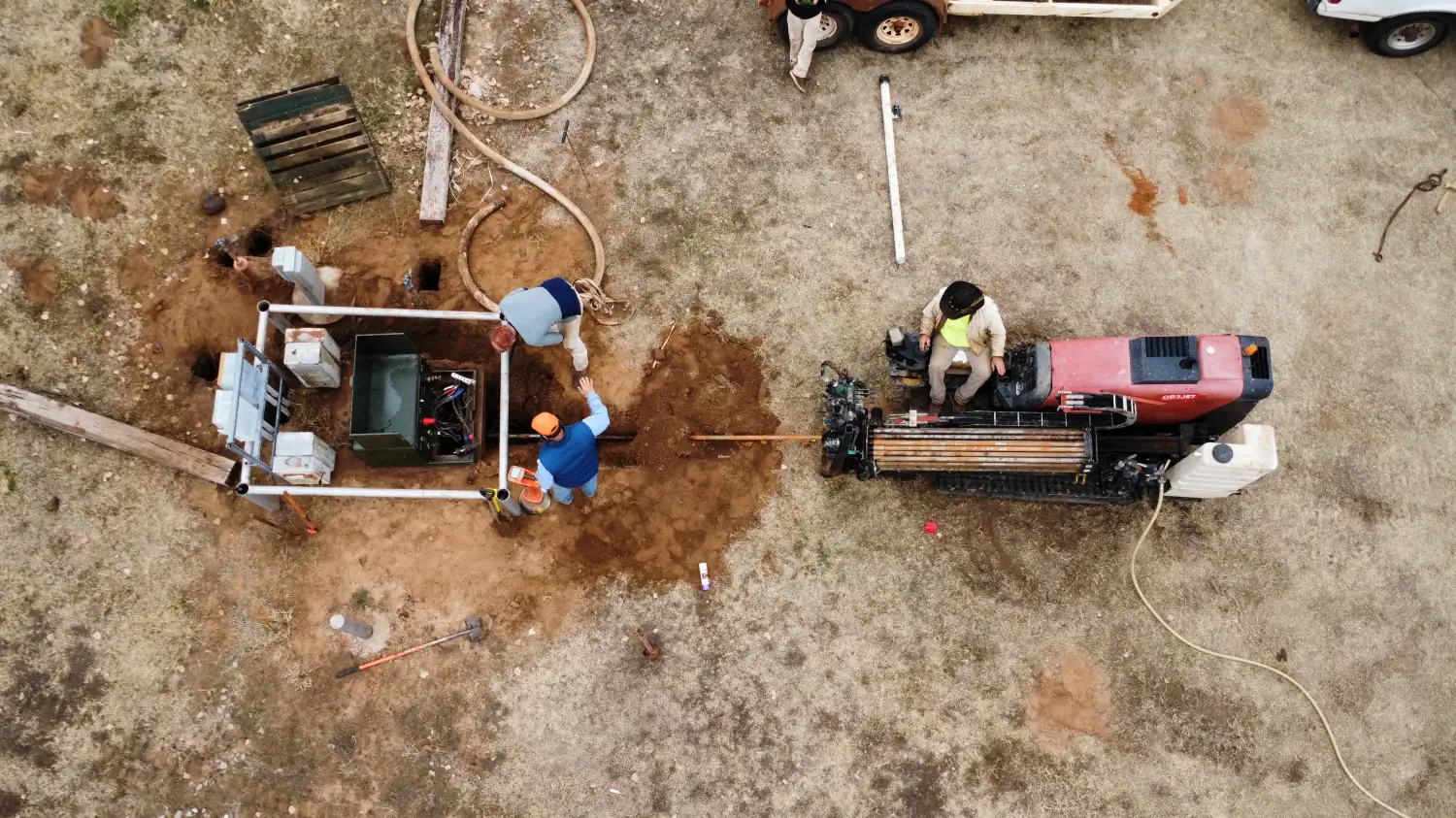
Work we have done that is like this
These are the same kind of crossing under live roads and runways. Only the first is a toll road job.
- A turnpike crossing. We bored beneath the John Kilpatrick Turnpike in Oklahoma City.
- FAA conduit under runways. We bored 840 feet of FAA conduit under runways at Will Rogers World Airport in Oklahoma City. The runway was closed while we bored and reopened after.
- A sleeve under a street and a water main. At the Clara Luper Center in Oklahoma City, we bored a 6 inch PVC sleeve under NE 24th Street and a live water main for a general contractor.
- An emergency gas replacement. At the TA truck stop at Council Road and Interstate 40 in Oklahoma City, we made two bores of about 280 and 275 feet under roads for a 2 inch emergency gas replacement.
The road name is not the permit address
Start with the pin and the cross section
At the John Kilpatrick Turnpike near Wilshire Boulevard, OTA’s widening notice describes changes to the shoulder, median barrier and bridges over Northwest Expressway (OTA project notice). That is an example of why we ask for the current road drawings, not a screenshot of pavement and grass. It is not the location or scope of our own Kilpatrick bore. If the road is being widened, show both the existing and proposed grades so we can see which one governs the profile.
In North Texas, a utility crossing of Sam Rayburn Tollway and a utility placement within its service road are not the same review question (NTTA project agreement summary). On State Highway 130, the operator changes between Segments 4 and 5 even though the road name stays the same (TxDOT toll operator list). Send a station or milepost as well as a pin. Name the person who can verify where the work area enters and leaves each jurisdiction. For an adjoining Oklahoma public highway, see our road and highway utility work page.
Show the bottleneck on the profile
Start with the part that leaves the least room. That could be the low point of a ditch, a drainage pipe, a wall footing or an existing line near the end of a ramp. The center of the pavement is not the only elevation we need. Show the top of the proposed carrier or casing and the clearance at the closest conflict. If the only workable pit lies beyond the toll authority’s boundary, flag the parcel and tell us if access has been arranged. We can compare methods on the crossing plan, but we cannot price space the crew does not have.
What we bring to a toll road utility crossing
We have bored beneath the John Kilpatrick Turnpike in Oklahoma City. We also installed a PVC sleeve beneath NE 24th Street at the Clara Luper Center. A city street sleeve and a turnpike crossing start with the same question: where can the crew get to both ends of the line? We have also bored 840 feet of FAA conduit beneath runways at Will Rogers World Airport and installed a 48 inch HDPE water intake at Fort Cobb Lake. Those are separate jobs, not additional toll road crossings.
We use horizontal directional drilling when the approved path calls for a steerable bore. If the plans call for steel casing on a straight alignment, we can compare it with jack and bore using our auger equipment. A casing note on the plans does not tell us whether a jacking pit will fit. Send the working limits and the distance from each pit to the nearest obstruction before settling on a method. For a water line, show us where the crew can stage the pipe and where it will tie in.
When the design has an existing utility crossing, we use hydrovac daylighting to expose the line and measure the clearance. Send records that distinguish a surveyed exposure from a line shown only on an old drawing. If a field measurement makes the approved path unworkable, we stop at that conflict and take it back to the project team rather than treating the permit as permission to move the alignment.
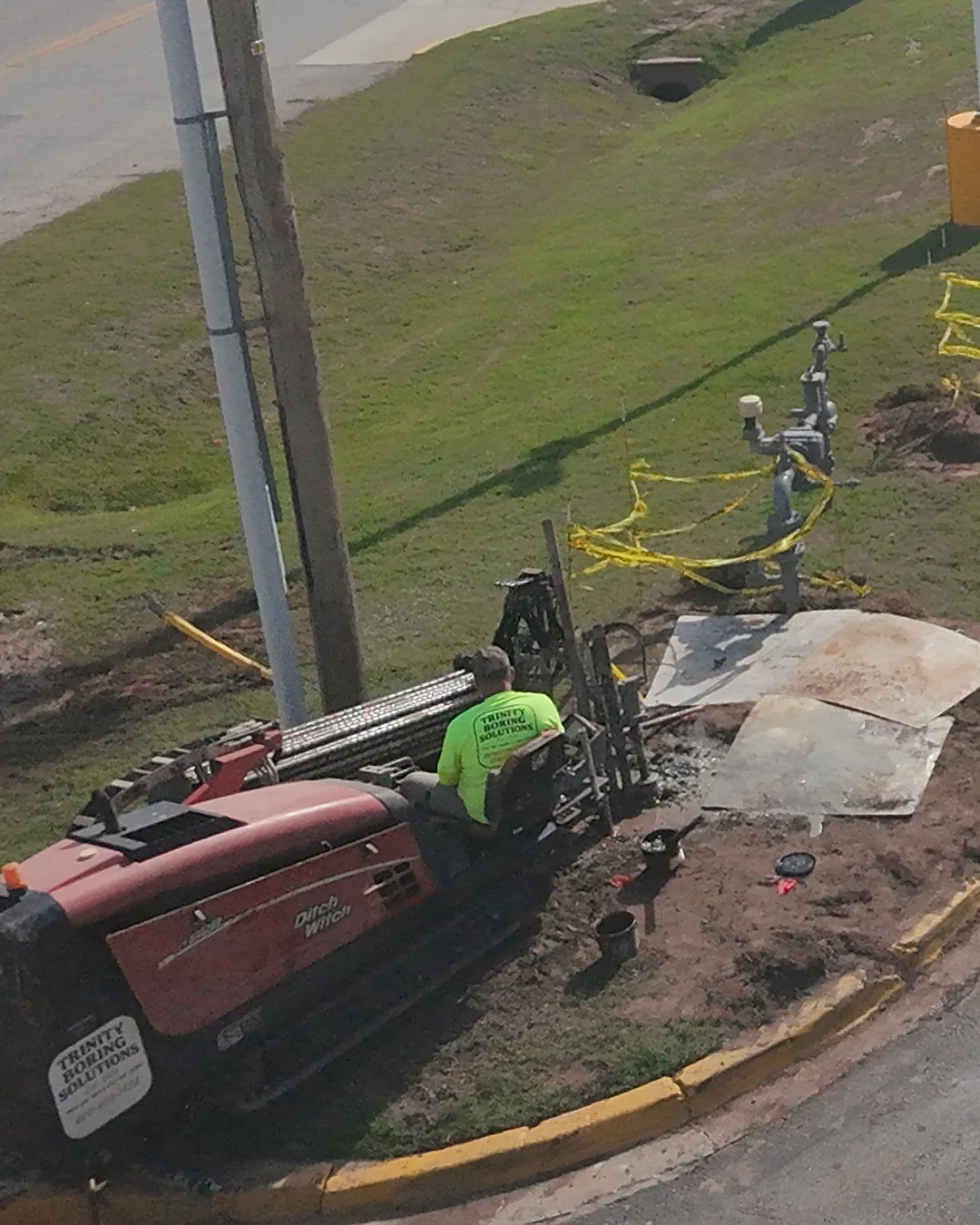
What we need from you to quote it
- One marked plan. Send the plan sheet, station or milepost, both bore ends, right of way limits and the crossing angle. Label the lanes, ramps, frontage roads and ditches. Include the sheet revision so we are pricing the same drawing the utility owner is reviewing.
- The line and profile. State the utility type, carrier size and material, casing if required, finished grade and the elevations at each tie in. For a gravity sewer, include the required slope. Flag any dimensions that are still provisional.
- The ground and existing utilities. Send geotechnical logs with their locations, any groundwater notes, the available utility records and measurements from known potholes. Mark where depth is unknown and say which exposures are in our scope.
- Room for the crew. Show where the rig, pipe staging and pits can go. Mark fences, walls, drainage structures and access gates. Tell us who controls the land at each end and whether entry is approved or still being discussed.
- Permit conditions and traffic control. Send the signed approval if available, or name the reviewer and list what is pending. Include inspector notice, work hours, restoration and record requirements. The customer or general contractor pulls permits and arranges traffic control. We supply the driller’s bore plan and profile, equipment and method description, and as built records for the package.
- Sequence and handoff. Give us the earliest workable window after approvals and locates, any traffic restrictions, and who will connect the line after we install it. Say whether the quote should include exposure, excavation, backfill and pit restoration or the bore alone.
Questions about boring under a turnpike or toll road
Do I need a permit to bore under an Oklahoma turnpike?
Yes, start with an OTA utility crossing license for work in its turnpike right of way (OTA Utility Management). The customer or general contractor should confirm the current license form and who must sign it. Send the turnpike name, milepost and route. Tell the authority if the crew also needs access across its land to a pit. We have bored beneath the John Kilpatrick Turnpike in Oklahoma City, and the customer or general contractor handles the turnpike license before we mobilize.
Is an OTA right of way access license the same as a utility crossing license?
No. The posted OTA access form says a utility crossing requires a separate license (OTA access license, clause I). Think of access as how the crew gets into the site and the crossing as where the new line goes. Show both on the drawing. Ask the authority which permissions apply before you schedule the work.
How do I request an NTTA utility permit?
Start with the Right of Way Manager listed on NTTA Roads and Projects. Provide the toll road name and a pin or station, and say whether the new line crosses the toll lanes, follows a service road or does both. Include a plan and profile if you have one. Ask the manager to confirm the current application and who should submit it.
Does NTTA or TxDOT permit work on a Sam Rayburn Tollway frontage road?
For utility placement within the Sam Rayburn Tollway service roads, NTTA’s project agreement summary names TxDOT as the permitting agency (NTTA official statement, Appendix A). That does not answer who reviews a bore under the toll lanes. Show both work limits if the line runs from a frontage road beneath the main lanes. Ask the agencies how they want the permit package handled.
Can a contractor or utility consultant submit an application in RULIS?
The utility owner submits directly to TxDOT, not the driller or the utility consultant (TxDOT RULIS FAQ). A consultant can prepare the application for the owner’s acknowledgment, but the utility owner also signs off on the final location records in RULIS (TxDOT RULIS FAQ). We supply the driller’s plan and profile, method description and records to the team.
Can I use RULIS for any Texas toll road?
No. TxDOT says RULIS does not accept permits for roads outside its jurisdiction (TxDOT RULIS FAQ). Use the segment and operator in the TxDOT toll operator list, not the billing agency on your toll statement, to start identifying the reviewer. Then confirm which authority controls each part of the work area.
How deep does a utility bore have to be under a toll road?
Use the cover on the approved crossing profile, not a single depth for every road. The TxDOT Austin District asks applicants to show proposed elevations and measure minimum cover at the lowest point of grade, not at the pavement edge or road centerline (Austin District utility permit guidance). Give us the applicable cover and mark the reference grade, including any planned road work that will change it.
Does a bore under toll lanes always need steel casing?
Not for every utility or crossing. For example, the TxDOT utility rule for water lines calls for steel encasement under paved highways within the right of way unless the district approves another type. The NTTA design manual calls for showing encasement material and dimensions. Send the approved casing material, length, both ends and carrier details before we price the installation.
Can we use jack and bore instead of directional drilling?
Yes, if the authority accepts the method and the work area supports it. For a straight steel casing run, show space for the jacking pit and the receiving pit. For an alignment that needs steering to clear a conflict, send the profile for directional drilling review. Ask the reviewer before switching methods on an already approved drawing.
When do I have to make a locate request for a toll road bore?
Contact 811 before excavation and confirm the start time on the ticket. Plan for at least three business days in Oklahoma, as recommended by OKIE811’s excavator guidance. The Texas811 FAQ says to notify at least two working days in advance, excluding holidays. Check responses and include both pits and any planned utility exposures in the marked work area.
Can we start the bore once the locate marks are down?
Not on the strength of the marks alone. Confirm the written crossing approval, site access and any required notifications to the inspector. A survey or design locate does not cover excavation (Texas811 FAQ). We use potholes to confirm the measured location at crossings. If the cleared route no longer fits the profile, take the conflict back to the project team before drilling.
What affects the cost of a toll road utility bore?
The length, pipe and casing, ground conditions and space at each end affect the quote. A short profile can still need substantial work if a pit has to sit beyond a frontage road or behind a wall. Send the current drawing and note what is excluded from our scope, such as traffic control, paving restoration or the final connection.
Get a quote for a turnpike crossing
Call (405) 409-7423 or send us the crossing plan. Start with the road name and the two pit locations. If a permit or easement is still pending, tell us what is missing so we can say which part of the scope we can quote. We work in Oklahoma and Texas from 9102 Northwest Expy, Yukon, OK 73099.
Talk to the crew that does the work
Fastest way to a number is a phone call. Tell us where the crossing is and what is going in the ground, and you will get a straight answer on the same call. Bores from 10 feet to 4,100 feet in a single shot, with longer runs bored in sections, 3/4 inch service line through 48 inch pipe, anywhere in Oklahoma and Texas. We run 24/7 for main breaks and emergency repairs.
Answered by a person, not a call center.
Would rather not call? Send the details and we will come back with a written quote.